Dr. Peter Cripton recently secured a $2.3 Million Dollar Grant funded by the United States Department of Defense CDMRP

Dr. Peter Cripton recently secured a $2.3 Million Dollar Grant funded by the United States Department of Defense CDMRP


Dr. Peter Cripton, Associate Professor in the Mechanical Engineering Department, Patrick Campbell Chair in Mechanical Design and Principle Investigator at the spinal cord research centre ICORD at UBC, has recently received a $2.3million dollar grant funded by the United States Department of Defense Congressionally Directed Medical Research Program (CDMRP). The “Applied Research and Advanced Technology Development Award” is designed for independent investigators interested in conducting research on “battlefield injury and care, particularly in post traumatic stress disorder, traumatic brain injury, prosthetics, and restoration of eyesight, and other vision-related ailments. …”[1]

The focus of Dr. Cripton’s research is to establish the allowable limit of vibrations for a person with an acute spinal cord injury. A broken bone through injurious compression, tension shear or bending of the spine can all damage the spinal cord and thus cause partial or complete paralysis. This also creates an unstable spine. Vibration of the unstable spine could exacerbate the effects of the spinal cord injury.

Dr. Cripton hopes to find guidelines for the safe medical evacuation of people with spinal injuries including military personnel as well as civilians. He hopes to develop the best evacuation procedure for people in emergency situations. For example, for a civilian who injures their spinal cord in a car accident, the vibrations caused by a bumpy ambulance ride to the hospital can potentially make the injury worse. For a soldier being evacuated from battlefield by helicopter, the vibrations of could also cause exacerbation of the spinal cord injury.

Dr. Cripton’s collaboration on this three year project with the University of Iowa, which specializes in vibrations, the United States Army Aero Medical Research laboratory, and UBC spine surgeon/neuroscientist Brian Kwon, will provide invaluable research on the effect of medical evacuation-related vibration on spinal cord injuries, which will ultimately benefit both the military and civilians.


[1] Adams, Donisha. “Applied Research and Advanced Technology Development Award: Improving Health Care for U.S. Service Members.” Science Career Magazine 14 Sept. 2009. Web.
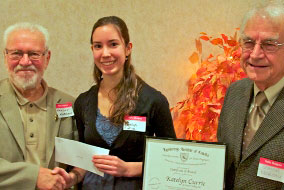

 

UBC engineering students recognized by Engineering Institute of Canada

Congratulations to Katelyn Currie, a second-year UBC Mechanical Engineering student, for receiving the Engineering Institute of Canada Vancouver Island Branch Scholarship Society scholarship on November 4, 2011. The $2,000 award is supported by the Canadian Society for Senior Engineers (CSSE). The scholarship is awarded to Vancouver Island high school graduates with high academic standing, financial need and leadership roles in extracurricular activities who are entering a second- or third-year engineering program in Canada.

Katelyn Currie has volunteered at numerous events and had been a part of a robotics team, designing and fabricating a robot to compete in Skills Canada Competitions, in high school. In addition to her extremely high academic average, she currently serves on the UBC Engineers Without Borders (EWB) executive as the Director of Overseas Connections and competes with the UBC Supermileage Team.

For the full article, please click here

Connect with Mech

Connect with Mech!

Check out our following profiles…

$2.5M gift from UBC alumni to create student Engineering Design Centre


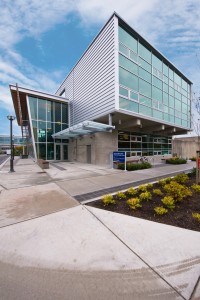
The Wayne and William White Engineering Design Centre officially opens today. The facility was made possible by a $2.5 million donation by UBC Mechanical Engineering alumnus William White (BASc ’67), and his twin brother, Wayne White (BASC ’67 Metallurgical Engineering).

“We are very grateful to Wayne and William White for their generosity and vision,” says Applied Science Dean Tyseer Aboulnasr. “They have contributed to a learning environment where students can develop into professional engineers equipped to tackle society’s most pressing issues.”

“It gives us great pleasure to provide a facility that we would have greatly enjoyed and benefited from as students,” says William White.

The $8.5 million Wayne and William White Engineering Design Centre is the first and only building on campus specifically intended to connect students from all UBC’s engineering programs in order to promote interdisciplinary team work, increasingly the norm in industry.

Dr. Srikantha Phani’s research with Centre for Blood Research colleagues published in UBC reports

An article about Dr. Srikantha Phani’s recent research with colleagues from the Centre for Blood Research was featured In UBC reports. Dr. Phani works with Associate Professor Jayachandran Kizhakkedathu to develop a series of experiments to test new surface coatings for medical implants.


Oct 20 – Engineering students and alumni to compete in UBC entrepreneurship competition

Come out and see Engineering students and alumni affiliated with Aeos Biomedical, Dynamic Monitoring Technology Corporation and RentGeek compete in the UBC’s entrepreneurship@UBC Seed Accelerator Competition! They have made it to the final rounds and will be pitching to become the first recipients of investments between $25k and $100k from the entrepreneurship@UBC Seed Accelerator fund.

Please join us for this exciting event:

  • Location:  Room 222, West Mall Swing Space, 2175 West Mall, UBC
  • Date:  Thursday October 20th, 2011
  • Time:  5:30 – 7:30pm

For more on the competition visit: www.entrepreneurship.ubc.ca


Aeos Biomedical
Aeos Biomedical, co-founded by Colin O’Neill (BASc ’10, IGEN), is an early stage medical device company. Their lead product, Target Tape, is a disposable adhesive tape with radiopaque locational markings, used with medical imaging. Target Tape is applied to the patient’s skin over the area of interest. The locational markings then appear on the medical scan image. When Target Tape is removed, it leaves behind an ink imprint of the locational markings, allowing the doctor to correlate and localize between the scan image and the patient’s skin. The two founders are alumni from Applied Science and the Sauder School of Business. They conceived of the Target Tape product as part of the 09/10 New Venture Design program.

Dynamic Monitoring Technology Corporation
Dynamic Monitoring Technology Corporation, co-founded by Daniel Sepasi (PhD ’11, MASc ’07 MECH) and Amir Rasuli (PhD Candidate in Electrical Engineering), is a private company specialized in machine health monitoring systems. Their lead product, DyMoShovel, is an intelligent shovel health monitoring system used in cable shovels operating in open pit mines, and provides fault diagnosis, failure forecast and prevention, visual and audio feedback to the operator, optimized maintenance schedule and real time analysis of cable shovel performance.  The founders and management team are composed of a PhD in Mechanical Engineering, a PhD Candidate in Electrical Engineering at UBC, and an MBA Candidate from the UBC Sauder School of Business.

RentGeek
RentGeek, which includes Danny Lum (BASc ’07, ECE) and Cameron Johnson (fourth-year ECE), is a personalized home rental site that integrates lifestyle needs, distance calculator, neighborhood information, and browse listings all in one place and makes smart recommendations as to which neighborhood fits your lifestyle.  The founders and management team include recent alumni from the Sauder School of Business and Faculty of Applied Science.


UBC innovator receives major Manning Foundation award for green engine technology

Vancouver, Canada—October 6, 2011—University of British Columbia Professor Emeritus Phil Hill has been named the 2011 recipient of the $100,000 Encana Principal Award by the Ernest C. Manning Awards Foundation. Hill was chosen for his discovery of a technology that enables diesel engines to run on clean-burning natural gas.

The high-pressure direct injection (HPDI) technology, which is being commercialized by UBC spin-off company Westport Innovations, allows diesel engines to operate on natural gas with the same power and efficiency they are known for, but reduces emissions of smog-forming nitrogen oxides and particular matter. It also reduces emissions of greenhouse gasses by up to 27 per cent.

Hill conceived of HPDI and first developed the technology in the late 1980s in his research lab at UBC’s Department of Mechanical Engineering. His research group’s work led to the founding of Vancouver-based Westport Innovations Inc. in 1995. Westport is now a publicly-traded company of over 650 employees and whose technology portfolio includes more than 200 patents, many of which stem from Hill’s original series of inventions.

The Manning Innovation Awards, which honour Canadian innovators in any sector, are selected by a distinguished independent body recruited from across Canada.

“There is a critical need for more innovation in Canada,” said David B. Mitchell, President of the Manning Foundation, in announcing its 2011 award winners. “Canadians need to create and commercialize innovations to compete in the global economy. We want to support, celebrate and draw attention to Canadian innovators and young Canadians showing potential to become future innovators, who have the imagination to innovate and the stamina to succeed.”

“As a university particularly concerned with sustainability and environmental issues, UBC is proud of this recognition of Prof. Hill’s work and of the resulting development of one of its most successful spin-off companies in Westport Innovations,” said UBC President Stephen J. Toope. “In addition to the environmental and economic impacts of his work, new generations of students and faculty at UBC now benefit from the legacy of his discoveries through multiple ongoing and productive research relationships and employment opportunities with Westport.”

Ten award winners in various categories – including young innovators – will be honoured in front of a large audience of Canadian leaders from business, academia and governments on October 14 in Edmonton.

For more information on the 2011 Manning Innovation Award recipients, please visit www.manningawards.ca.

To read more about Westport innovations, please visit www.westport.com

UBC Mechanical Engineering PhD Candidate Farzad Khademolhosseini Receives The Vanier CGS Graduate Scholarship

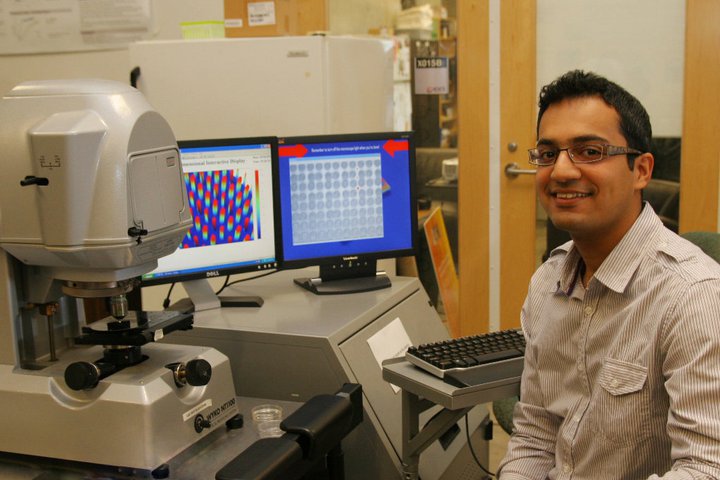
PhD Candidate Farzad KhademolhosseiniUBC Mechanical Engineering PhD candidate Farzad Khademolhosseini has received the Vanier CGS graduate scholarship – one of the most pretigious graduate scholarships in Canada.  According to the Vanier CGS website, the award is given to doctoral students who demonstrate both leadership skills and a high standard of scholarly achievement in graduate studies in the natural sciences and engineering, social sciences and humanities, or health sciences. The award is valued at $50 000 a year for three years.

Farzad Khademolhosseini’s research interests are in the field of Biomedical Micro-Electro-Mechanical Systems (BioMEMS) and Mechanics of Cells. Specifically, he looks at the interaction of MEMS with cells. He is currently developing microdevices that can increase/direct cellular growth through application of controlled mechanical stresses and strains on cells. Such devices will have applications in the field of tissue regeneration. The goal is to help patients with cardiovascular disease recover faster after surgery. He is a member of the UBC Microsystems and Nanotechnology Group (Mina), works under the supervision of Dr. Mu Chiao, and collaborates closely with researchers from UBC Pharmaceutical Sciences and Vascular Surgeons at the Vancouver General Hospital.

UBC researchers invent new drug delivery device to treat diabetes-related vision loss

Vancouver, Canada—June 29, 2011—A team of engineers and scientists at the University of British Columbia has developed a device that can be implanted behind the eye for controlled and on-demand release of drugs to treat retinal damage caused by diabetes.

Diabetic retinopathy is the leading cause of vision loss among patients with diabetes. The disease is caused by the unwanted growth of capillary cells in the retina, which in its advanced stages can result in blindness.

The novel drug delivery mechanism is detailed in the current issue of Lab on a Chip, a multidisciplinary journal on innovative microfluidic and nanofluidic technologies.

The lead authors are recent PhD mechanical engineering graduate Fatemeh Nazly Pirmoradi, who completed the study for her doctoral thesis, and Mechanical Engineering Assoc. Prof. Mu Chiao, who studies nanoscience and microelectromechanical systems for biological applications.

The co-authors are Prof. Helen Burt and research scientist John Jackson at the Faculty of Pharmaceutical Sciences.

“We wanted to come up with a safe and effective way to help diabetic patients safeguard their sight,” says Chiao who has a family member dealing with diabetic retinopathy.

A current treatment for diabetic retinopathy is laser therapy, which has side effects, among them laser burns or the loss of peripheral or night vision. Anti-cancer drugs are also used. But these compounds clear quickly from the bloodstream so high dosages are required, thus exposing other tissues to toxicity.

Key to UBC’s innovation is the ability to trigger the drug delivery system through an external magnetic field. The team accomplished this by sealing the reservoir of the implantable device – which is no larger than the head of a pin – with an elastic magnetic polydimethylsiloxane (silicone) membrane. A magnetic field causes the membrane to deform and discharge a specific amount of the drug, much like squeezing water out of a flexible bottle.

In a series of lab tests, the UBC researchers loaded the implantable device with the drug docetaxel and triggered the drug release at a dosage suitable for treating diabetic retinopathy. They found that the implantable device kept its integrity with negligible leakage over 35 days.

They also monitored the drug’s biological effectiveness over a given period, testing it against two types of cultured cancer cells, including those found in the prostrate. They found that they were able to achieve reliable release rates.

“The docetaxel retained its pharmacological efficacy for more than two months in the device and was able to kill off the cancer cells,” says Pirmoradi.

The UBC device offers improvements upon existing implantable devices for drug delivery, says Chiao.

“Technologies available now are either battery operated and are too large for treating the eye, or they rely on diffusion, which means drug release rates cannot be stopped once the device is implanted – a problem when patients’ conditions change.”

Pirmoradi says it will be several years before the UBC device is ready for patient use. “There’s a lot of work ahead of us in terms of biocompatibility and performance optimization.”

The team is also working to pinpoint all the possible medical applications for their device so that they can tailor the mechanical design to particular diseases.

UBC lab welcomes a new “soft touch” mobile robot system

UBC’s Collaborative Advanced Robotics and Intelligent Systems Laboratory (CARIS) — led by Mechanical Engineering Prof. Elizabeth Croft – has acquired a new human friendly robot. UBC is the first Canadian university to work with the PR2 model from Willow Garage, a U.S.-based developer of personal robot open source software and hardware.

Dubbed Charlie by the CARIS team, the advanced robot research system navigates indoors at walking speed, handles customary workplace and home obstacles, lifts a 10 kilogram load in each hand, and reaches from the floor to a two-metre high shelf. As well, Charlie has a “soft touch,” ideal for Croft’s research on robot assistant behaviours for manufacturing assembly and home healthcare assistance. For more information, visit: http://caris-ubc.blogspot.com/2011/08/pr2-arrives-at-caris-and-lcicrl-labs-in.html