When you compare the transport efficiency of moving an equivalent weight of goods by truck, train, airplane or ship, the shipping industry is the most efficient. And yet the global marine shipping industry is responsible for producing two to three per cent of global carbon dioxide emissions.
Dr. Altintas elected member of National Academy of Engineering and ACATECH
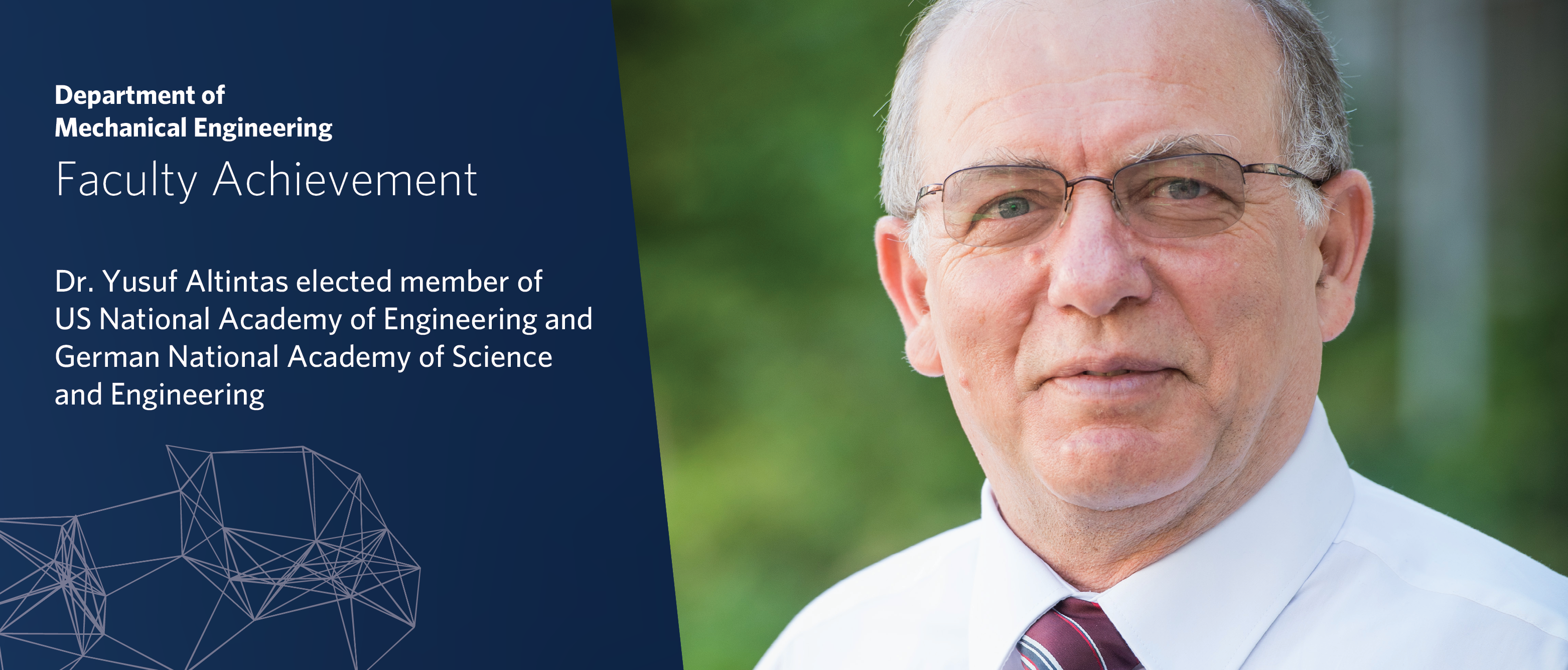
Mechanical Engineering Professor Yusuf Altintas has recently been elected a Member of two prestigious engineering organizations, the US’ National Academy of Engineering (NAE), and German National Academy of Science and Engineering, ACATECH.
Dr. Altintas’ membership in the NAE recognizes his leadership in the field of “metal-cutting mechanics and machine tool systems research and industry applications.” The NAE is part of the US National Academies of Sciences, Engineering, and Medicine. It has 2698 members of which Dr. Altintas joins as one of the 22 international member elected this year. NAE has a total of 310 international members to be recognized with this prestigious honor.
Membership in the NAE recognizes the contributions of outstanding engineers who have impacted their field through:
…engineering research, practice, or education, including, where appropriate, significant contributions to the engineering literature,…the pioneering of new and developing fields of technology, making major advancements in traditional fields of engineering, or developing/implementing innovative approaches to engineering education.
The German academy, ACATECH brings together expertise from various science and engineering fields. With about 600 members, Dr. Altintas appears to be the first member of ACATECH from Canada.
At UBC’s Department of Mechanical Engineering, Dr. Altintas is the NSERC–P&WC-Sandvik Coromant Industrial Research Chair, where he conducts research on the development of digital model of machining physics integrated with the machine tool’s structural dynamics and computer controller. His publications received about 34,500 citations with an h index (a rating of a scholar’s impact) of 96 on Google Scholar, and his digital manufacturing technology is used by more than 300 companies in aerospace, machine tool, and machining industry globally. He is also the founding coordinator of the Department’s highly-sought after undergraduate Mechatronics Option.
Alumni shoot for the moon, win multiple awards at global space conference
What struck me most was the size of the community and how much knowledge there was.
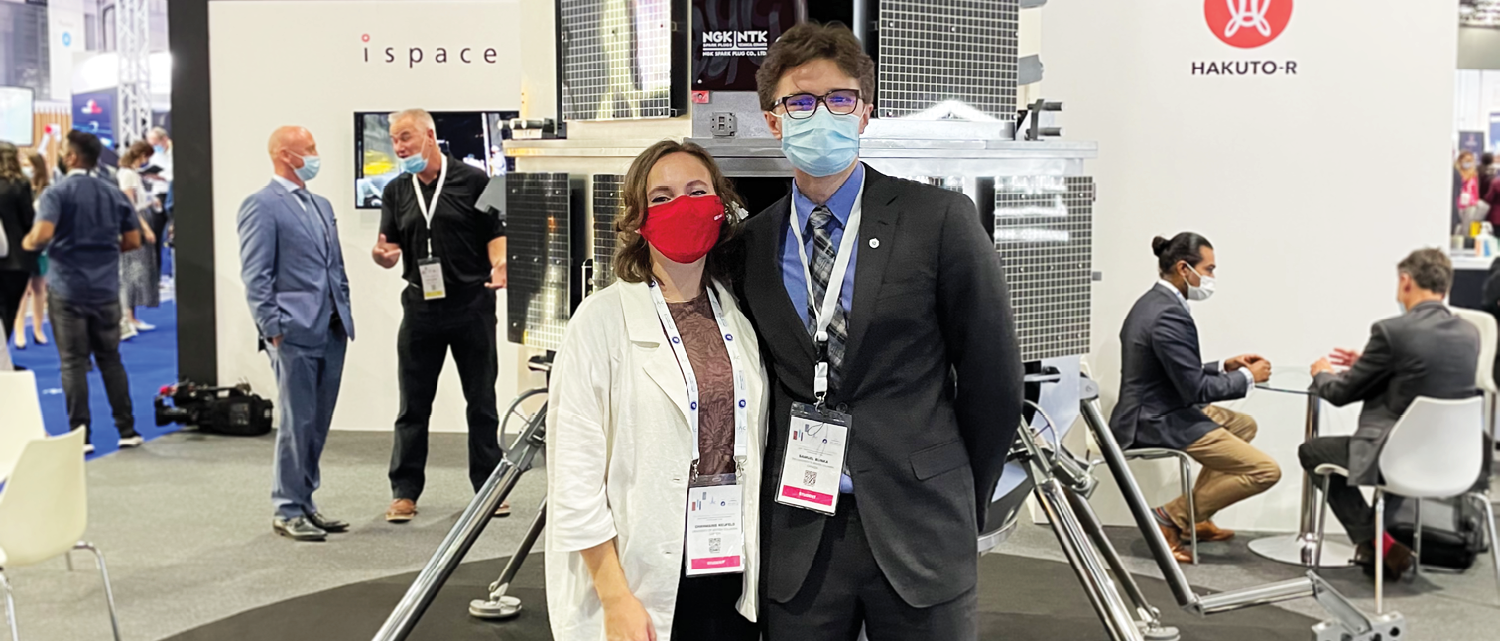
UBC Mechanical Engineering graduates Sam Bunka and Charmaine Neufeld have won three awards for two presentations they made at the 2021 International Astronautical Congress (IAC) held in Dubai. The IAC is the leading global conference for space technology, attended by the likes of NASA and Elon Musk. They developed the papers from their mechanical engineering capstone project completed spring of 2021, in which they designed an antenna pointing mechanism for a small moon rover, working under the guidance of the Canadian Space Agency (CSA).
As classes were being held online due to COVID-19, many of the projects submitted by MECH 45X industry sponsors were analytical or digital, but Bunka and Neufeld’s capstone team were interested in building a physical prototype for their final project. Bunka reached out to the CSA, and the agency gave the team the challenge of designing a mechanism that could point a directional antenna towards the earth while being compact and light enough to fit on a micro lunar rover. The capstone team (nicknamed “the Comoonicators”) designed a rotating platform that could be tilted upwards to the correct angle needed, which was less than 1/10th the size of the mechanism used on the Mars Perseverance rover, weighed less than 3.8 kg, and required minimal power. Bunka and Neufeld transformed their project reports for class into two presentations outlining their design, and addressing its industry case and applications in the space sector. As recent alumni, they attended the conference alongside students and recent graduates from the University of Toronto, Carleton University, and Concordia University. At the conference, both of their presentations won awards:
Technical Paper: “An ultra-low profile high-gain antenna pointing mechanism for micro lunar rover platforms” (abstract)
-
-
- The British Interplanetary Society award for the paper with the best technical content
- The Association Aéronautique et Astronautique de France (3AF) Gold Medal for the best oral presentation
-
Project Management Presentation: “Telecommute to the moon: A case study in managing undergraduate engineering projects without access to resources” (abstract)
-
-
- International Astronautical Federation award for best interactive presentation
-
Neufeld also submitted a paper she had written specific to her interests in propulsion, “Investigation of Numerical Modeling Methods for Liquid Fuel Combustion and Applications for Small-Scale Bipropellant Liquid Rocket Engines.” Speaking about the experience of attending the IAC, Neufeld noted:
What struck me most was the size of the community and how much knowledge there was. Coming from UBC, with a relatively small space interest, [I] didn’t realize the scale of interest in new technologies in specific fields (like… combustion research and…propulsion).
Similarly, Bunka discussed what an expansive experience the conference was to the young engineers and scientists they encountered:
“Charmaine and I went to talk with the host agency, the Mohammed bin Rashid Space Centre about their new lunar rover, and within a few minutes we were speaking with the head scientist of the program, who was similarly interested in our project. Lots of students and young professionals would find jobs within a few days of meeting people.”
The duo set out to gain experience in the space industry while studying remotely during a pandemic, and ended up winning multiple awards at the world’s biggest space conference. Learn more about the Comoonicators’ design in their 45X Capstone presentation, “A Low-profile Attitude Mechanism for Directional Antennas.”
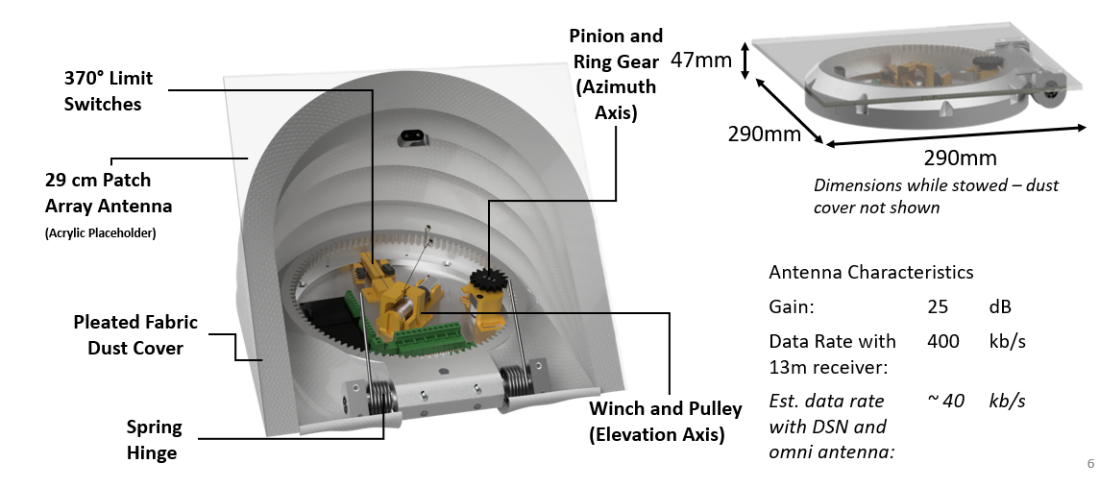
The final design of the team’s antenna pointing mechanism
Dr. Rob Rohling reappointed Director of ICICS
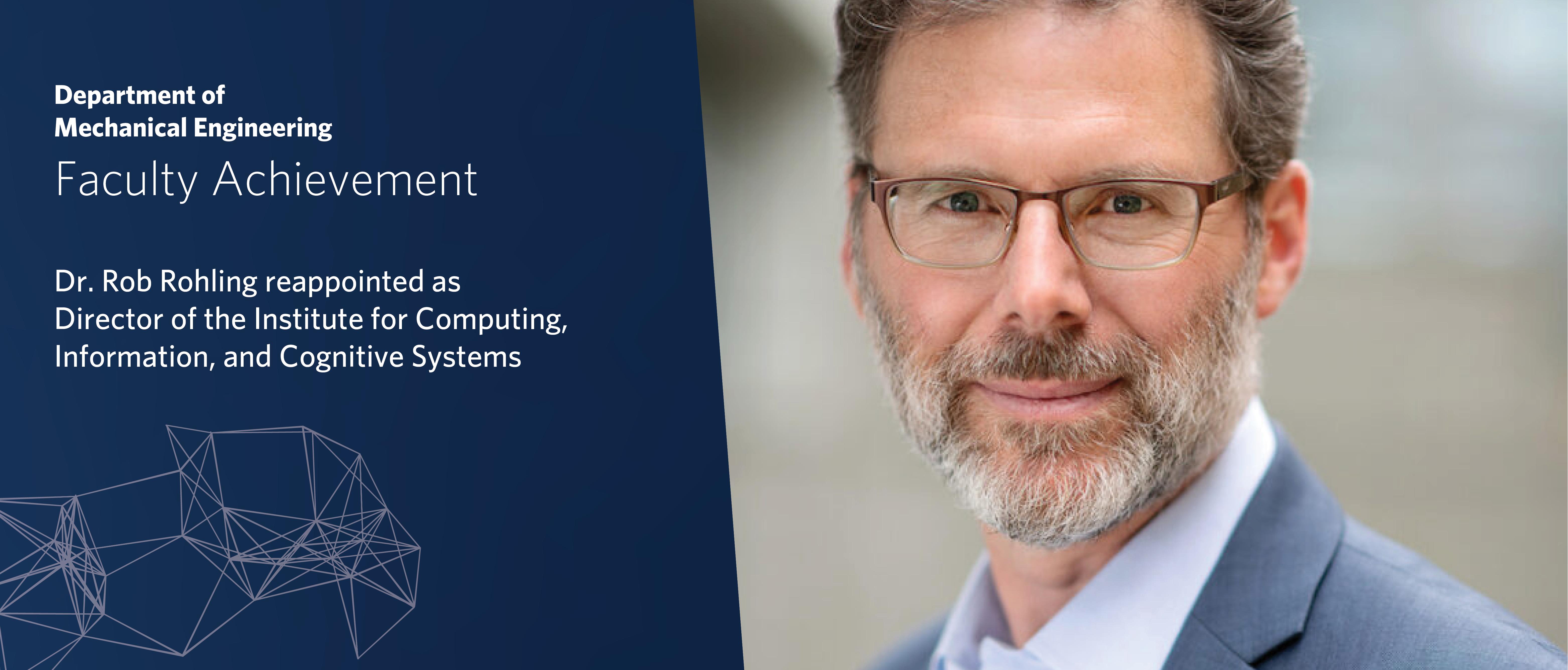
Dr. Rob Rohling has been reappointed as the director of the Institute for Computing, Information, and Cognitive Systems (ICICS) for another five-year term. Dr. Rohling is cross-appointed as a Professor in UBC’s Mechanical Engineering and Electrical and Computer Engineering departments, where he pursues research on biomedical engineering, medical imaging, medical information systems, and robotics and its application to surgery. He has been the Director of ICICS since 2017.
ICICS is an interdisciplinary research center that brings together different areas of expertise to foster technological advancement. With members from across 10 faculties and schools, it is home to several research clusters, including AI in Embedded Platforms, Biomedical Imaging and AI (BMIAI), Bionics Network, Blockchain@UBC, Centre for AI Decision-making and Action (CAIDA), Designing for People, Marine Systems Initiative (MSI), Quantum Computing, and STITCH. ICICS is also home to several Mechanical Engineering research labs, such as Sensing in Biomedical Processes Lab (SimPL), the Modeling and Simulation Research Group, the Microelectromechanical Systems (MEMS) Lab, the Micro & Nano Mechanics Lab, and the Collaborative Advanced Robotics and Intelligent Systems (CARIS) Laboratory. UBC’s HATCH startup accelerator is located in ICICS, where it provides office space, a maker space, mentorship and other tools to support UBC student or alumni tech entrepreneurs in developing and prototyping their products. ICICS is overseen by both the Faculties of Applied Science and Science, allowing it to bring together innovation across campus.
Dr. Rohling has overseen many accomplishments in his previous five years as Director, including building the HATCH program, which started in 2016 as the initiative of Applied Science Dean James Olson, as well as the UBC-Rogers partnership, which began during the challenges of the pandemic and has been recently extended to 2025. Professor Rohling is joined in the ICICS leadership team by fellow Mechanical Engineering Professor Antony Hodgson and Computer Science Professor Karon MacLean, who are the institute’s Associate Directors.
See the ICICS announcement for more details on Dr. Rohling’s reappointment and achievements at ICICS.
New publication tackles unstructured mesh optimization
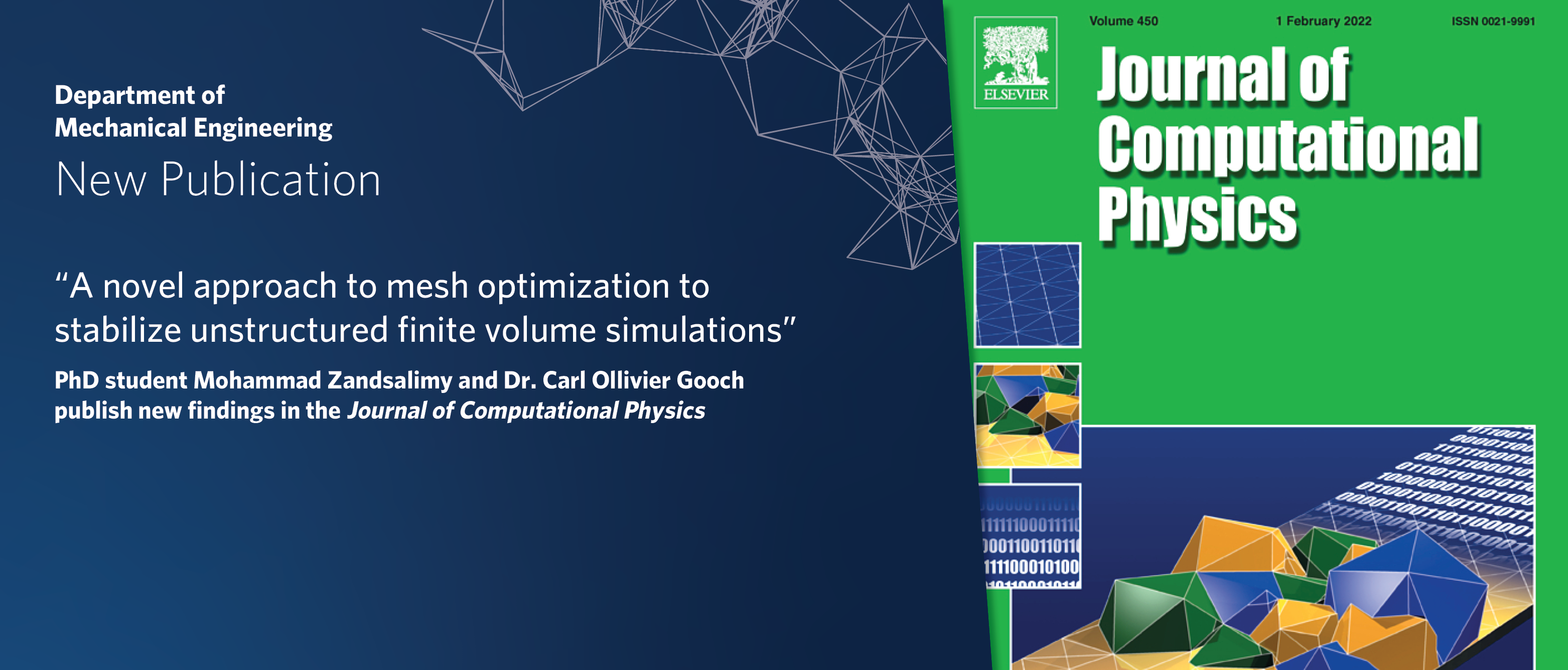
Doctoral student Mohammad Zandsalimy and supervisor Dr. Carl Ollivier-Gooch have approached an ongoing problem in fluid simulation in their recent publication in the Journal of Computational Physics. Meshes are used to calculate complicated geometrical shapes, like topographies or computer graphics. Unstructured meshes are used to solve particularly complex problems like fluid flow, whereas structured meshes calculate quickly and accurately, but don’t represent as complex structures. With the complexity of unstructured meshes comes a give and take between the accuracy of the computations and the speed it takes the computer to execute them, as well as increased possibility for errors and instability. This paper presents a solution to the issue of stability, making unstructured meshes more reliable, accurate and faster to use in complex calculations.
Read “A novel approach to mesh optimization to stabilize unstructured finite volume simulations” at https://doi.org/10.1016/j.jcp.2022.110959, which is accessible for free until March 11, 2022.
Media Mention: Dr. Steven Rogak discusses the efficacy of using air purifiers as another layer of protection against COVID-19 in indoor spaces.
Chatelaine: Along with masking, gathering outdoors when possible, staying home when you’re sick and reducing contacts, air purifiers can add another layer of protection indoors.
Dr. Boris Stoeber wins Dean’s Award for Excellence in Service
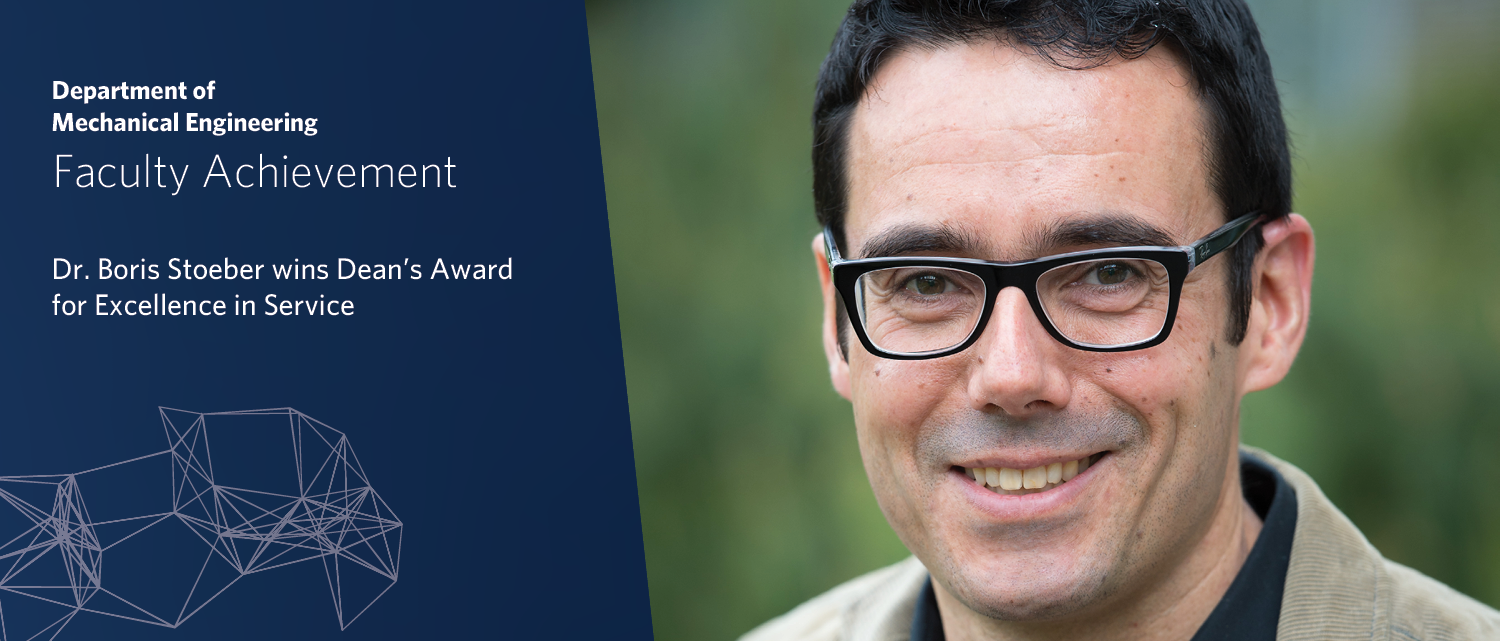
Professor Boris Stoeber has been awarded a 2021 Dean’s Award for Excellence in Service, recognizing his contributions to the Department of Mechanical Engineering and Faculty Applied Science. Jointly appointed by Mechanical Engineering and Electrical and Computer Engineering, Dr. Stoeber has served as the Associate Head of Teaching for several years in Mechanical Engineering, most recently through 2020 and 2021. His leadership in navigating the transition to online teaching was invaluable, heading up the department’s Cyber-E Task Force which prepared faculty and staff to deliver a successful online teaching program throughout 2020 and 2021.
Through this time, he was also an advocate for equity in student’s virtual learning experience, raising important concerns about the challenges faced by students in different time zones from instruction and with different access to resources. His push for student support resulted in the creation of MECH’s lab-in-a-box system, which saw lab materials shipped to students all over the world so they could participate in hands-on learning despite lack of access to the classroom. The assignments created for lab-in-a-box were so successful some of them are being integrated into regular classroom instruction.
Dr. Stoeber is a trusted colleague in the Department, who has given countless hours to support excellence in teaching and provide students with the best possible learning experience despite the challenges of the virtual classroom.
Visit the Faculty of Applied Science to see all the 2021 recipients of the Dean’s Award for Excellence in Service.