UBC Master of Engineering Leadership (MEL) Naval Architecture and Marine Engineering students recently visited Seaspan’s Vancouver Shipyards. Seaspan is an association of Canadian companies that are primarily involved in marine transportation, ship docking, ship escort, ship repair and shipbuilding services in Western North America. Employing over 2500 people within Canada, Seaspan plays a critical in our local marine transportation and supply chain. Seaspan is a trusted partner in repair and conservation for government, commercial, and private vessels, and a key site for building non-combat vessels under Canada’s National Shipbuilding Strategy.
2021 Academic and Leadership Awards
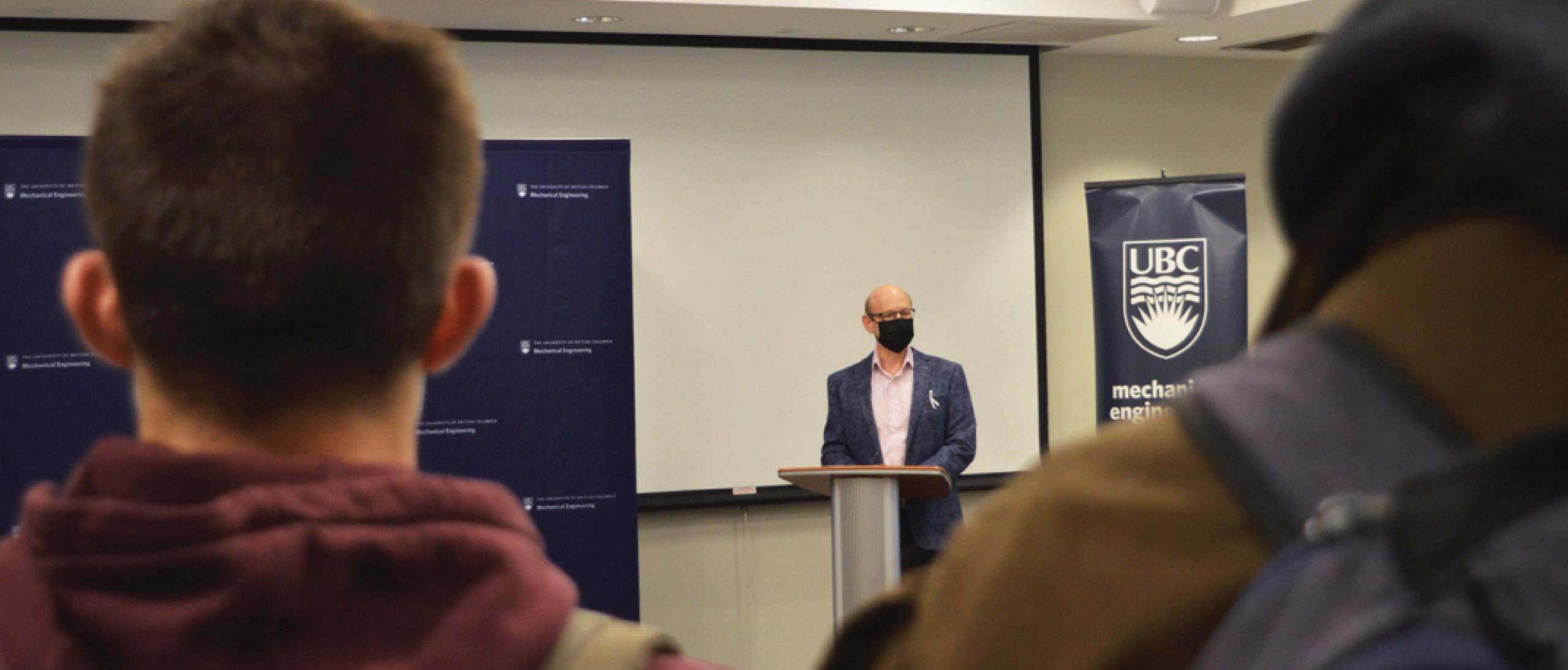
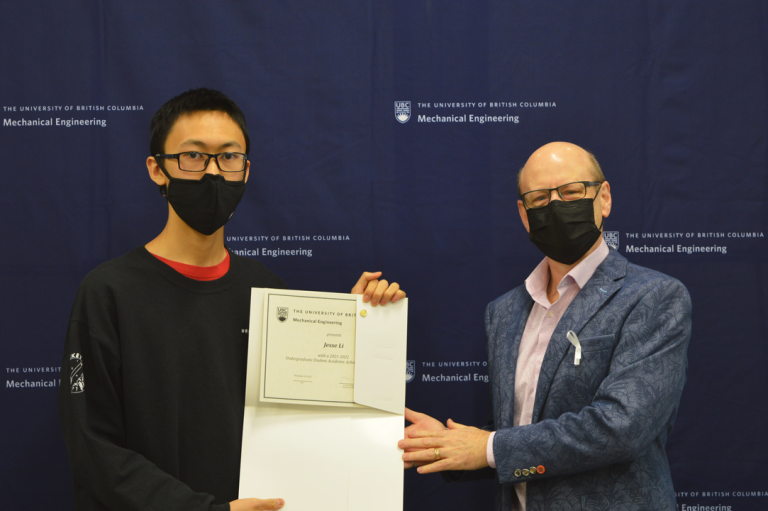
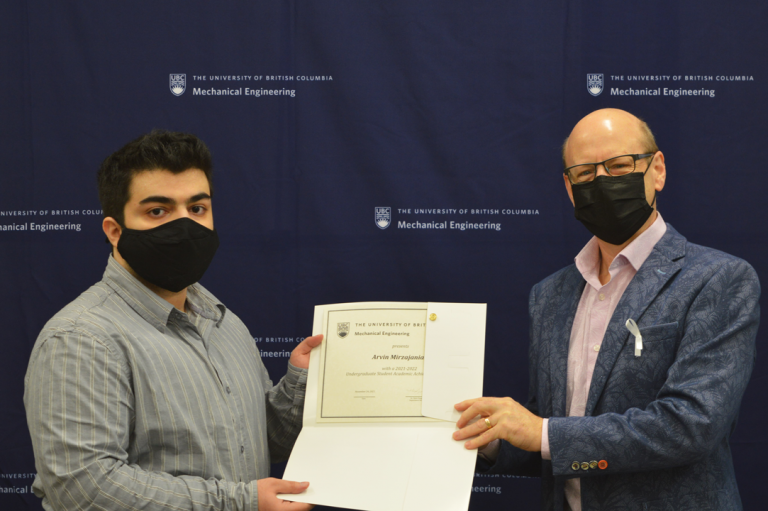
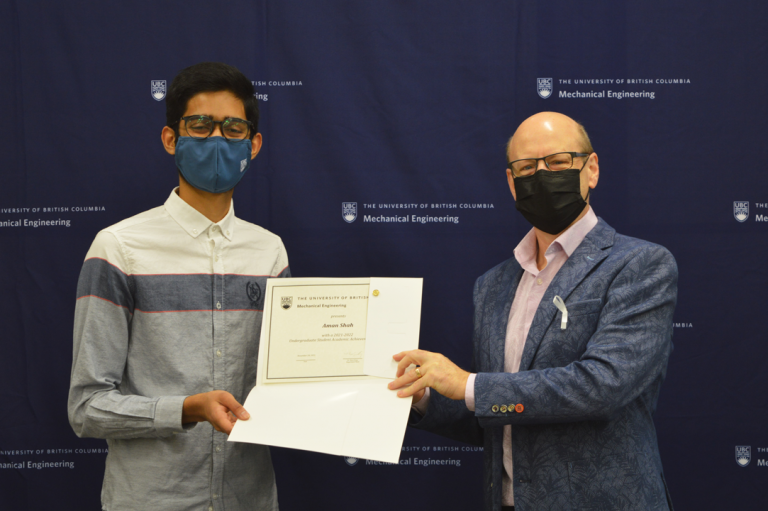
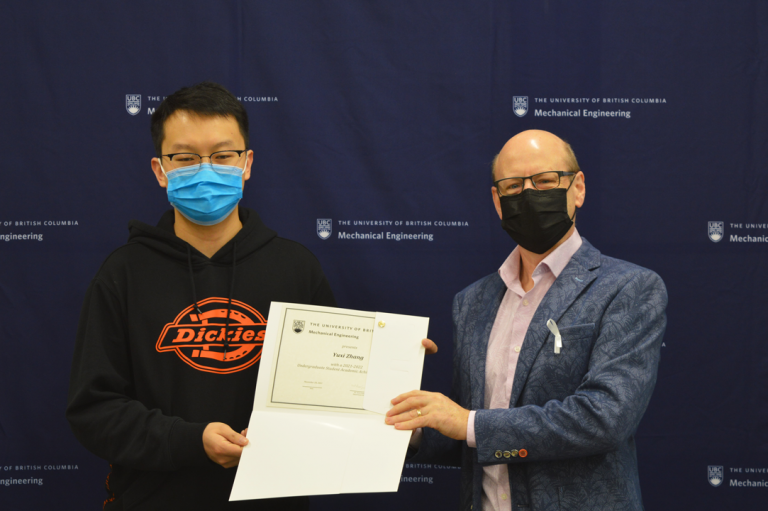
The Department of Mechanical Engineering recently recognized current students who have shown outstanding academic achievement and leadership, by presenting them with awards at a special event on Wednesday, November 24th. Awards were presented by Associate Head of Teaching, Dr. Tony Hodgson.
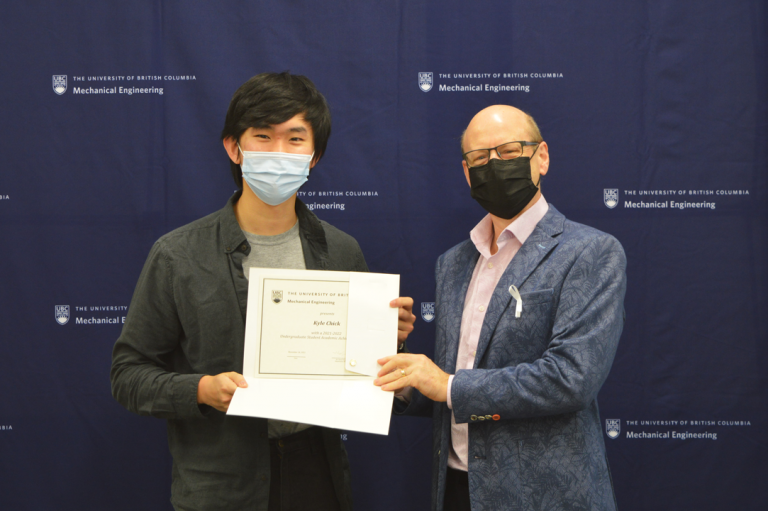
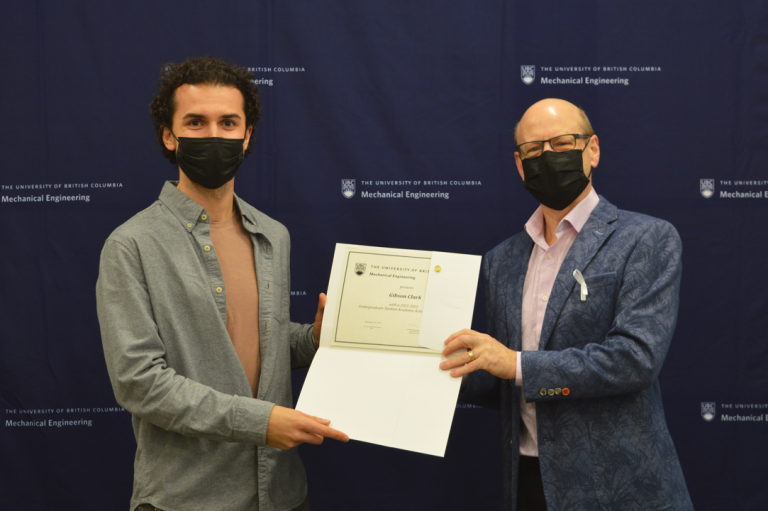
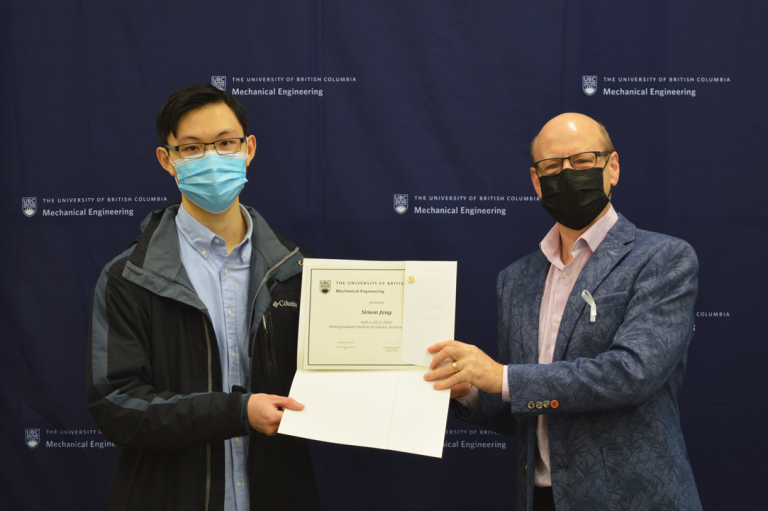
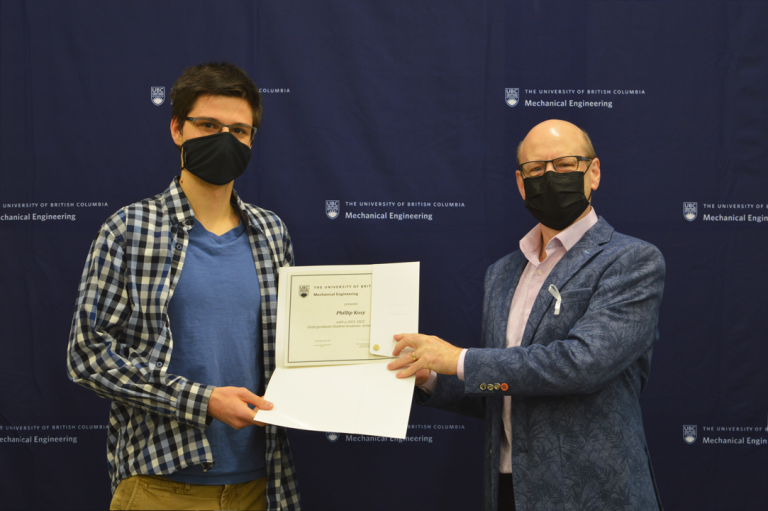
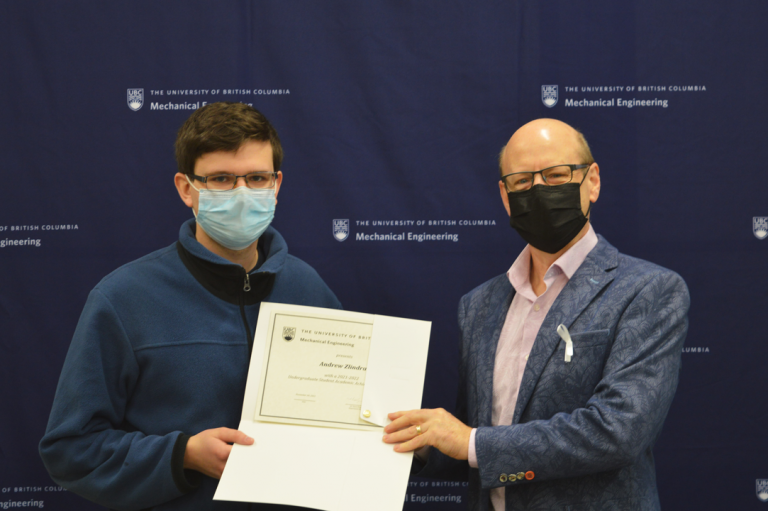
Undergraduate Academic Achievement Awards
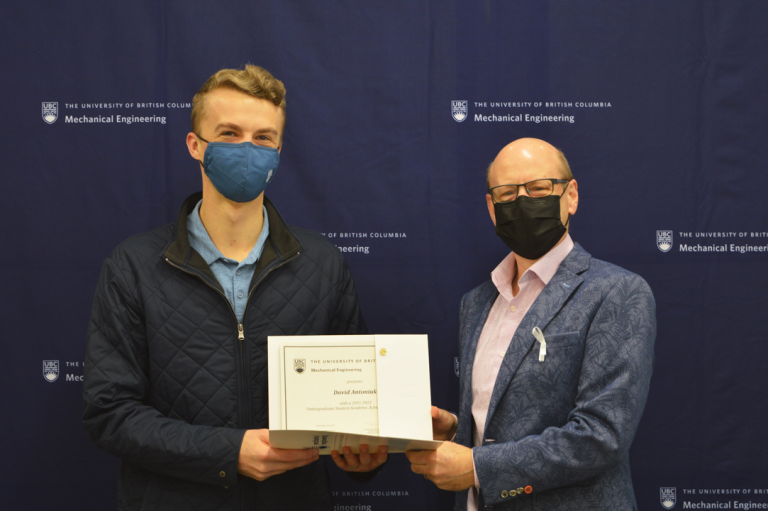
A certificate of recognition was presented to exceptional undergraduate students who have excelled academically throughout their degree. Each of the following students achieved an overall sessional average above 90% in the last academic year.
|
|
Department Scholars
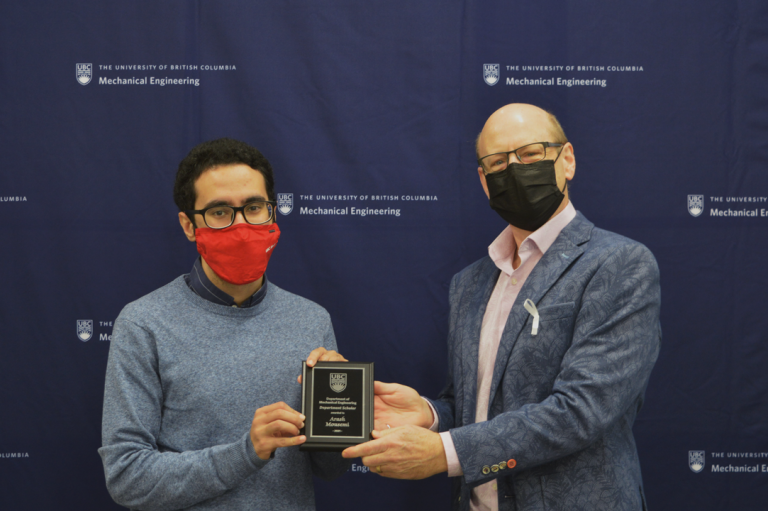
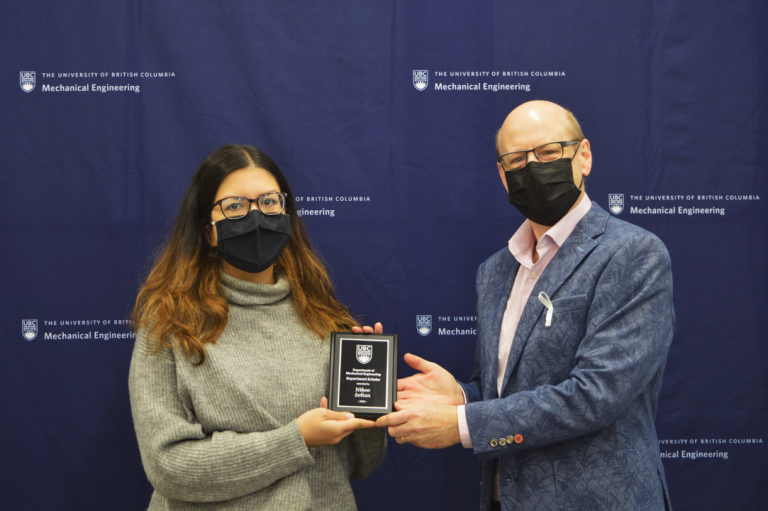
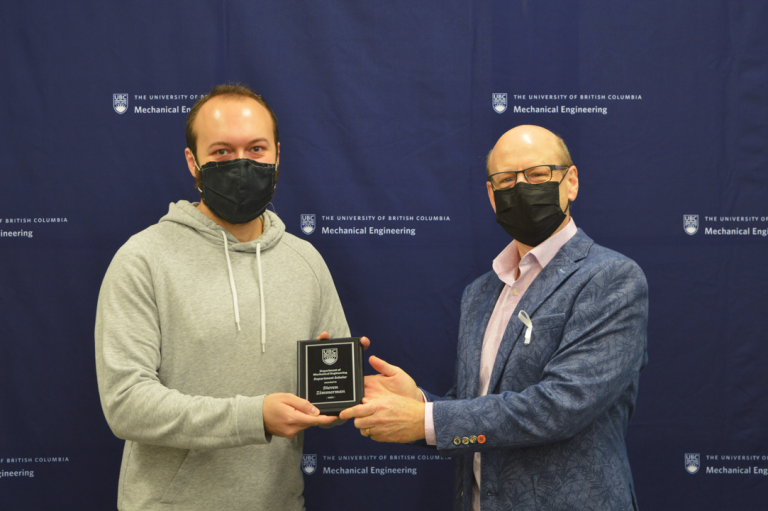
Graduate student achievements in academics and research are recognized with the designation of Department Scholar. This honorary designation may be given to a student at any point in their program, and they hold the designation through the remainder of their degree.
- Sebastiaan Mainardis – NSERC Master’s Scholarship
- Arash Mousemi – PhD Four Year Fellowship
- Nikoo Solton – MASc Affiliated Scholarship
- Steven Zimmerman – NSERC Master’s Scholarship
Teaching Fellowship
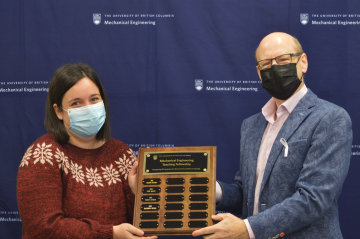
This Fellowship recognizes senior doctoral students who have demonstrated dedication to, and a talent for, teaching. The Teaching Fellowship is awarded annually to 1-2 students based on a competitive application process and includes an award as well as the opportunity to teach within the Department. Each year, the recipient is added to the plaque which hangs in the Department.
2021 Teaching Fellowship Recipient: Elizabeth Trudel
Student Leadership Awards
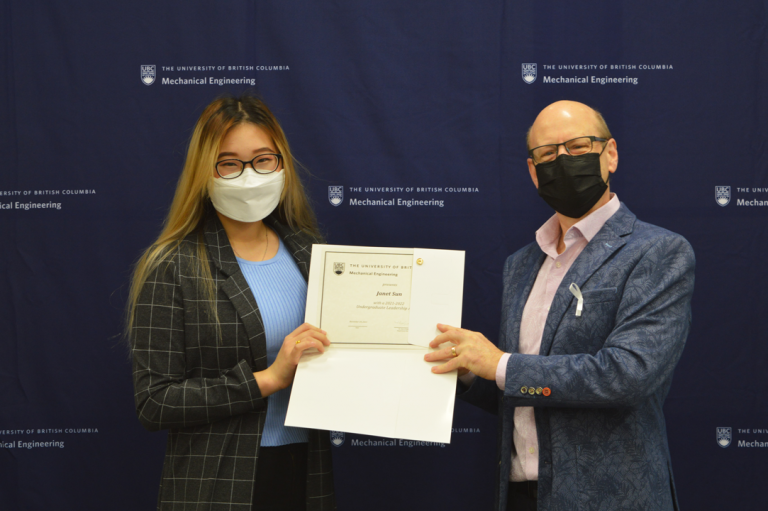
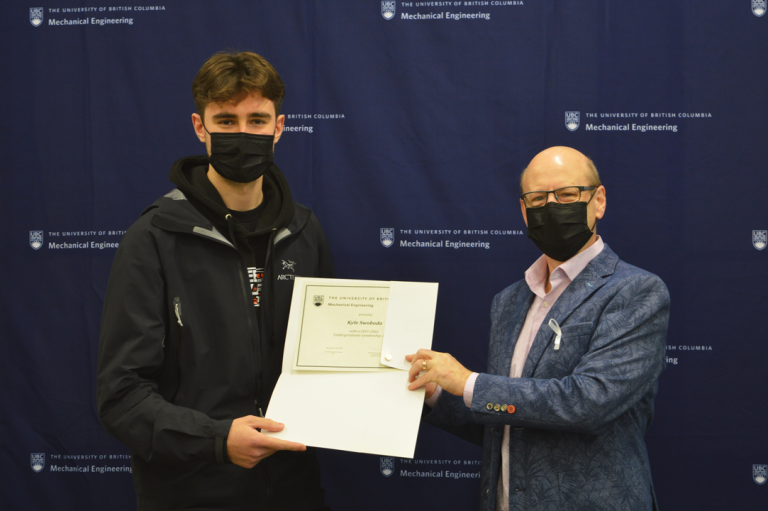
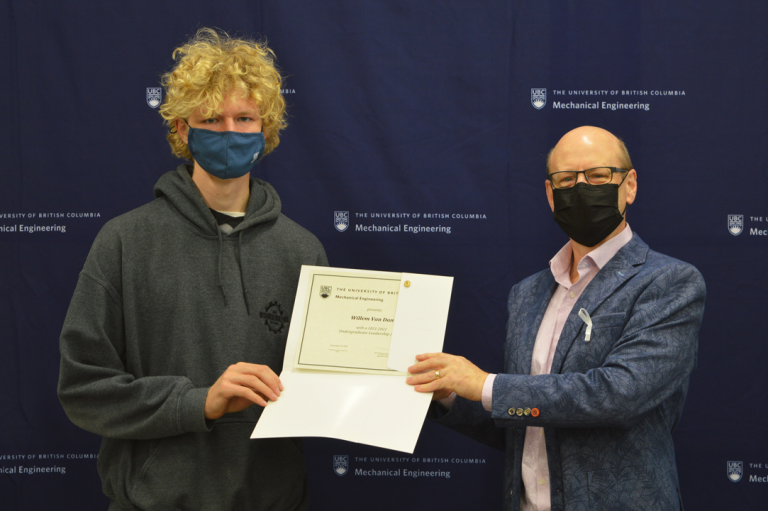
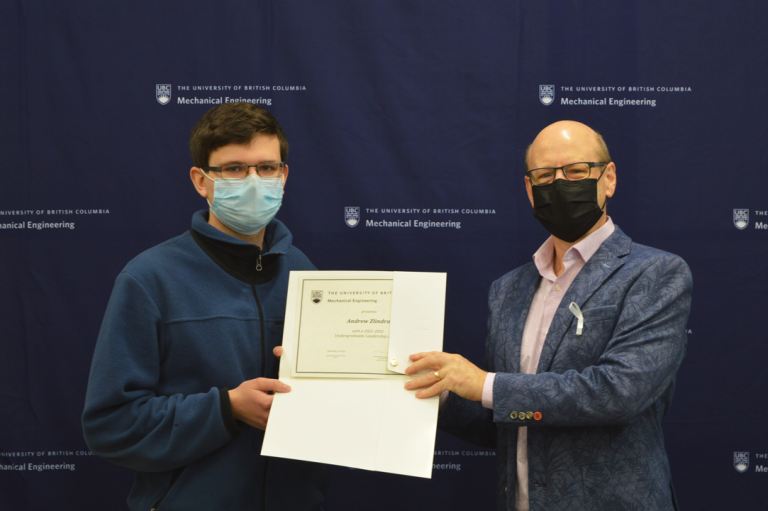
The Department recognizes outstanding student leaders for their dedication and service to student teams or groups with a Student Leadership Award. Thank you for your contributions to our Mechanical Engineering community as well as the broader engineering community at UBC!
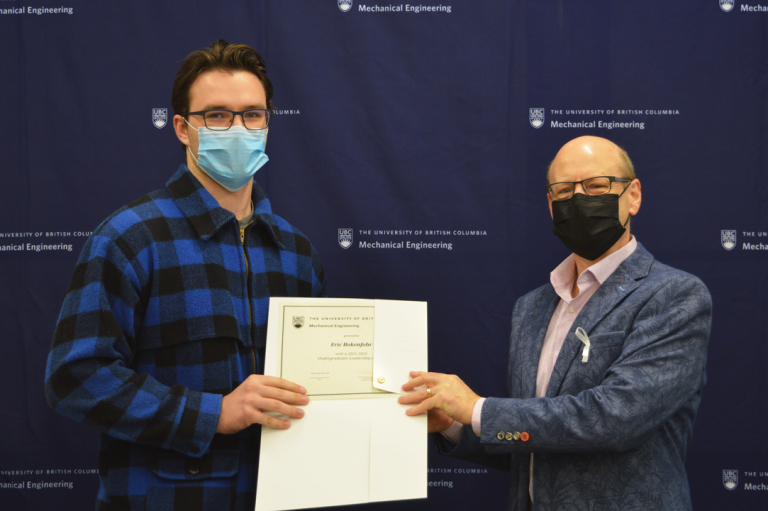
- Erik Bokenfohr – Supermileage Co-Captain
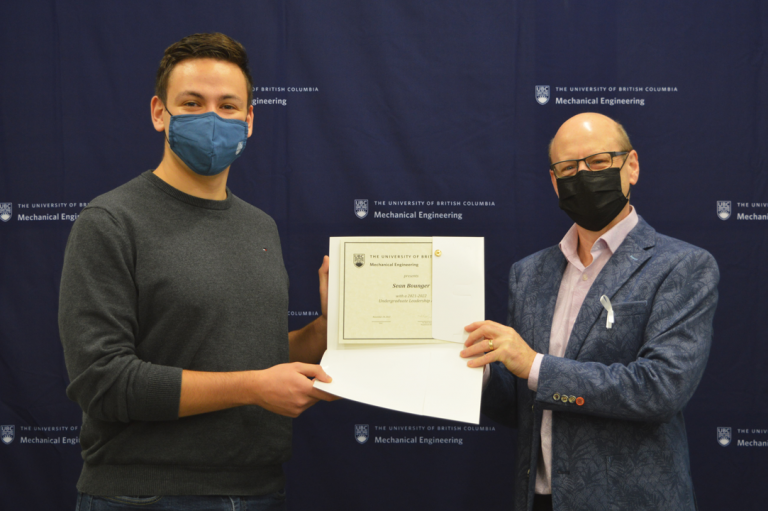
- Sean Bounger – UBC Rocket Captain
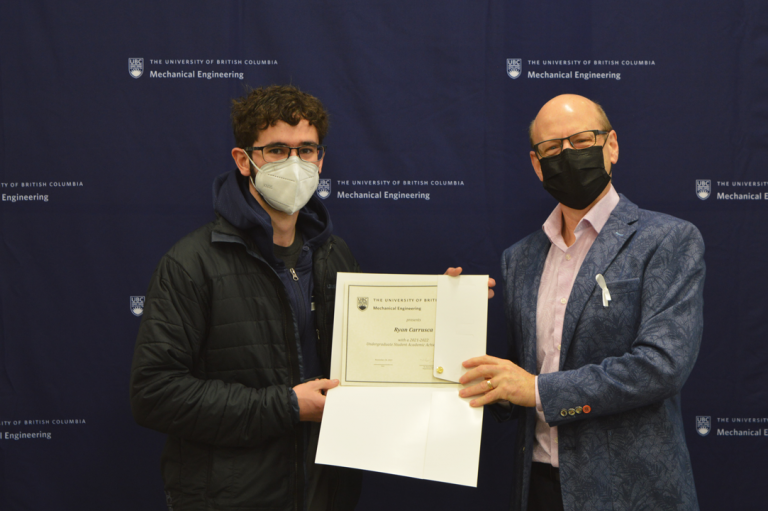
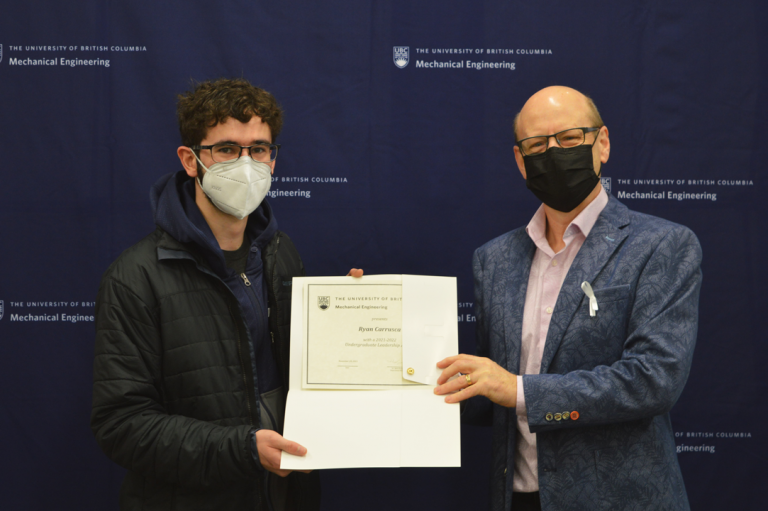
- Ryan Carrusca – UBC Concrete Canoe Co-Captain & Club Mech Grad Rep
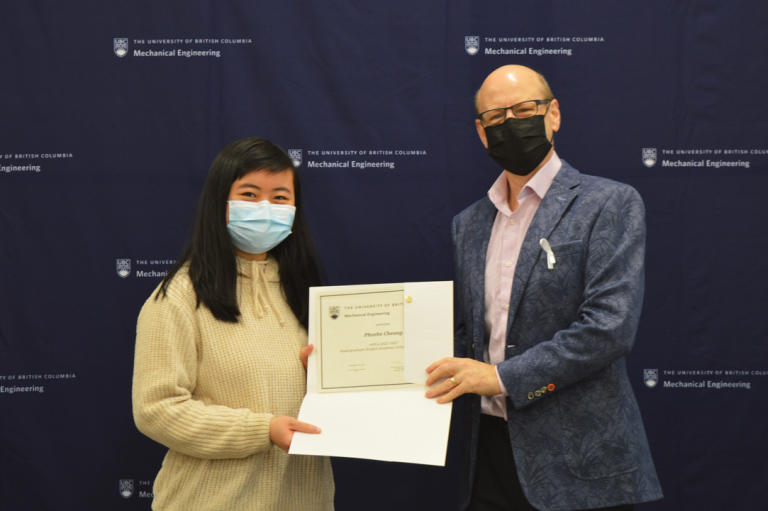
- Phoebe Cheung – AeroDesign Co-Captain
- Emilie Ho – Club Mech Vice President
- Allan Kwong – UBC Solar Captain
- Andrew Mah – SUBC Captain
- Wojtek Sobczyk – Formula UBC Captain
- Janet Sun – Club Mech President
- Kyle Swoboda – Baja Team Captain
- Willem Van Dam – UBC Rapid Captain
- Andrew Zlindra – UBC Mars Colony Captain
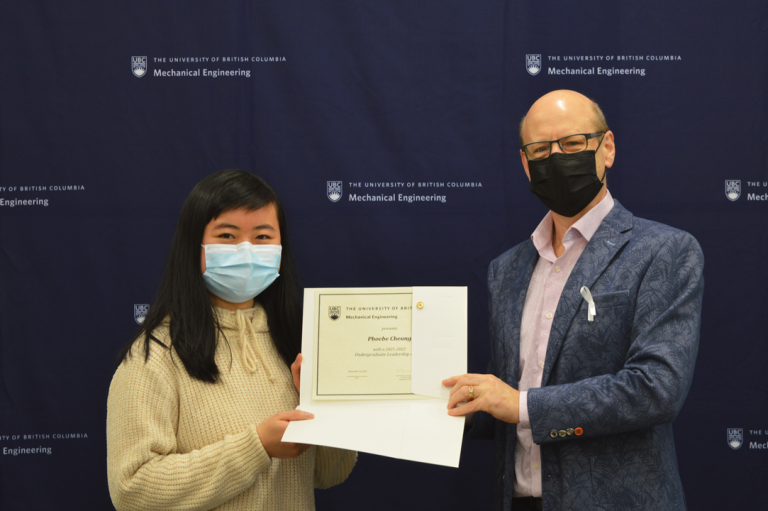
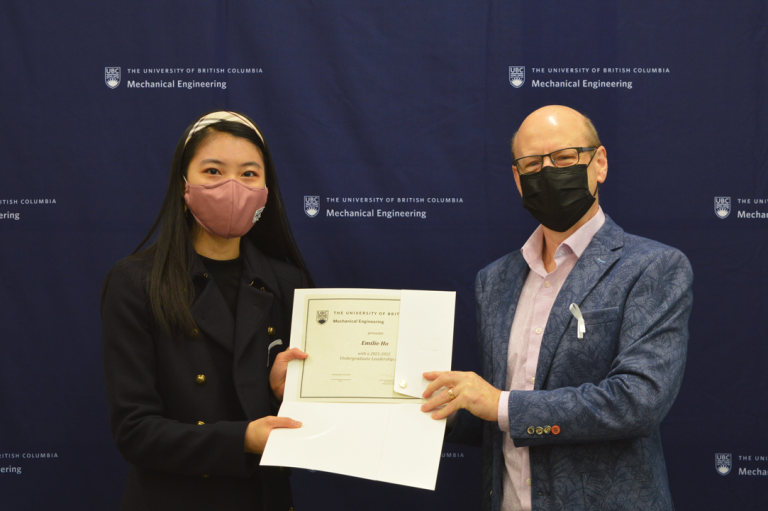
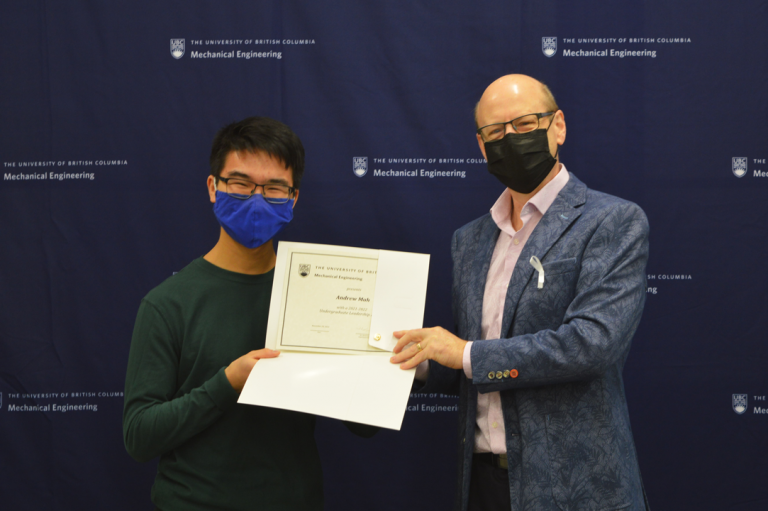
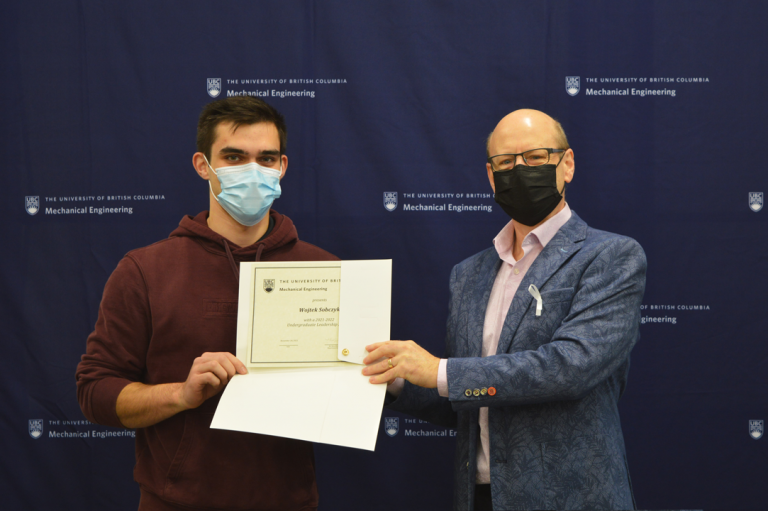
Congratulations to all our student award winners on their achievements!
Celebrating our November 2021 Graduates!
Congratulations to the class of 2021! We’re excited for you to celebrate your university achievements, and to embark on your next chapter and the bright future ahead.
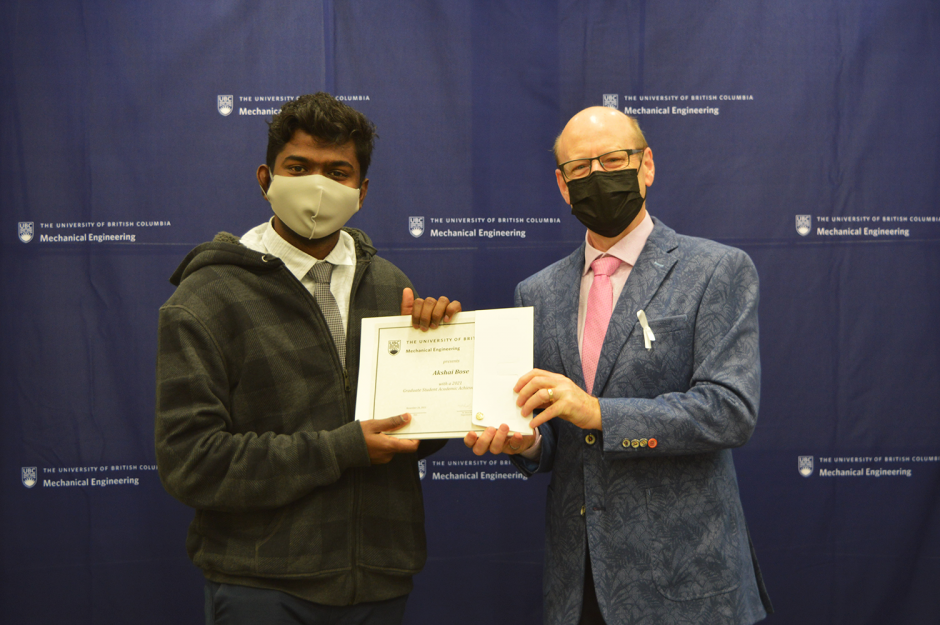
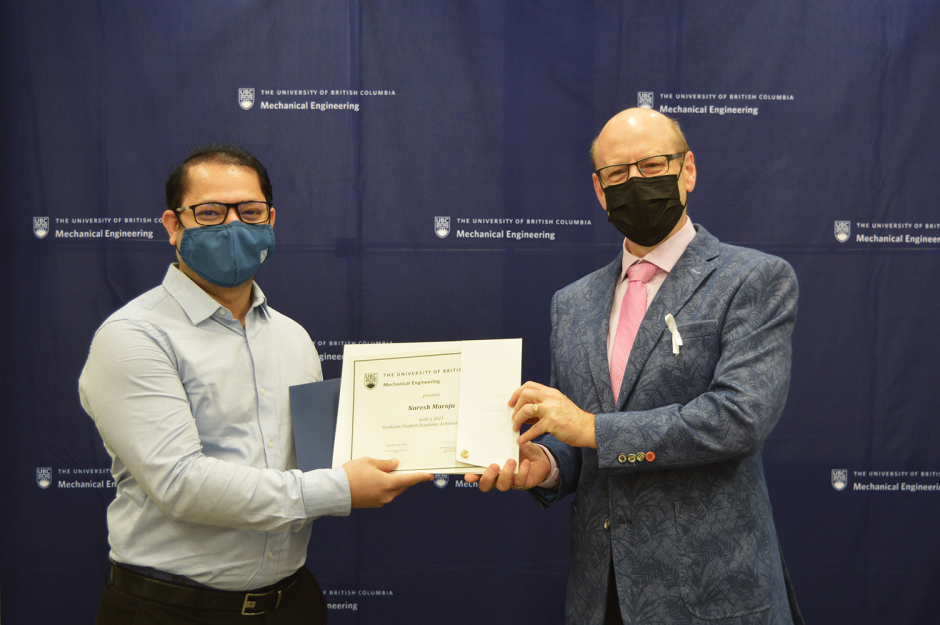
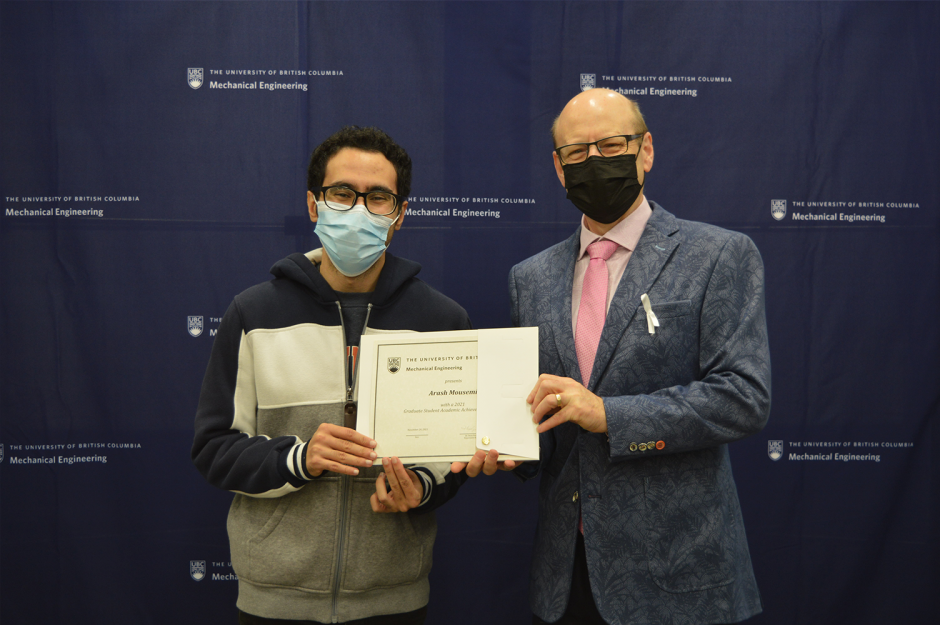
We were so happy to celebrate our November graduates with our first in-person awards ceremony since the beginning of the COVID-19 pandemic. The following awards were presented on Friday, November 25th after convocation.
Awards
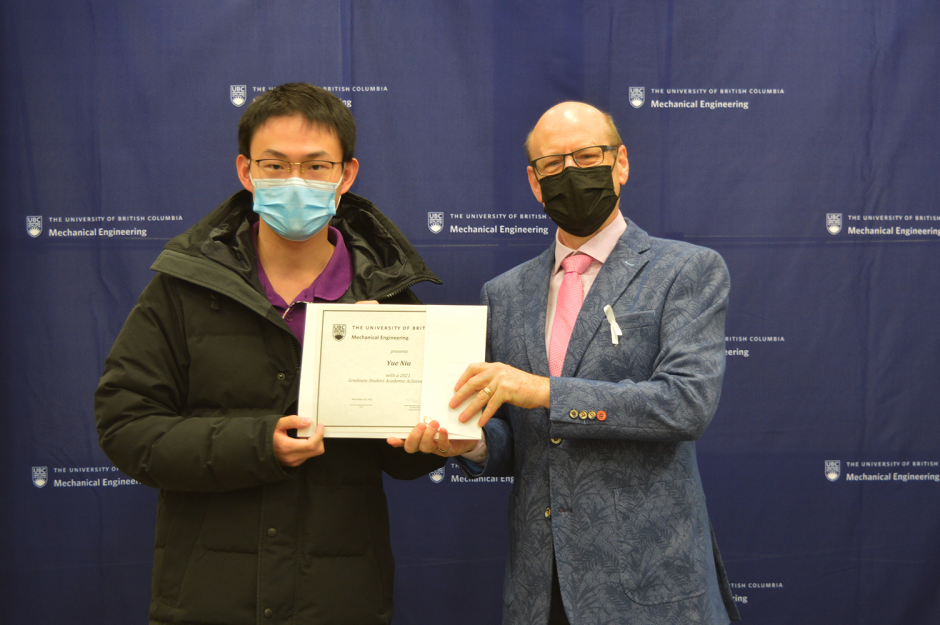
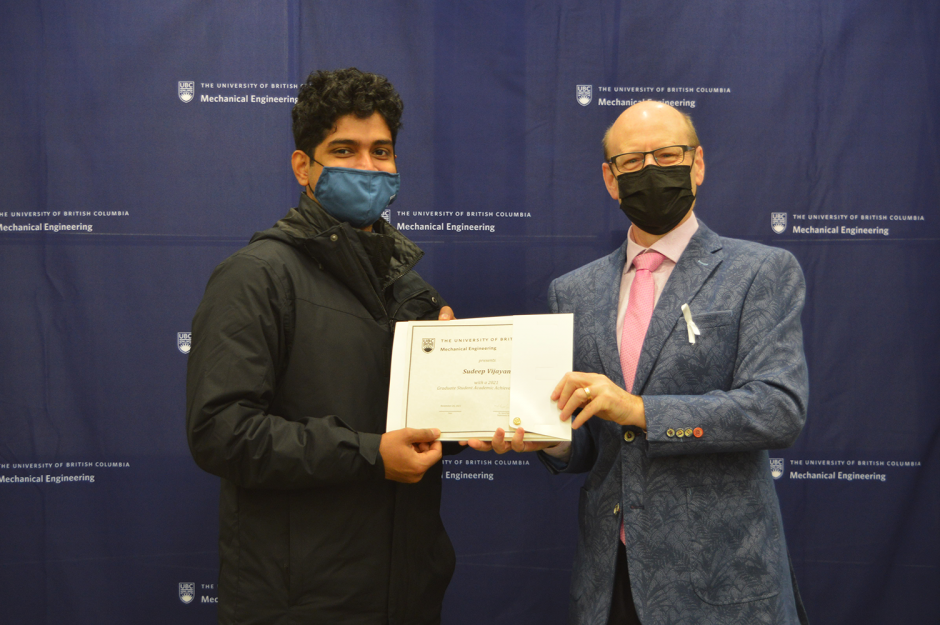
Graduate Academic Achievement Awards
These awards are given to outstanding graduate students who have achieved an overall average throughout their program of above 90%.
- Akshai Bose – MEng
- Naresh Maroju – PhD
- Arash Mousemi – MASc
- Yue Niu – MASc
- Douglas Prisnie – MEng, NAME
- Sudeep Vijayan – MEng, NAME
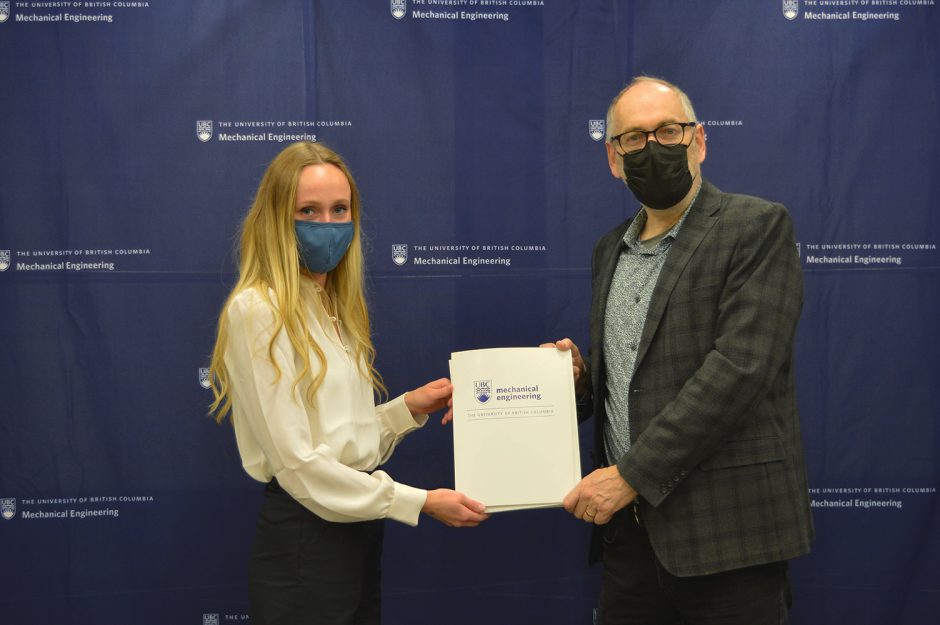
Naval Architecture & Marine Engineering Design Award
The Naval Architecture & Marine Engineering Design Award recognizes outstanding accomplishments in engineering design for the NAME MEng final ship design project, which was presented to members of industry.
Project: Gulf Island Seabus – A Fuel Cell Powered Hydrofoil Catamaran
Team members:
-
-
- Alice Brais
- Madeline Odegaard
- Joel Pacas
-
Congratulations to the award winners and to all of our graduates on their accomplishments! Welcome to the UBC and Mechanical Engineering alumni community!
Awards Ceremony Photos
APSC Rising Star Suraj Kashyap: The serendipitous world of fluid flows
“Progress is equal parts hard work and epiphany.”
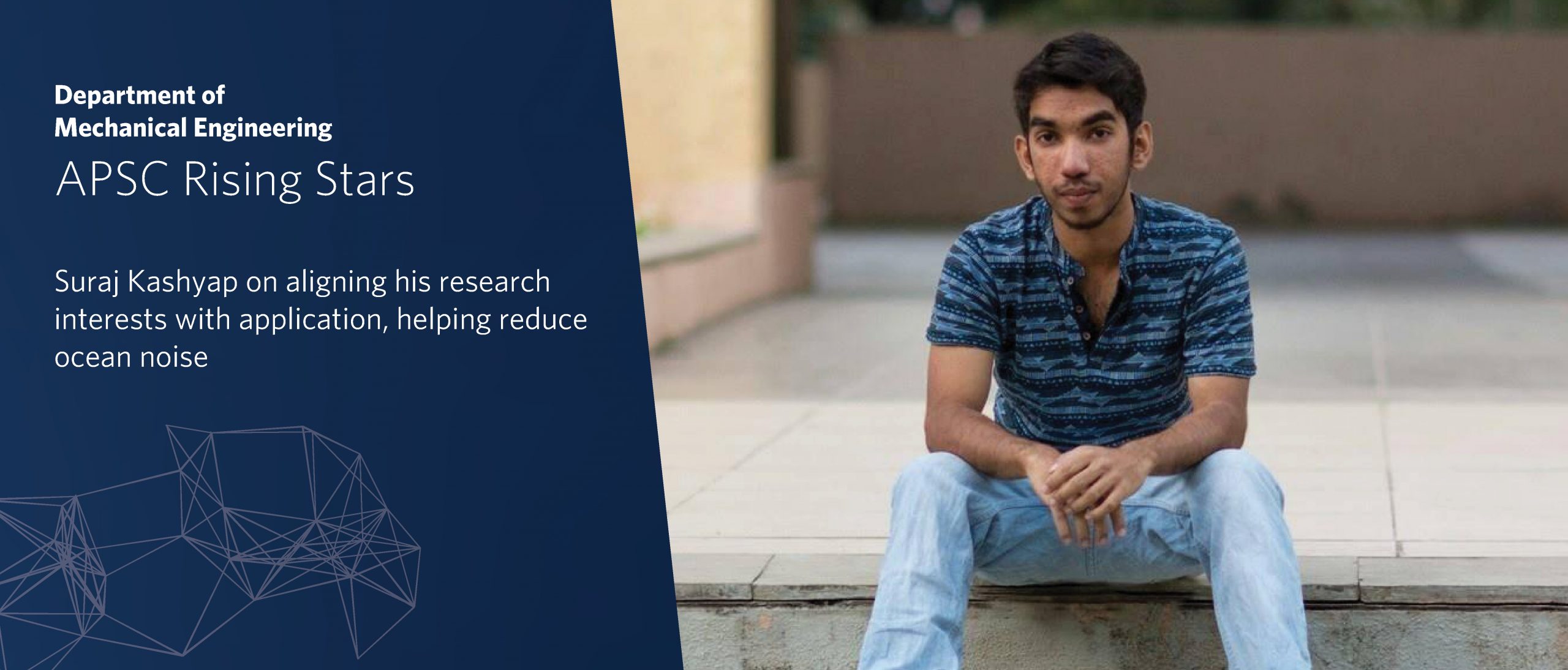
Suraj Kashyap
Degree: Master of Applied Science
Grad year: 2021
Program: Mechanical Engineering
Campus: Vancouver
I am a graduate researcher at the Computational Multiphysics Laboratory at UBC. My work revolves around using computational methods to study complex flows in the oceans. When I am not busy solving fluid dynamics problems, you are most likely to find me outdoors with my trusty old camera.
Why did you choose to go into your field of study at UBC?
My program provided me with a unique amalgamation of my interests – physics, computer science and the opportunity to apply it to a practical problem that impacts the natural environment. Besides, it is hard to say no to studying in a beautiful place like BC.
How are you applying the skills you learned through your studies at UBC?
My interest has always been in contributing to the natural environment around us. The courses and research I undertook at UBC helped me in honing my skills towards this. My research was targeted at making the oceans a more comfortable place for marine mammals. UBC also provides an extremely well laid-out infrastructure for taking your interests to higher levels. My experience with e@UBC is helping me align my research interests with practical applications. Currently, I am working towards launching my own venture that I hope will one day help make the marine environment quieter and more liveable.
What advice would you give a student entering your degree program?
Network and converse! The university provides a unique environment where you can meet smart people working to push the boundaries in extremely diverse fields. So talk to as many people as you can, from your own discipline and beyond. Try to join a club that aligns with your interests. There is always something new to learn – you will discover inspiration from completely unexpected sources.
How do you feel your degree has benefitted you compared to a different field of study?
The MASc program gave me a good exposure to research in the Applied Sciences. It was a perfect combination of learning and application. I really enjoyed the flexibility to take courses from different disciplines which as a whole helped me define my research and career interests.
What has made your time at UBC memorable?
Definitely the people. I got the chance to meet and work with people from very diverse backgrounds – engineering, arts, business studies – and also made some lifelong friends.
Find me on: Instagram Facebook LinkedIn
Reposted from UBC Applied Science’s Student + Alumni Stars.
APSC Rising Star Matthew Primeau: Engiprenuership: when engineering meets entrepreneurship
“So often we are scared to start pursuing our dreams and make a difference in the world – in fear that we may not be 100% ready to do so yet… However, what I’ve learned is that we may never be ‘ready’, but that doesn’t mean we can’t start anyways.”
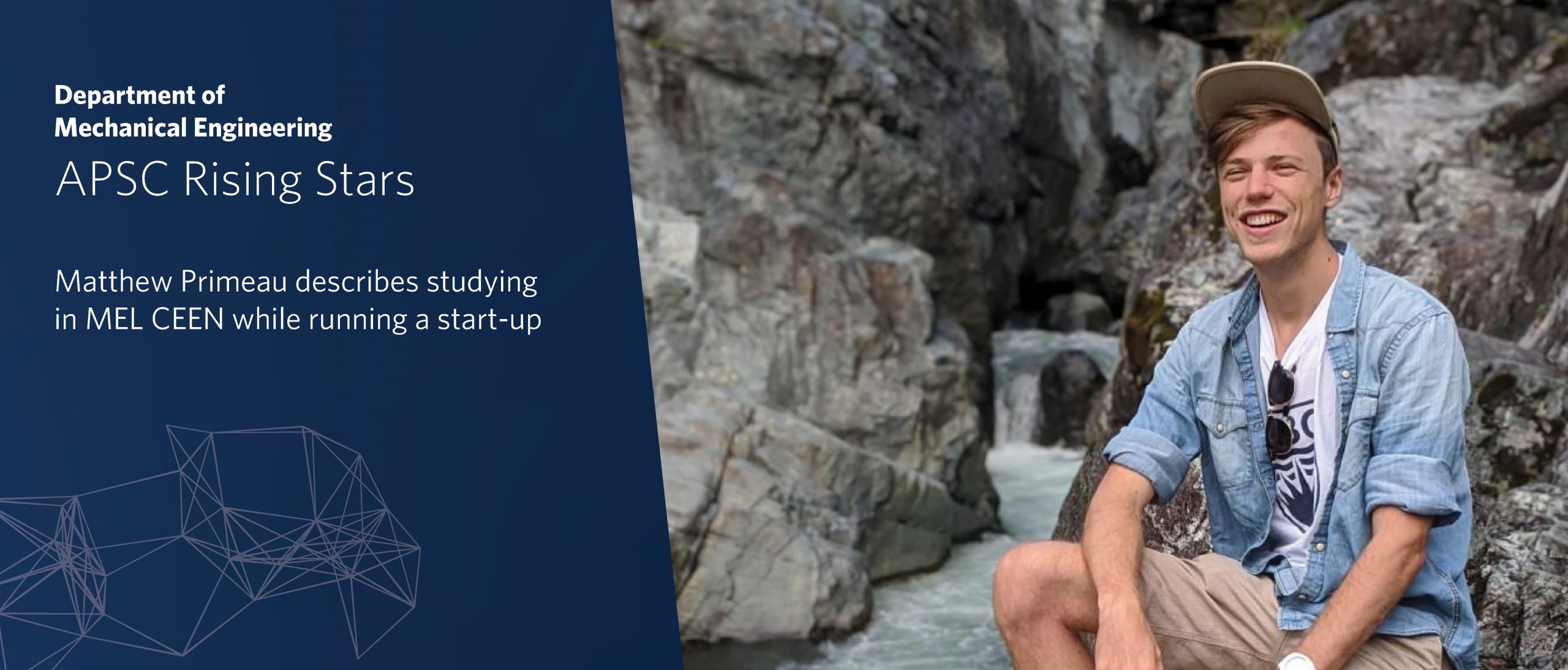
Matthew Primeau
Degree: Master of Engineering Leadership
Grad year: 2021
Program: Clean Energy Engineering
Campus: Vancouver
Hi, I’m Matthew! I sometimes describe myself as an ‘Engipreneur’ – which is what you get when you take an engineer down the entrepreneurial path. I am driven to make a positive impact within the world, in a manner that is socially and environmentally conscious. My mission in life is to leave every person and place I come across more empowered and balanced than when I first found them.
For the past two years, I have been simultaneously a graduate student at UBC studying a Masters in Engineering Leadership: Clean Energy and a full-time entrepreneur, co-founding and leading operations at a circular economy start-up called Scrapless. In the past I have worked and volunteered far and wide across the engineering industry; from advocacy work with Engineers Without Borders Canada, project management for a medium-sized enterprise, design consultation for a large industrial corporation, to on the ground construction labour (admittedly, I wasn’t great at that last this one – but I did learn a lot!).
My passions are environmental sustainability, renewable energy, circular economy, entrepreneurship, philosophy, mindfulness, healthy living, and self-growth. I work hard every day to craft a career for myself that will bring all of these passions together.
Why did you choose to go into your field of study at UBC?
Ever since I was a kid, I was destined to pursue a career in green technology. From early childhood memories of my grandmother teaching me to repurpose and recycle old margarine containers, to spending summers at my family’s cottage catching (and releasing) insects and fish — I was raised with such a high appreciation for nature, balance, and sustainable living. These appreciations led me to pursue engineering as a means for me to contribute to solving some of the larger problems facing our planet. After obtaining my undergraduate degree in Architectural Conservation and Sustainability Engineering, it was never certain for me that I would eventually go back to study for a master’s degree. The spark that made me want to deepen my engineering knowledge came when I learned of UBC’s Master of Engineering Leadership Program in Clean Energy. What attracted me to the program was that is offered a balance of technical engineering expertise, business and entrepreneurial acumen, and political literacy. I knew that to become the environmental leader I strive to become, I would need such a well-rounded skill set — and thus, I applied to the program.
What has made your time at UBC memorable?
What was most memorable for me during my studies at UBC was working on my capstone project, which was to perform a Triple Bottom Line Analysis on an innovative drone reforestation technology created by Canadian start-up ‘Flash Forest’. This project was so memorable because it served as a culmination of bringing together all that I learned across the entire program — from evaluating carbon emissions, energy efficiency and storage, energy policy, and market strategy — it was an excellent opportunity to leverage all of my knowledge, skillsets, and network of resource to create a true academic achievement for myself. It was also incredibly fulfilling to me to learn that learning outcomes from my project proved valuable for the sponsoring company going forward with their business operations.
How are you applying the skills you learned through your studies at UBC?
Co-founding and managing operations for a start-up while simultaneously being a graduate student provided a unique learning opportunity for me during the program. This was because a large portion of my academic work related to business, entrepreneurship, and organizational leadership, all of which were directly applicable to my work within my start-up. It became fairly common that I would learn something in class, and then immediately get presented an opportunity to apply that learning that same day in “the real world” while working on my company. In a way, it felt as if my start-up was one large ongoing school assignment. Now that I have finished my studies, I continue to use the technical and entrepreneurial skillsets taught to me nearly every day as my business pursuits and ventures continue to expand.
What are your future plans to make a difference in our world?
My current ambition is to help green businesses grow. Whether they be additional start-ups that I found in the future or other small businesses that require support, I plan to use the skillset and knowledge gained from my time at UBC to help make them flourish. I am hopeful that my contributions to the industry in the form of innovative and novel business can help restore our planet, and those living on it, to harmony.
Find me on: Instagram LinkedIn
Reposted from UBC Applied Science’s Student + Alumni Stars.
Researchers create new ultra-strong alloy
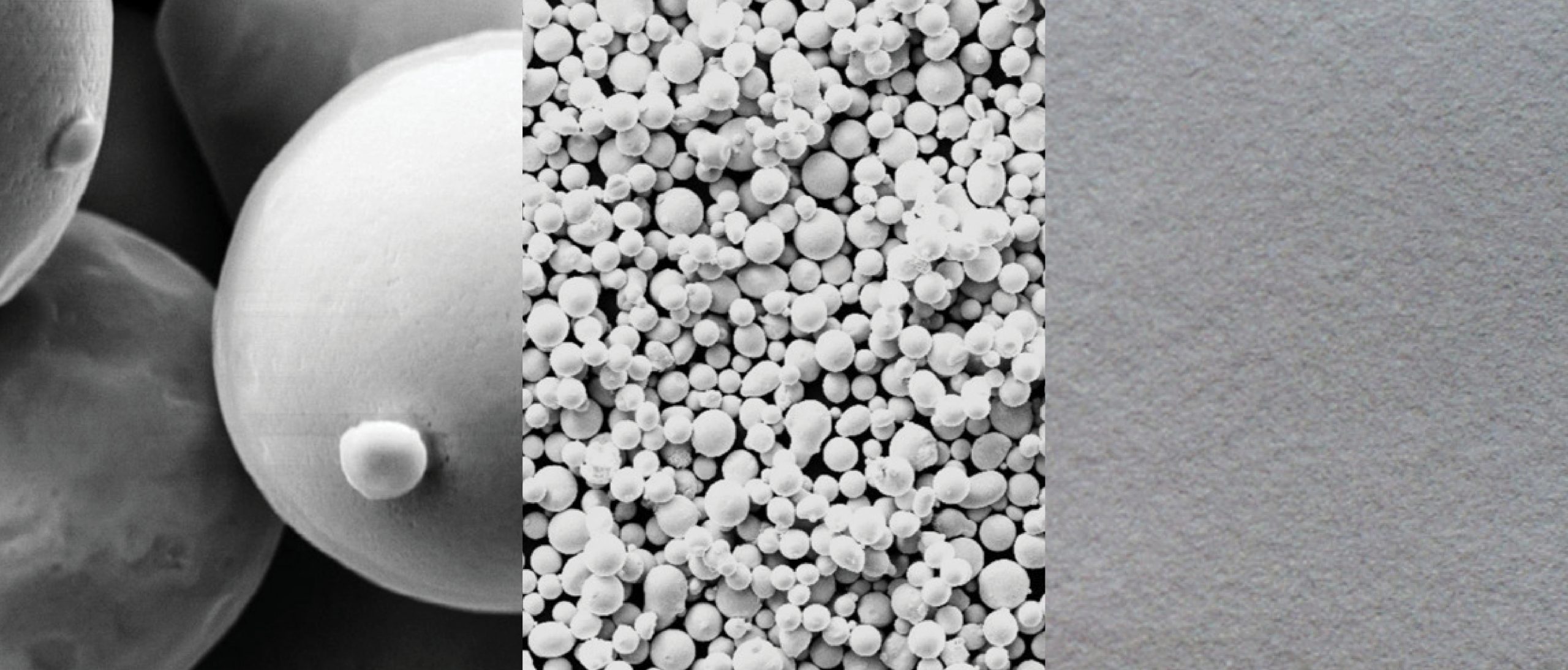
The Modelling and Simulation Research Group and collaborators have recently published a paper investigating a new high-entropy alloy (HEA). The team, led by Assistant Professor Mauricio Ponga, designed the material’s composition using atomic-level computer simulations to find an optimal mixture of elements. This novel material combines cobalt, chromium, iron, molybdenum, and niobium atoms. It was manufactured using an additive manufacturing technique called cold spray. “Cold spray is an additive manufacturing technique where particles are accelerated to velocities as high as 1000 m/s. Once the particles reach a substrate, they get deposited due to severe plastic deformation”, says Ponga.
The team found that the high-velocity impact of the microparticles generates dynamic recrystallization of its grains. This means that the material’s microstructure can be changed drastically due to the stresses developed during the impact. As a result, the novel material exhibits grains with various sizes ranging from billionths to millionths of a metre (~1 nm to ~1 micron). The resulting alloy is one of the strongest HEAs known. It is mechanically stronger than most alloys commercially available, including high-strength steels.
By understanding how material properties work at the atomic level, Dr. Ponga’s group is dedicated to finding new ways to develop and manufacture materials with specific properties. By using computer modelling to design materials at the smallest level, they are investigating what is essentially the creation of custom materials, tailor-made to fit specific applications.
The paper “Mechanical and microstructural properties of a CoCrFe0.75NiMo0.3Nb0.125 high-entropy alloy additively manufactured via cold-spray” can be found at https://doi.org/10.1016/j.jallcom.2021.162309.
APSC Rising Star Rachit Gupta: Nothing ventured, nothing gained: from structural engineering to multi-disciplinary engineering
“A calm mind is an ultimate weapon against your hurdles. And when you are calm, you have won half the battle.”
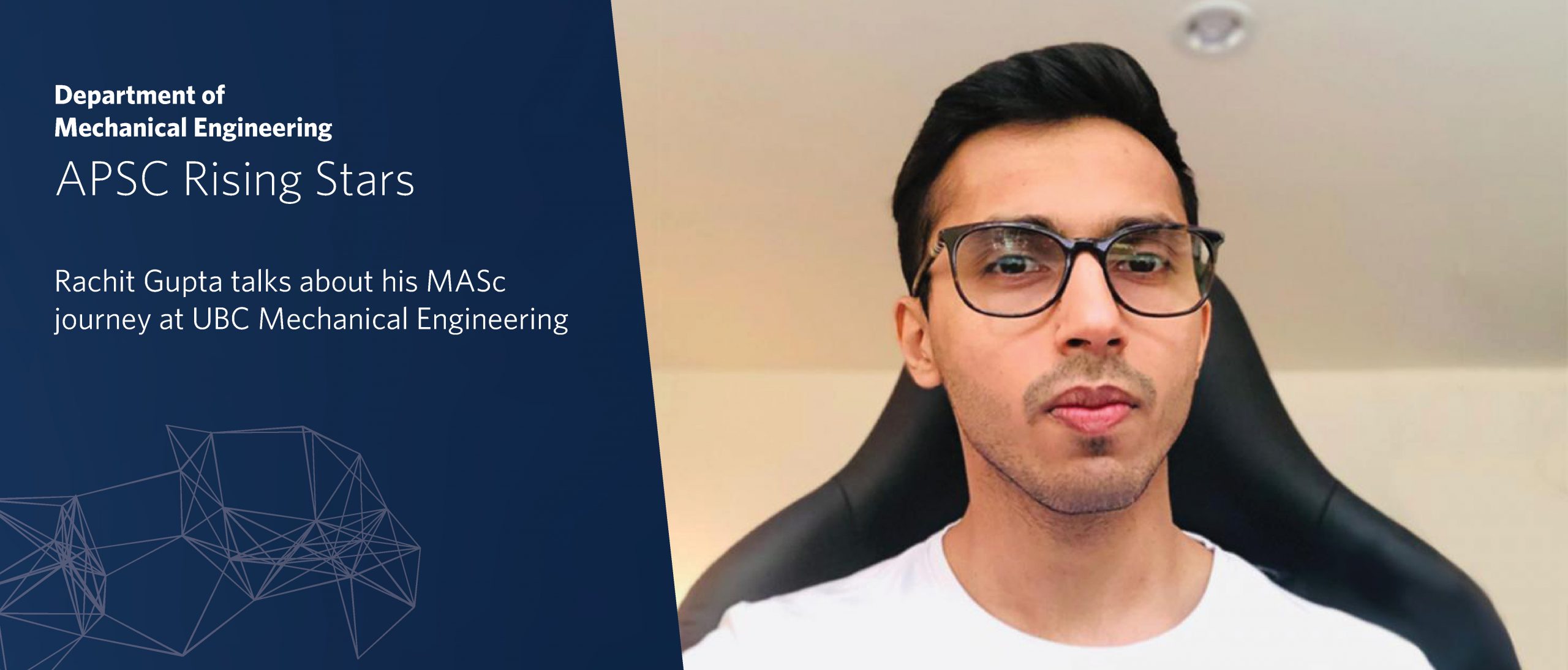
Rachit Gupta
Degree: Master of Applied Science
Grad year: 2021
Program: Mechanical Engineering
Campus: Vancouver
I graduated from Delhi College of Engineering with a Bachelor’s degree in Civil Engineering and am currently pursuing a Master’s degree in Mechanical Engineering at UBC under Prof. Jaiman’s supervision. I’m working on various research projects based on machine learning-enabled cognitive systems and bio-inspired designs for intelligent and green marine vessels (IGMVs). During my tenure at UBC, I have published journal articles and volunteered in many technical conferences such as APS, USACM, AIAA, etc. I’m also a co-founder of AvaShip, a spin-off company working on digital twin solutions to track and manage underwater noise radiation and its impact on marine mammals. Besides research and venture building, I also enjoy inspiring and motivating students through teaching assistant activities. In my spare time, I like to unwind at the gym or the tennis court.
Why did you choose to go into your field of study at UBC?
I closely followed Dr. Rajeev Jaiman’s latest development at UBC related to Artificial Intelligence in ship designs and flying vehicles which fascinated me! I wanted to contribute to his ideas that can foster Industrial 4.0 digitization and decided to connect with him. I was fortunate enough to be selected by Dr. Jaiman under the umbrella of Mitacs Globalink and NSERC fellowships to pursue this active area of research further.
What has made your time at UBC memorable?
There were many moments to cherish both in my professional and social life at UBC. However, one of the most memorable experiences I recall was publishing my first journal in Physics of Fluids and getting a lot of recognition for it from my peers.
Tell us about your experience in your program. What have you learned that is most valuable?
The most crucial takeaway during my program was that no matter how challenging the task is, it is essential to keep going and believe in yourself.
What advice would you give a student entering your degree program?
Be calm and patient, especially when things become overwhelming in your degree problem. There is nothing that can’t be solved. Break it down and take it one day at a time.
What are your future plans to make a difference in our world?
I want to develop tools to reduce the ship’s underwater noise and carbon footprint generated during propeller operation. I want to develop a digital twin technology that will help regenerate the marine ecosystem by protecting the underwater species from propeller noises.
Is there anything else about your degree experience you’d like to elaborate on?
During my degree program, I met many talented individuals from various backgrounds and parts of the world. They not only inspired me but introduced me to different cultures, traditions, and tasty cuisines.
Reposted from UBC Applied Science’s Student + Alumni Stars.