Media Mention: EGBC's Innovation Magazine features mask research by Dr. Steven Rogak

Media Mention: Delta Optimist shares SmellVan App – “What’s that Stink in Delta?”

DELTA OPTIMIST: Delta residents now have a new option if they smell something rotten in their neighbourhood.

A team of researchers from the University of British Columbia (UBC) recently launched a public web application called Smell Vancouver — or SmellVan, for short — that’s designed to track reports of odours throughout the greater Vancouver area.

The app was developed as part of a new research project that’s investigating odours and their potential health effects. It allows anyone to submit a report of an odour, from the mildly unpleasant to the downright pungent, using the app’s map.

Researchers receive NSERC Alliance grants for sustainable energy collaborations

Photo of Howe Sound by Erik Ringsmuth on Unsplash

Two faculty members at the Department of Mechanical Engineering have received NSERC Alliance grants to support their collaborations with local sustainable-energy companies. A relatively new initiative, the NSERC Alliance grants began in 2019, and aim to bring together academic and industry expertise, seeking to more quickly translate research results into wider use.

Dr. Walter Mérida has received an Alliance grant to facilitate his project “Hydrogen production via water electrolysis at high temperature and pressure” done in partnership with Carbon Engineering Ltd., a company based in Squamish, BC that specializes in carbon capture and carbon-neutral fuel technologies. Sustainably produced hydrogen can be used as a fuel itself, or combined with carbon captured from the air to produce carbon-neutral synthetic fuels that can be used in existing infrastructures. Learn more about this partnership in Mérida Labs’ video on carbon neutral fuel research.

Dr. Mauricio Ponga is working with Sea to Sky Energy Solutions Corp. on the project “Enhancing capabilities of Run of River facilities through computational modelling and experimental validation.” Sea to Sky Energy Solutions runs and manages Run-of-River hydro-electric power facilities, as well as creating technology and providing consulting services that support this type of power. Run-of-River facilities are more sustainable with a much smaller impact on salmon migration and water quality than reservoir-based electricity production that relies on large dams, but their power output is more variable due to fluctuating river levels.

The NSERC Alliance grants received by Dr. Mérida and Dr. Ponga facilitate local collaborations addressing problems with global impact, bringing sustainable energy solutions that much closer.

Read more about the over $6 million NSERC Alliance funding awarded to UBC Engineering projects.

Photo of Howe Sound by Erik Ringsmuth on Unsplash

Media Mention: Dr. Steven Rogak comments on the efficacy of wearing two masks

NATIONAL POST: Should we all be wearing two masks? What experts say about the latest COVID-19 debate. Some experts are considering whether people should wear two masks to increase the likelihood of protecting themselves from more transmissible COVID-19 variants.

Amid growing concern over vaccine deliveries and new reported cases of contagious COVID-19 variants, health experts are reemphasizing the importance of social distancing and of wearing a mask — or even two.

Chief public health officer Dr. Theresa Tam said on Feb. 2 that at least 148 cases of the variants that first emerged in the United Kingdom and South Africa have been confirmed across Canada, even as overall counts of new COVID-19 cases continue to decline.

Clean Energy Engineering: a holistic perspective for energy-sector leaders

As we find ourselves in the midst of the climate crisis – the drivers of which are linked to other global sustainability crises, including biodiversity loss, pollution and the current pandemic – there’s an urgent need for transformative change that acknowledges the interconnections between systems.

We see this in policy and planning discussions around the decarbonization of our energy sector that are now taking into account factors such as health, well-being and justice. Given the lifespan of engineering infrastructure, taking into account these long-lasting impacts of energy systems on our social well-being is critical. Our engineered systems are going to be around for decades.

MECH students design affordable, see-through full-face COVID respirator

UBC Engineering students have designed a full-face respirator that they claim is transparent, breathable and comfortable to use. The respirator protects against COVID-19 and other harmful particles, like wildfire smoke, and it is lightweight enough to wear all day, says the team. “At just 270 grams and $65, it’s slimmer and cheaper than other full-face respirators in the market today,” says lead designer Faheem Saeed, a fourth-year engineering student who conceived the technology during the early days of the COVID-19 pandemic.

UBC AeroDesign Places 1st at SAE Aero Design West

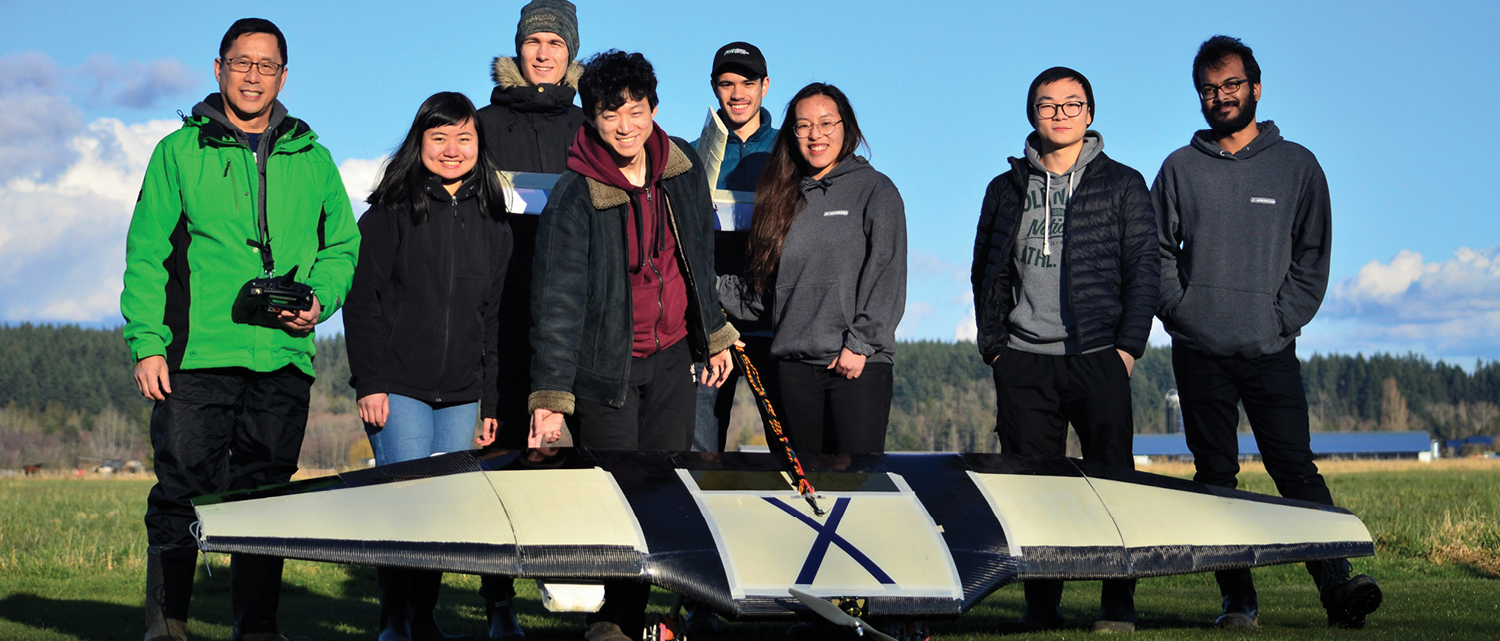
Team members gather behind their Advanced Class aircraft.

(UBC AeroDesign poses with their Advanced Class aircraft prototype before the shut down of in-person gatherings in March, 2020)
Despite a summer without many of the usual aspects of the design competition experience – such as access to the machine shop or the ability to travel – UBC AeroDesign has still brought home first and third place titles in the 2020 SAE Aero Design West.

While the in-person competition was cancelled (originally to be held in Texas), UBC AeroDesign was still able to present the culmination of their 2019-2020 design work at a virtual competition held on June 12th, 2020. The virtual presentations garnered them first place overall in the Regular Class category and third overall in the Advanced Class category. The team also won awards for the design report (first place in Regular Class) and the technical presentation (second place in Regular Class, 3rd place in Advanced Class).

The Regular Class mission challenges teams to design an aircraft to carry the most payload, represented by soccer balls and steel plates. With a 120-inch wingspan, 1000 watts of power, and 100 foot runway limitations, the team strived to reduce their plane’s weight while maximizing its payload capacity. The Advanced Class mission is designed to simulate colonization on Mars, with a variety of payload being released mid-flight, including autonomous gliders carrying table tennis balls (“colonists”). This was only the team’s second year competing in Advanced Class, and they had to both optimize aircraft performance as well as develop a reliable avionics system to accurately release their payload on target.

Led by the 2019-2020 team captains, Steven Zimmerman (BASc ’20, MECH) and Gabriel Robinson-Leith (4th Year, ENPH), the team pursed two novel designs: a bi-plane for the Regular Class aircraft, and a blended-wing-body for the Advanced Class aircraft. The 60-member team had the opportunity to build two prototype aircrafts and successfully complete three test flights prior to the shut-down of in-person campus activities in March.

At the SAE virtual competition, the Regular Class technical presentation was given by Zimmerman and Robinson-Leith, while the Advanced Class technical presentation was given by class leads Neil Farvolden (BASc ’20, MECH) and Zhaowei Huo (4th Year, ELEC).

The team expresses their gratitude to the supporters who enabled their success:

“UBC AeroDesign would especially like to thank our sponsors for their generosity, Mr. John Siu (Team Pilot) for flying our planes at test flight, and Dr. Carl Ollivier-Gooch (Faculty Advisor) for his support.”

Congratulations to UBC AeroDesign on their achievement, and their ability to rise above the unique challenges of competing in a design competition during a global pandemic!

 

UBC News: Is there something in the air? These UBC researchers want to know

We all know air quality can sometimes be imperfect. The smells and aromas produced by traffic, businesses and industry, and thousands—if not millions—of people living in close proximity can combine to produce an olfactory experience that’s less than pleasant.

Enter Naomi Zimmerman and Amanda Giang, a pair of UBC researchers who are studying the different scents that permeate Metro Vancouver. They’re seeking the public’s help to map this “smell scape” through a new odour tracking app, called SmellVan.