Student Group Funding Applications Now Open!

Student Group Funding Applications Now Open!

The Mechanical Engineering Department is now accepting student group funding applications. To download the application package, click here. The application deadline is October 10th at 11:59pm.

Please note that groups/teams must submit both an electronic and a hard copy to the MECH Student Services Office (CEME 2205). Late applications will not be accepted; however, hard copies will be accepted after the deadline so long as the electronic copies are sent to students@mech.ubc.ca on time.

To submit an application or if you have any questions, contact MECH Student Services at students@mech.ubc.ca.

Glenn Jolly receives 2017 President’s Staff Award

We are excited to announce that Glenn Jolly, Technician and Electronics Shop Supervisor, has been named a 2017 recipient of the President’s Staff Award!

This award recognizes the personal achievements and contributions that our staff make to UBC, and to the vision and goals of the university.

Glenn’s practical electronic and technical knowledge, and his every-day mentorship and advice to colleagues, undergraduate and graduate students alike, has had a transformative influence on the department.

Glenn is the unsung hero behind many undergraduate laboratories, graduate research projects, and in the delivery of outstanding education programs. His genuine passion for his work has created an outstanding learning experience of countless undergraduate student and graduate students in Mechanical Engineering.

Glenn regularly contributes to technical content in undergraduate curriculum and has had a hand in instrumentation aspects of most of the custom-built teaching lab apparatus in the department.

As an electronics and instrumentation shop technician, Glenn has established himself as the go-to instrumentation expert, not only with students, but also with professors outside of Mechanical Engineering.

Glenn’s expertise, developed from many years of practice, has helped countless graduate students and professors in successful research projects. He is a mentor to junior colleagues in the shop, and is the force behind undergraduate labs that earned Mechanical Engineering its reputation for excellence in teaching.*

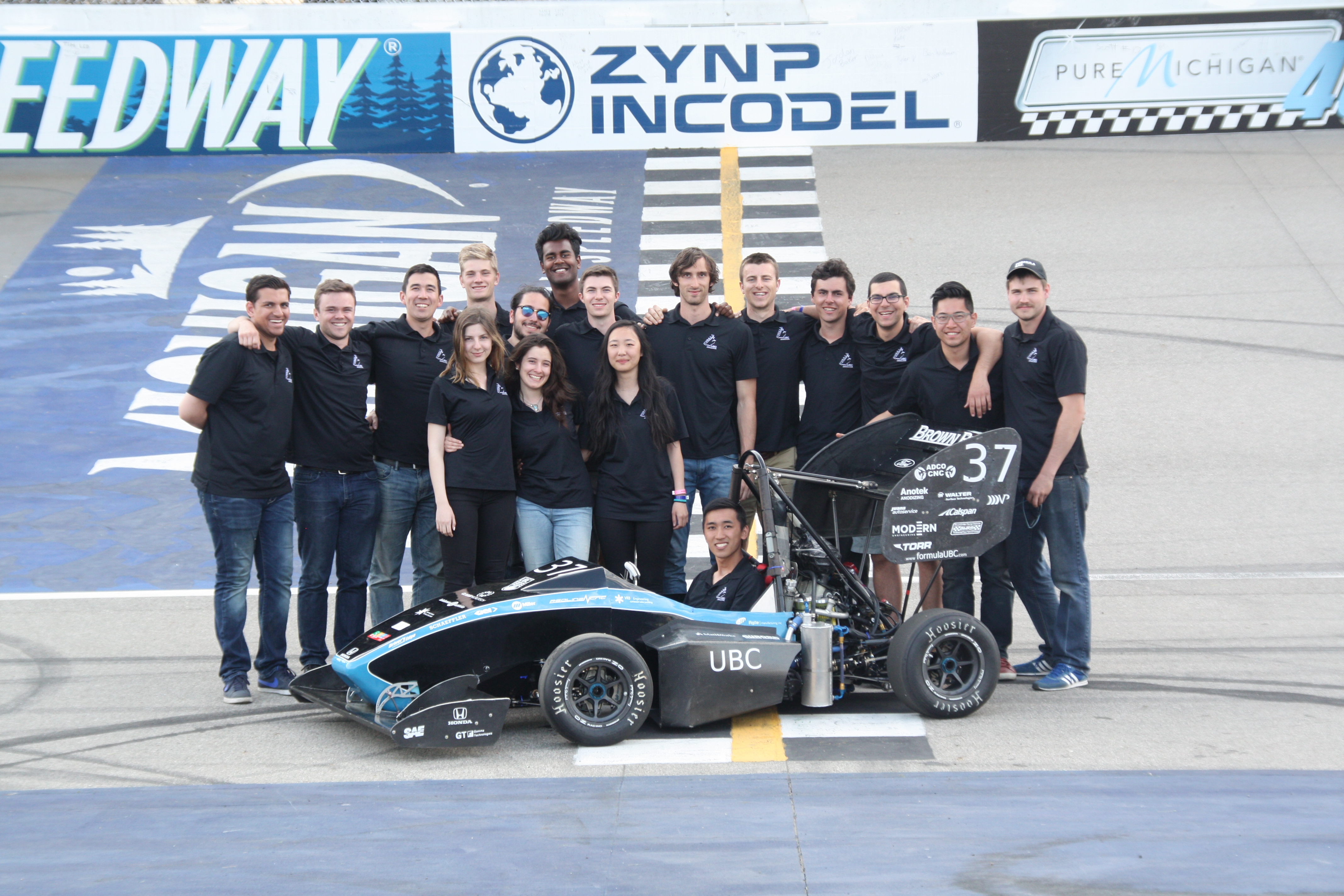
UBC Formula SAE Team Places 23rd out of 120 at Formula SAE Michigan

Submitted by the UBC Formula SAE team.

In May, the Formula UBC Racing team participated in the Formula SAE Michigan competition. The team secured 23rd place overall out of 120 teams.

The design goals for the 2017 competing race car included a drastic weight reduction which lead to a full redesign of the car’s primary sub-systems. Changes included a smaller chassis and a switch from 13” to 10” wheels. An incredible 70 lbs was removed from the previous year’s design resulting in a final weight of 447 lbs (without the driver). An example of the weight-cutting technologies implemented to aid in this aggressive weight target was the development of carbon fiber suspension components, which required extensive physical testing to validate strength.

Formula SAE competitions are comprised of both static and dynamic events. The static events include the engineering design presentation, the business presentation, and the cost event, in which the team placed 18th, 65th, and 91st, respectively. Dynamic results were as follows: 15th in acceleration, 22nd for skid pads, 23rd in autocross, and 30th for endurance. The team also placed 1st for their engineering drawings, which awarded them the Three View Drawing Excellence award for the second year in a row.

Due to a lack of time for suspension adjustments and practice, drivers had difficulty completing their autocross runs cleanly and with competitive times. Nearing the end of the event, the second driver took a more conservative driving style and ran a fast lap earning the team 23rd in the autocross event.

The team started the endurance race strong due to diligent preparation and tuning that took place before the event. Unfortunately, however, due to an overheating engine, it became necessary for the driver to slow down to preserve engine life. After 11km of racing and a successful driver change, the front brake rotors shattered due to the second driver’s continuous hard braking. The driver pushed through the race with only the rear brakes while still managing to finish 30th overall.

In the end, Formula UBC secured 23rd place at the Formula SAE competition in Michigan. The success was attributed to the innovative design concepts and quick problem-solving skills exhibited by the drivers and team members. The team plans to address the issues faced during the endurance race to reach their goal of finishing top 20 at next year’s Michigan competition.

The team would like to thank all the sponsors and supporters for such a successful year. The project could not be possible without them.

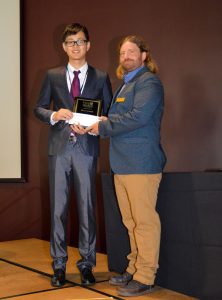
Gary Yan earns third place in the Aviation 2017 Student Paper Competition in Computation Fluid Dynamics

PhD candidate Gary Yan and his supervisor Carl Ollivier-Gooch recently received third place for their submission to the American Institute of Aeronautics and Astronautics (AIAA)’s Aviation 2017 Student Paper Competition in Computational Fluid Dynamics (CFD). AIAA is the world’s largest technical society dedicated to the study and profession of aerospace.

Yan presented his paper at Aviation 2017, a forum that aims to bring the aviation industry together to address both present and future industry challenges and to act as a venue for researchers to present on aircraft design, air traffic management and operations, and aviation technologies among other subjects. Their paper, “Applications of the Unsteady Error Transport Equation on Unstructured Meshes” is a numerical study of using the error transport equation to obtain higher order accurate discretization error estimates and corrected solutions is performed for unsteady compressible flow.

You can read Yan and Ollivier-Gooch’s paper here: Applications of the Unsteady Error Transport Equation on Unstructured Meshes

Smart Stimuli Responsive Surfaces: A Multifunctional Material


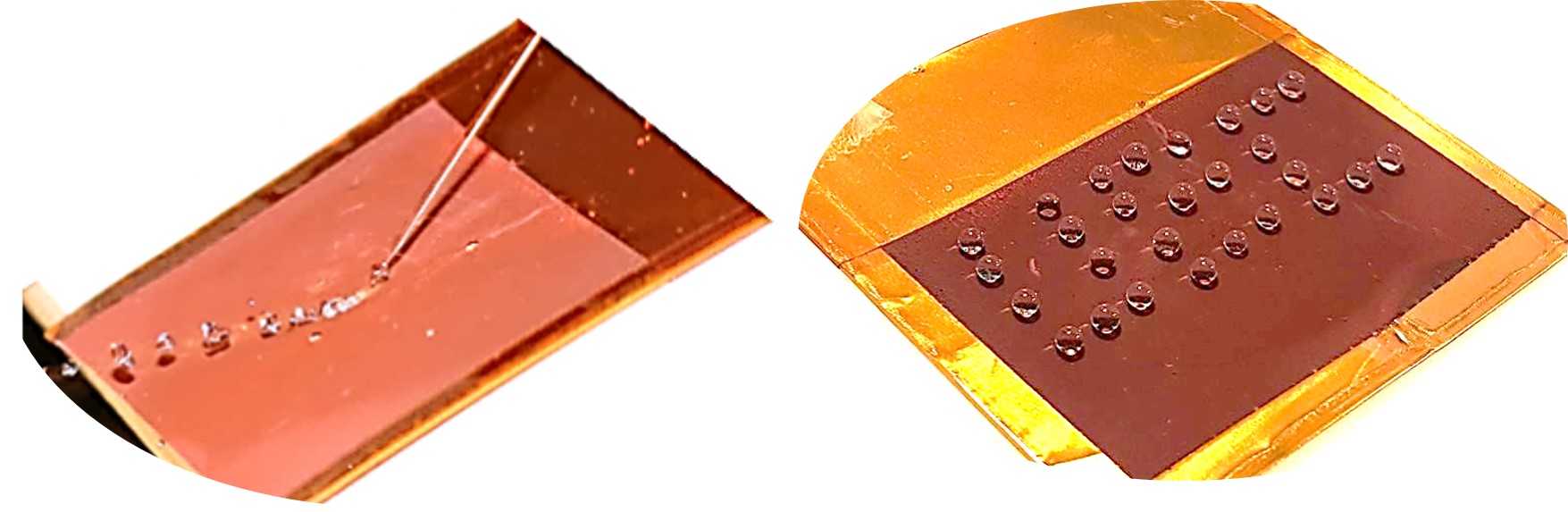
New research by UBC’s Clean Energy Research Centre has made the cover of Wiley’s most recent issue of Advanced Materials Interfaces. The article, which was co-written by Beniamin Zahiri, Pradeep Kumar Sow, Chun Haow Kung and Walter Mérida, discusses fast and reversible control over surface wetting properties–from superhydrophobic (water-repellant) to superhydrophilic (water-attractive) using a small voltage that could be supplied by conventional batteries. The elegance of the approach lies in the simplicity, preciseness and reversibility of the wetting manipulation. The smart material offers the flexibility and versatility to be applied in a number of applications, such as self-cleaning surfaces, smart filtration and microfluidic devices.

 
In nature, there are three different types of surface interactions with water: self-cleaning (e.g. lotus leaf), high adhesiveness (e.g. gecko foot) and water absorbing (e.g. peat moss). Scientists have found that such variation arises from the nanoscale features of these surfaces. Over the past decade, engineers and scientists in the field of biomimetics have developed self-cleaning glasses, water-repellent fabrics and oil-water separators for ocean cleanup. Dr. Mérida’s team has now created a smart surface using the inexpensive and controllable process of electrodeposition. The team found that by coating a surface with a thin (< 5 nanometer) layer of copper oxide and applying a low voltage (< 1.5 V, which can be provided by a standard battery), the thin oxide could be transformed into pure metallic copper, and the way the surface interacts with water could therefore be altered. During the transformation, the surface transitioned from lotus-type, to gecko foot-type, to the fully absorbent peat moss-type. This is the greatest range of transition that has ever been observed for a metal/metal oxide surface, and the rate and extent of the transition can be fully controlled.


These results have enabled a new field of research based on smart surfaces with metal oxides and nanoscale geometries. The team’s research shows that a small water droplet can be manipulated to collect solid particles on the surface (in lotus leaf mode) and deliver them to a specific location by applying voltage (in adhesive gecko foot mode). Such precise manipulation is important for biomedical applications where finite number of solid particles need to be mixed. The concepts illustrated by this work are also useful in the field of microfluidics, where control over the flow rate on a small scale can be achieved by changing the wetting properties of the flow channels.

 
The full article can be found here: http://onlinelibrary.wiley.com/doi/10.1002/admi.201700121/full

 
This research has also been featured in EurekAlert!, a publication by the American Association for the Advancement of Science: http://www.eurekalert.org/pub_releases/2017-07/uobc-sse072517.php


Newly formed UBC Rocket defeat MIT and McGill


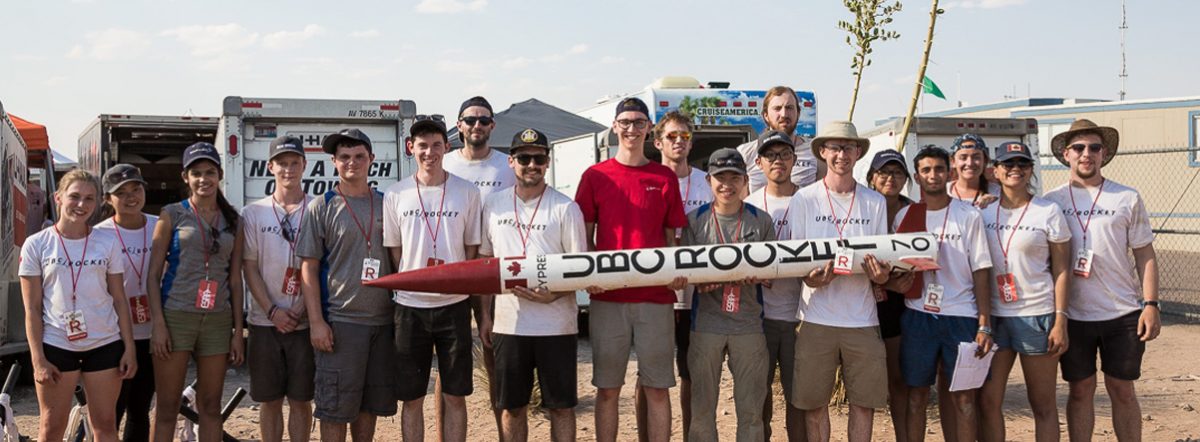
Competing in their first international competition, UBC Rocket hardly expected to take home a first place prize. One of 15 competing Canadian schools, UBC Rocket recently took part in the Intercollegiate Rocket Engineering Competition which ran from June 20 to 24 in New Mexico, USA.

The flagship event of the Spaceport America Cup, the competition challenges teams to design and build rockets. Teams are judged based on rocket innovation and functionality, as well as flight performance and other criteria depending on the event category. UBC Rocket received first place for their performance in the “10K – All Propulsion Types” category, wherein teams compete to launch their rockets to exactly 10,000 feet. Using a solid propulsion system, UBC Rocket was able to control the launch of their rocket to 10,053 feet, earning them first place over 50 other teams.

Construction of the team’s rocket, named Cypress after our local Cypress Mountain, began just over a year ago. Despite their relatively new status at UBC, the team has quickly grown to include over 55 active members, from four different faculties and seven engineering disciplines. The team hopes to repeat their success next year, and has set up a Crowdfundraising page to help recover the costs of this year’s competition and support future efforts. You can find their Crowdfundraising page here: UBC Rocket Goes to Competition

The team was also recently featured on CBC News, which interviewed Joren Jackson on the The Early Edition. You can hear Jackson’s interview, and watch Cypress’ launch here: UBC Amateur Rocket Team Beats Out Caltech and MIT


James Olson inducted into Canadian Academy of Engineering

Nominated and elected by peers, MECH professor and interim dean James Olson, PEng, was inducted as a fellow of the Canadian Academy of Engineering (CAE) in recognition of his “distinguished achievement and career-long service to the engineering profession.”

Olson joined 49 other new fellows and two new international fellows who were welcomed by the CAE on June 26, 2017 at a ceremony in Ottawa, in conjunction with the CAE’s 2017 Annual General Meeting and Symposium. The CAE is an independent, self-governing and non-profit organization established in 1987 to serve Canada in matters of engineering concern.

Olson’s CAE citation reads as follows:

Dr. James Olson is a visionary leader, pioneering researcher, and inspiring educator who has made transformative contributions to the forest products sector of engineering. As a direct result of Dr. Olson’s innovative research and patented inventions, the pulp and paper industry can produce premium pulp using half the energy, has access to more effective fibre separation and refining processes, and is able to measure key properties of fibres more accurately and efficiently. Dr. Olson’s honours include two NSERC Synergy Awards, two NSERC Discovery Accelerator Supplements, an APEGBC Meritorious Achievement Award, the BC Lieutenant Governor’s Innovation Award, and nine best papers.

Three other UBC faculty members were also among those inducted in the 2017 ceremony — Perry Adebar, PEng (Civil Engineering), Choon (Jim) Lim, PEng (Chemical and Biological Engineering), and ex-dean Marc Parlange, PEng (Civil Engineering). You can read their CAE citations.

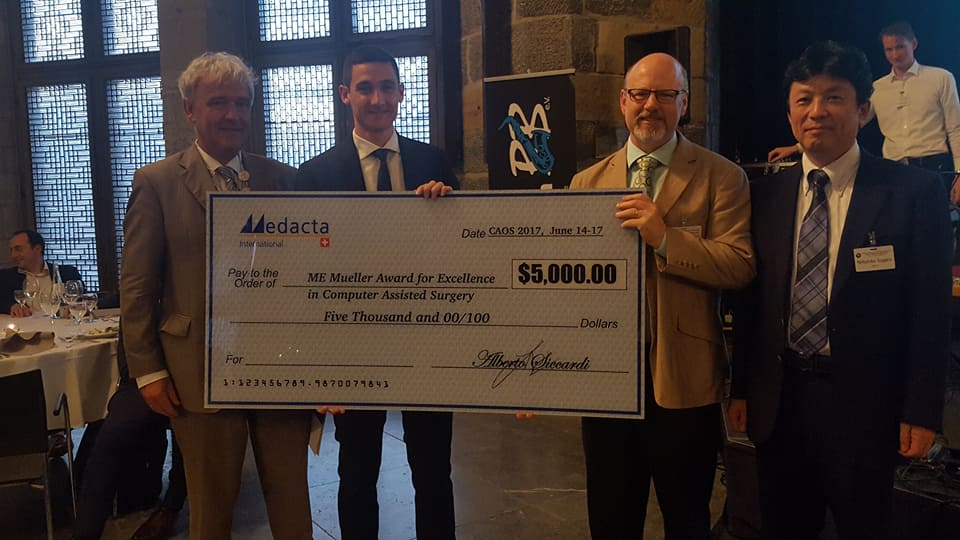
Antony Hodgson presented with the Award for Excellence in Computer Assisted Orthopaedic Surgery at CAOS 2017

Dr. Antony Hodgson, Director of the Biomedical Engineering Graduate Program and Professor in Mechanical Engineering, was awarded the highly reputable “Medacta ME Muller Award for Excellence in Computer Assisted Orthopaedic Surgery 2016-2017” at the CAOS 2017 conference. The conference ran from June 14-17, 2017 in Aachen, Germany.

The award recognizes a career long contribution to Computer Assisted Surgery, with achievements that have had a fundamental effect in advancing this research field.


Original story: UBC Biomedical Engineering

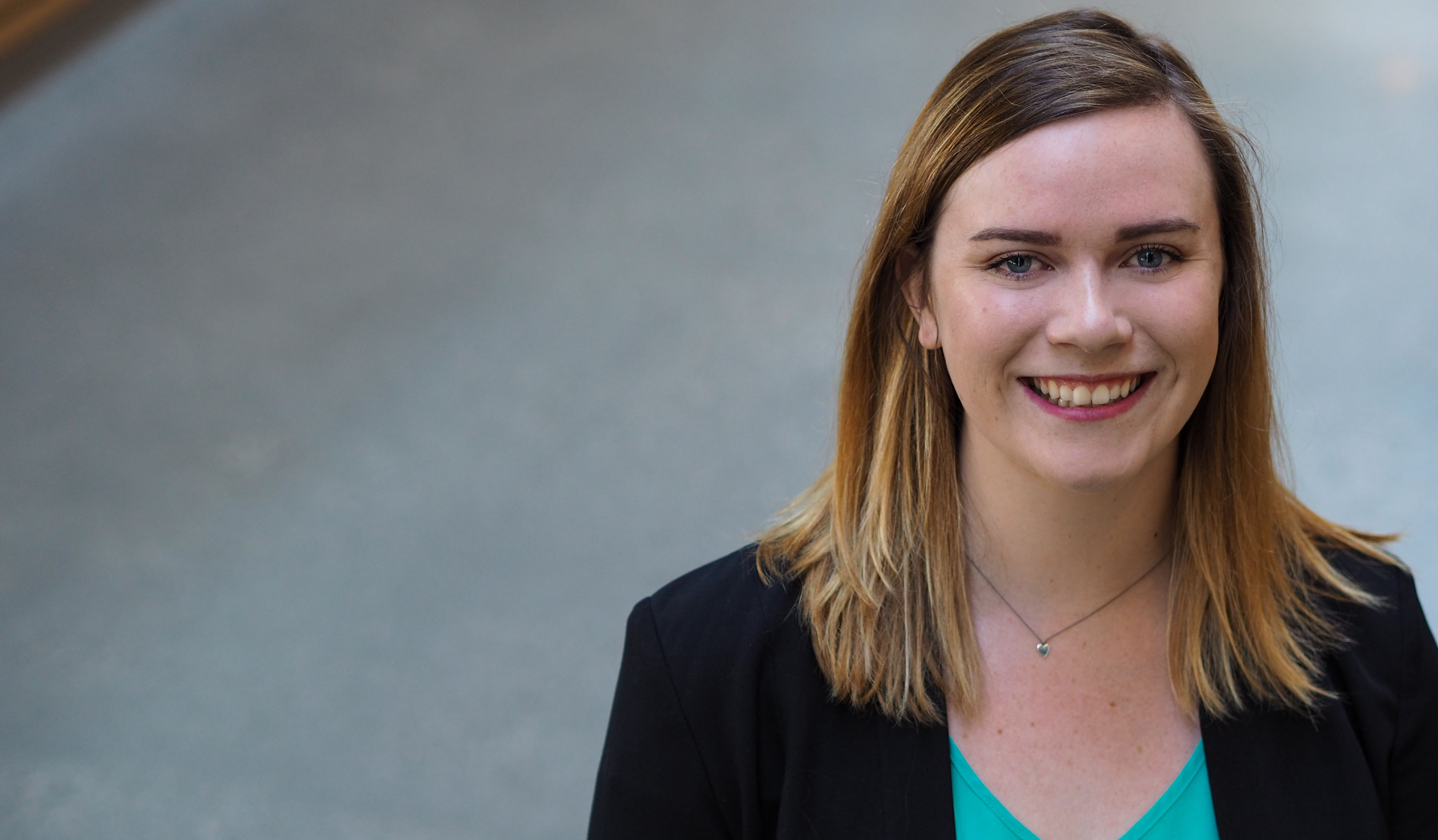
APSC Rising Stars 2017: Rebecca McCreedy, BASc ’17, MECH Alumna


Applied Science Class of 2017

“Engineering is a team sport. It’s daunting and tough on your own, but when you have a group of people to tackle it with it gets a bit easier.”

My name is Rebecca McCreedy, I’m a graduating student from the Department of Mechanical Engineering. I was a fairly involved student in high school, so when I came to university, I looked for ways to get involved in the UBC Engineering community. In my first year, I joined Alpha Omega Epsilon (AOE), UBC’s Engineering Sorority. Throughout my degree, I went on to hold multiple positions within the sorority, including Social Coordinator, Publicity Rep, Secretary, Treasurer, Vice President and eventually President in my final year. In my second year, I became involved with the EUS, becoming a Publicity Rep, which I continued until my fourth year, and started volunteering with eng∙cite at outreach events for high school girls. Over the next three years, my involvement with both the EUS and eng∙cite grew, until I was a member of EUS council, and working as Vlogger on the Engineering Stories YouTube channel for eng∙cite.

Why did you choose engineering?

I chose engineering because I liked math and science in high school, but also loved working on hands-on projects and solving problems. I didn’t really understand what engineering was until I did a project in my physics class where we had to make a bridge out of spaghetti and glue, which I loved, and ended up winning the competition. When I realized this was actually engineering, I started to do more research and I realized that the main aspects of engineering were exactly what I was looking for in my post-secondary education — problem solving and working to make a positive impact on the world.

What has made your time at UBC the most memorable?

The thing that has made my time at UBC the most memorable is the wonderful group of people I have been able to work and study with. I’ve met some really inspiring people who I know are going  to change the world, and it’s been so much fun to get to know them, learn from them and work with them. Through my involvement in AOE, I’ve been able to meet a wonderful group of women and have been able to have a strong support system throughout my degree, as well as be able to provide that support system to others. I’ve met some of my best friends in the whole world at UBC, who supported me through my time here, and who I know will be lifelong friends.

What have you learned that is most valuable?

Probably the most valuable thing I’ve learned throughout my studies at UBC is how to apply the various things I’ve learned to real world scenarios. In engineering, especially in mechanical, you learn the theory behind various every day concepts, but it’s only really in project scenarios that you get to learn how to use them. The theory courses end up being the tools you need to solve a problem, but the most valuable thing I’ve learned is how to use those tools effectively.

What has been your most memorable or valuable non-academic experience studying engineering at UBC?

The most valuable non-academic experience I have had at UBC is through my work as a mentor with eng∙cite. Especially over the last year, I’ve answered hundreds of questions from high school students, mostly girls, from grades 9-12. It’s been really fun to see the same faces show up at events over the year, and to give students more information on engineering as a degree, and UBC Engineering in particular. I feel so lucky to be a part of one of the biggest decisions in their lives, and I know I would have been immensely grateful for a mentor like that when I was in high school.

What advice would you give a student considering engineering?

The best advice I’ve heard while at UBC, and that I frequently pass on to high school students at outreach events is that engineering is a team sport. It’s daunting and tough on your own, but when you have a group of people to tackle it with it gets a bit easier. University, and UBC Engineering in particular, is a great time to find a group of people you connect with, whether it’s based on a common interest, a shared sense of humor, a sports team or a club you are involved in. Finding people you can hang out, study and go to class with really makes the day-to-day toughness of engineering a lot easier, because your friends will almost definitely have strengths where you have weaknesses and vice versa.  This is something I absolutely loved about engineering — everyone wants everybody else to get through, and people always take the time to help out someone who is struggling.

Where do you find your inspiration?

I find my inspiration most often from the people around me. My parents, friends, mentors and classmates are all strong, thoughtful, smart people who are doing amazing things in this world, and they drive me and support me in my efforts to make a positive impact on the community around me.

What are your plans for the future?

My plans for the future include taking a much needed summer vacation, and travelling Europe for June and July, something I’ve wanted to do for years. In August, I will come back to Vancouver to start work at Rokstad Power, a company I did co-op with, in a full time position. I’m also looking to start an Alumnae chapter of AOE in Vancouver, to keep in touch with everyone I’ve met through my years at UBC, and to continue to support the active AOE chapter at UBC. The goal with this chapter is to later expand this to a group for young professional women in male-dominated fields.

How will you go on to make a difference in our world?

I hope to make a difference in our world by continuing to drive for gender equality in engineering, first by continuing to support organizations such as eng∙cite, promoting engineering for high school girls, and also to extend this to the professional world, where women still face significant challenges. STEM outreach has been my passion project during my degree, and I hope to continue that passion when I’m out of university, in the working world.
 

More information: Student and Alumni Spotlights