Outstanding Entrepreneur: Miayan Yeremi, 31, a Mitacs PhD student in the Department of Mechanical Engineering at the University of British Columbia, and co-founder of Vancouver-based BarrelWise Technologies. Yeremi’s company has invented a breakthrough technology that provides winemakers with unprecedented automated information that lets them know exactly what’s going on inside each oak barrel in a wine cellar — a task typically done manually, and which a study shows can be conducted up to 74 per cent faster using the company’s technology.
New Frontiers in Research: Cannabis, Air Quality, Health and Community Impact

Cannabis cultivation in Canada: Assessing the air, health, and equity impacts of a growing and uncharted industry | Nominated Principal Investigator: Naomi Zimmerman, Co-Principal Investigator: Amanda Giang
On October 17, 2018, Canada became the second country in the world to federally legalize cannabis. Ten months later, the legal cannabis industry had grown by 185 per cent. Beyond the debates over retailers and dispensaries, cannabis is no longer a hypothetical premise in Canada but a large agricultural industry; however, many policymakers have little scientific data on its impacts on which to base decisions for their communities. Dr. Naomi Zimmerman and Dr. Amanda Giang, aim to address the lack of information around cannabis and industrial air pollution, by harnessing an innovative mobile lab, comprehensive data modelling, and strategic partnerships with national, provincial and civic organizations.
Often, civic governments interact with cannabis on the level of nuisance – a member of the community lodges a complaint about the smell near an industrial greenhouse – but as Dr. Zimmerman points out, odour is just one component of the emissions created by this new industry, emissions that we only know very little about:
Thinking from my air pollution background…[I wonder] what might those compounds be and what might happen to those compounds – if there’s sunlight, or other pollutants present? Do they stay as they are? Do they react with other pollutants in the atmosphere?”
Dr. Zimmerman and Dr. Giang, have recently been awarded a New Frontiers in Research Grant to study the air quality and health impacts of industrially growing cannabis. This $250,000 grant for high-risk, high-reward research will enable them to measure the terpenes and cannabinoids – emissions that off-gas from cannabis plants – and see if they if they further react to produce any pollutants that could affect the health of community members, and who might be most affected.
The pair are working with an interdisciplinary team that will allow them to directly create community impact with their work. They are joined on the study by co-applicant Dr. Sarah Henderson, Senior Scientist with the BC Centre for Disease Control and Associate Professor at UBC’s School of Population and Public Health, and are collaborating with Esther Berube and Julie Saxton at Metro Vancouver, and Angela Eykelbosch at the National Collaborating Centre for Environmental Health. Discussions with both the CDC and Metro Vancouver had identified the issue of cannabis-related emissions as an area of interest, and having engaged community partners in the construction of the study, Zimmerman and Giang are hopeful that the data generated will go back to the communities that helped generate it.
Beyond working with provincial and municipal institutions, the team will collaborate with the larger community. Using odour reports from the public to help create their sampling campaign, they will measure the compounds present by using the Portable Laboratory for Understanding human-Made Emissions, aka the PLUME van. The PLUME van is a mobile lab equipped to detect pollutants, and the NFRF grant allows the team to add specialized sensors for measuring the cannabis-specific terpenes and cannabinoids, and the pollutants they might create by merging with other components in the air. Combining the data from the PLUME van and the odour reports, the team can create a geospatial visualization framework that will give them a wholistic view of how and where cannabis-related emissions are affecting local populations. This will also allow them to address equity issues of whether certain segments of the population are disproportionately facing health impacts, whether through proximity or susceptibility.
Dr. Giang explains how the unique mechanisms of the NFRF allow for this research:
I think if we had pursued this research individually it wouldn’t have been as strong, as we would have pursued it from these separate angles. But now, we can integrate all these different data streams – and all these different holistic dimensions of this challenge – in a way where I actually think it’s going to be much more usable for decision making and for actually understanding the impacts in ways that matter to policymakers and also local communities.
The funding is also allowing undergraduates from a variety of disciplines to gain valuable research experience, as the team is joined by three students from Mechanical Engineering, Computer Science and Environmental Science who are helping to advance preparations.
While encouraging interdisciplinary collaborations, the NFRF program supports high-risk projects, allowing for outcomes to be uncertain. The team’s main goal in the next two years is to generate initial data, which can then be leveraged by potential policymakers, or expanded on by industry or international partnerships. “[This is] an opportunity for Canadian-specific research that could be really impactful,” Dr. Zimmerman explains. The project is responding to a current issue faced by Canadians and has the potential to contribute directly to local communities. “A lot of this is policy in progress; the policy is trying to catch up to where we’re at right now.”
Image by Richard T on Unsplash
Alumnus’ startup helps pharmacies with asymptomatic COVID-19 testing

In the fall of 2018, when Nicholas Hui was taking Applied Science’s New Venture Design course as part of his final undergraduate year in Mechanical Engineering, he had no idea he would co-found a company providing services in response to a global pandemic. The former AeroDesign Team Captain hadn’t considered a startup as his first career goal after graduation, but the course sparked an interest that would lead to his co-founding and becoming Chief Product Officer of MedMe Health, a software platform currently helping Alberta pharmacies deliver asymptomatic COVID-19 testing.
After graduation, Hui took part in Toronto’s NEXT 36 entrepreneurship program where he met business partner Purya Sarmadi. The two began envisioning a platform that would enable pharmacies to deliver unique services in an increasingly online world by leveraging their medical expertise. Seeking a pharmacist to complete their team, they were joined by Dr. Rui Su. Since, MedMe has won the $100,000 Grand Prize of startup incubator Velocity’s June 2020 Virtual Pitch Competition, and was also one of 15 out of 2500 start-ups selected as part of Wefunder’s Fight-the-Virus program.
In July 2020 Alberta opened asymptomatic COVID-19 testing to pharmacies, and the team quickly developed a new software module in response. Their COVID-19 Module supports the safety of pharmacists and the public by moving parts of the testing process online, such as screening and scheduling, so that the only thing done in-person is the test itself. By facilitating quicker testing, the software will support more accurate and timely identification of outbreaks. After releasing the module in early July, one of their first customers had 20 appointments booked within 24 hours of offering the service, and about one month later, pharmacies using the module have conducted an average of 140 tests each. MedMe will soon offer a flu-shot module, which will similarly reduce the time spent in-person during a time of high demand for both immunizations and COVID-19 tests. By facilitating influenza vaccination, they also hope to help reduce the load on COVID-19 testing due to the crossover of symptoms between the two illnesses.
While pharmacy care may seem like a field far from his undergraduate training, Hui is leveraging the skills he learned at Mechanical Engineering and UBC AeroDesign. Being a design team captain gave him project management, communication, fundraising, and leadership skills he has used in creating a startup. As MedMe’s Chief Product Officer, his “job is essentially to figure out what to build,” and he continues to use engineering design principles to identify needs and create solutions:
One of the coolest things about Mechanical Engineering is that there really aren’t a lot of rules – as long as you comply with basic standards, most things are up to engineers to learn, explore, and improvise on. This paired with the very challenging learning curriculum, many mechanical engineers including myself are very confident in being able to just pick up new topics outside our expertise and become very good at [them] very quickly.
New Publication on head impacts in American football by Dr. Lyndia Wu
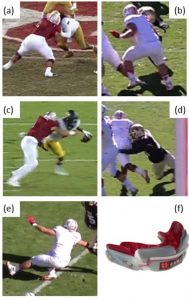 Mechanical Engineering Assistant Professor Lyndia Wu has co-authored a paper in the Journal of Biomechanics, “Analysis of head acceleration events in collegiate-level American football: A combination of qualitative video analysis and in-vivo head kinematic measurement.” Building off previous work she was involved in at Stanford University, the study looks at head impacts in football, combining impact measurements from a unique mouthguard containing accelerometers and gyroscopes with video capture of the impact event. By correlating the two, the researchers could see what kinds of impacts were causing specific head accelerations. Significantly, they found that that the forces on the head involved in direct helmet impacts were equal to the “inertial head loading” sustained through regular activities like blocking or tackling that would otherwise not have been considered as a significant contributors to brain injury. With the growing understanding of the role accumulated sub-concussive impacts play in brain injury, this study provides insight into under-recognized activities that may affect players’ brain health in American football. Co-authors include Gregory J.Tierney (University of Leeds), Calvin Kuo, (School of Biomedical Engineering, UBC), Dan Weaving (Beckett University), David Camarillo (Stanford University).
Read the full publication here.
Dr. Agnes d’Entremont Wins ASEE Outstanding New Mechanical Engineering Educator Award
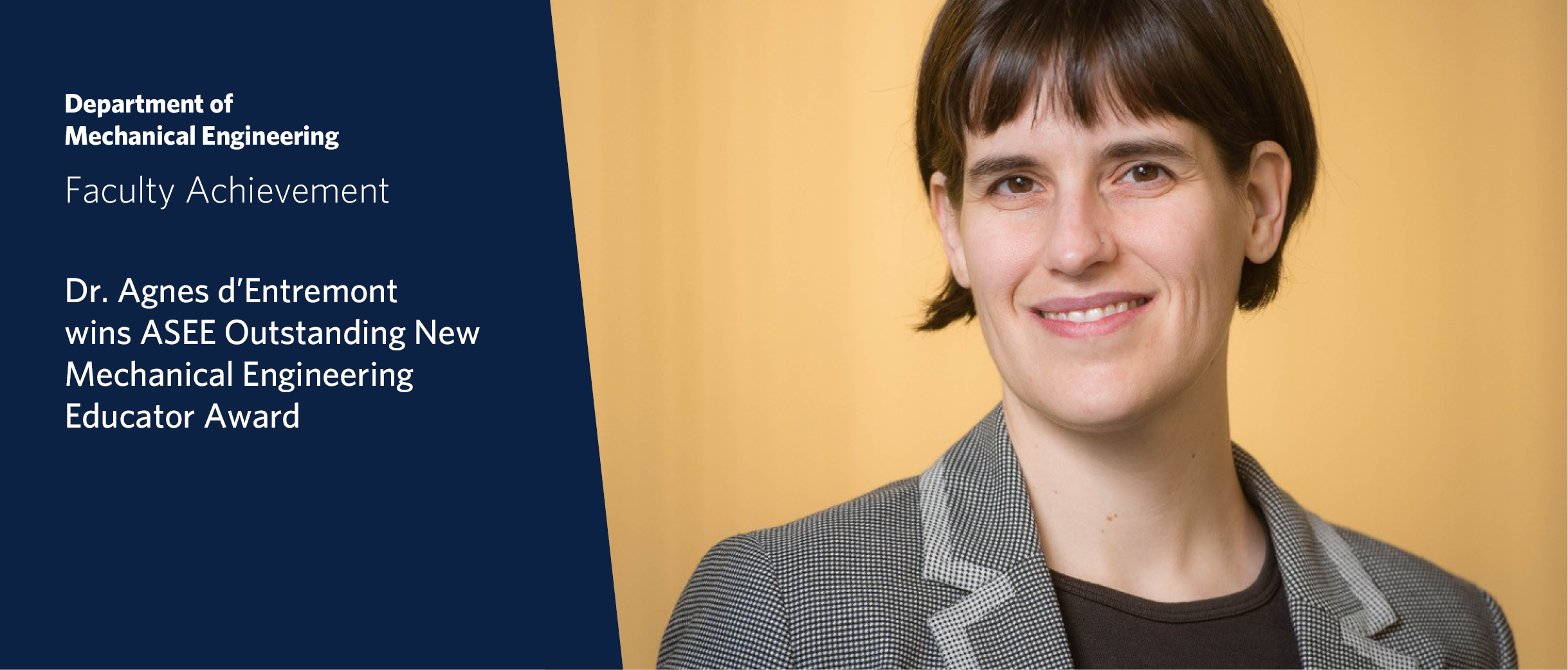
Dr. Agnes d’Entremont has been awarded the Outstanding New Mechanical Engineering Educator Award by the American Society for Engineering Education (ASEE). The organization’s Mechanical Engineering division selects the winner who is “an individual early in their mechanical engineering education career who has demonstrated the potential, effort and persistence to make sustained and exceptional contributions to mechanical engineering education.” The award was presented at their annual conference, held virtually on June 23. Founded in 1893, the ASEE is a large U.S.-based organization, which has 400 member Universities, colleges and technical institutions and over 12,000 individual members from the US, Canada, and internationally. This makes Dr. d’Entremont’s win particularly noteworthy, as it means her contribution has stood out amongst educators from across North America and beyond.
Recently recognized for her contributions to teaching at UBC, Dr. d’Entremont was awarded a 2019/2020 Killam Teaching Prize, one of UBC’s highest teaching awards, for her dedication to student learning, access to engineering education, and excellence in teaching.
New Frontiers in Research: Materials à la carte

Materials à la carte: Accelerating materials discovery with large scale ab-initio simulations and machine learning | Nominated Principal Investigator: Mauricio Ponga, Co-Principal Investigator: Jasmin Jelovica
When an engineer designs a new device – whether it’s an airplane or a ballpoint pen – an important consideration they must take into account is the abilities and limitations of their material. Now imagine the engineer could chose the properties they want their material to have, and design it to their needs. This is what a new project undertaken by Mechanical Engineering professors Dr. Mauricio Ponga and Dr. Jasmin Jelovica is attempting to make possible.
Dr. Ponga uses the analogy “Materials à la carte” to describe their goals:
Imagine yourself going to a restaurant, you take a look at the menu and you realize that you can design your order. Now, by combining different items in this menu you create a new dish. However, you quickly realize that what you ordered is not food, but rather a new material that is as strong as steel but five times lighter; or a new drug used to treat deadly diseases, and is specifically designed to be biocompatible with your body.
The pair have received a research grant from the competitive Government of Canada New Frontiers in Research Fund (NFRF) to advance their idea closer to reality. The $250,000 funding will cover two years of work, and is specifically focused on “high-risk, high-reward and interdisciplinary research.” Together with their Co-applicant, Dr. Chris Orvig from the Department of Chemistry, their expertise encompasses chemistry, mechanics, materials science, and computational physics.
The goal is to enable the quick design of new materials, but materials is a very broad subject. The study will focus on two types of material: structural, for building planes and buildings, etc., and molecular-level materials for use in medicine, specifically the creation of radio-isotopes that can be used for treating cancer. In order to create new materials from scratch based on their desired properties, the team needs to understand what causes these properties at the molecular level. Dr. Ponga explains:
To understand these things, you really have to know what is going on with these elementary players. How these atoms and molecules interact within each other. It turns out the mathematical expressions that dominate that world are the same independently, whether it’s lightweight materials, or structural materials, molecules or even living things, the equations are the same.
But, as Dr. Ponga notes, “the devil is in the details.” In order to understand how the interaction of atoms and molecules create different material properties the researchers will run large simulations using artificial intelligence, in particular deep learning and optimization algorithms, to explore different possibilities from the beginning – accelerating the process of material design, which has traditionally relied on making step-by-step increments.
Since the grant only covers two years of study, the team will be focusing on gaining an underlying understanding these molecular interactions work, and from there how they can be controlled and finally manipulated. The creation of new materials may lie after the scope of the NFRF study, but they will have laid the groundwork for future partners to take the information they have generated and use it to produce new materials – from biocompatible cancer treatments, as their partner in Chemistry aims to do, to enhanced structural materials that engineers could use to create the built world around us.
Image by John Mark Arnold on Unsplash
Dr. Peter Ostafichuk an Inaugural Fellow of the CEEA-ACEG

Mechanical Engineering faculty member Dr. Peter Ostafichuk was elected an inaugural Fellow of the Canadian Engineering Education Association (CEEA-ACEG). The organization announced the recipients at their virtual AGM on June 19, 2020. CEEA-ACEG created the title to recognize engineering educators who have made notable contributions to the field:
The designation of Fellow honours individuals who have demonstrated noteworthy service to engineering education, engineering leadership, or engineering design education through their work with CEEA-ACEG.
Dr. Ostafichuk has made innumerable contributions to engineering teaching at UBC and to the CEEA-ACEG as a member and presenter. His contributions to instructional leadership in the department and Faculty of Applied Science run deep, as he is the current Chair of First Year Engineering and former Mech 2 Coordinator, as well as a member of the team that developed this award-winning second year program that is the foundational bedrock of the UBC Vancouver Mechanical Engineering undergraduate program. He has been involved with the CEEA-ACEG for seven years, contributing as an author and presenter on over 20 papers, as a conference organizer and reviewer, and the lead of the Institute for Engineering Teaching.
As an educator, his teaching interests involve the areas of team-based learning, outcomes-based assessment, active learning, and team dynamics. As a researcher on engineering education, his interests span areas of equity, diversity and inclusion; educational technology; curriculum design; design education; accreditation; first year education; and student wellbeing. Previous honours for his work have included the Margaret Fulton Award, 3M National Teaching Fellowship, the Killam Teaching Prize, and the Wighton Fellowship.
APSC Rising Star: Paige Ngo, BASc ’20, Mechanical Engineering
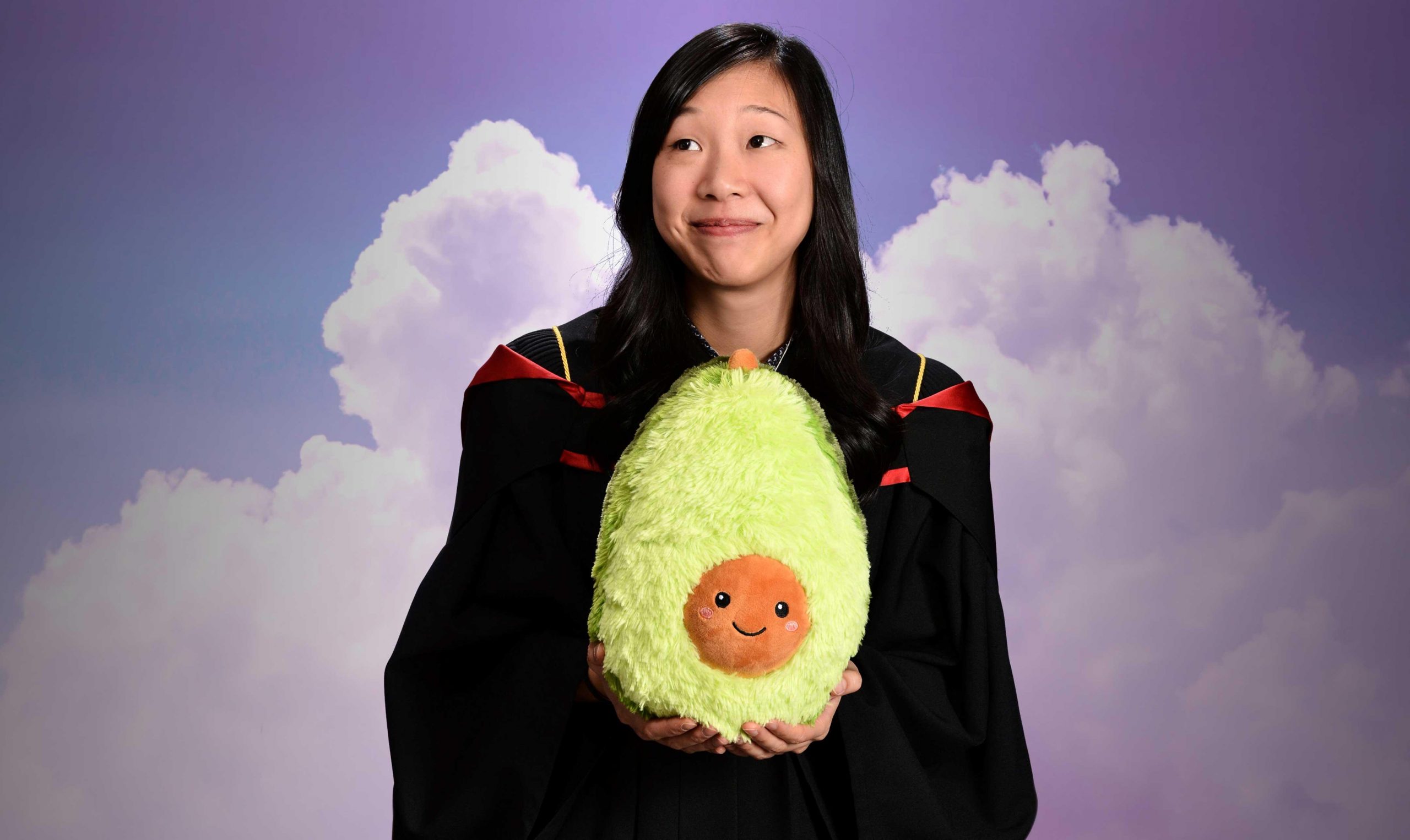
“The law of conservation of energy generally applies to your time at UBC. The amount of time and effort you put into a project will produce equal returns in terms of practical knowledge.”
My parents came to Canada as refugees and worked extremely hard to provide for me (for which I am eternally grateful), and while their struggle inspired me to work hard to achieve my goals, it also made me more aware of other people’s situations. This is why it’s difficult for me to write about myself when others are being systemically oppressed due to racism. We live in a time where climate change, pandemics and riots are rightfully on everyone’s lips. Writing about myself feels self-indulgent at a time when I believe we, as a society, should be focusing on defunding the police and reducing greenhouse gas emissions.
In lieu of writing a bio, here is a quote by Maya Angelou:
“Life is pure adventure, and the sooner we realize that, the quicker we will be able to treat life as art.”
― Maya Angelou
Why did you choose to go into your field of study at UBC?
I choose engineering to fulfill an ever-growing desire to effect change in the world, as cliché as that sounds. I count myself lucky to have found a degree that would both fuel my passion for design and provide me the tools to make a difference. Unfortunately, this realization came six years after I needed to make my initial choice after graduating high school. I had completed a bachelor’s in biology and spent a couple of years teaching English in Japan before I discovered I could build my ideas with a degree in mechatronics. I credit my British friend, Cherie, and a chance late-night conversation we had for this discovery. My decision to dedicate another five years to study and amass more debt was difficult to make, but in the end, I don’t have a single quark of regret.
What has made your time at UBC memorable?
Many of my fondest memories are from my time at UBC; designing and racing air balloons in MECH2, coffee meet-ups in Seedlings, Dr. Schajer’s homemade trifle, Gomenaspike winning the EUS Voll-E Ball tournament, brewing beer and playing DnD with friends, volunteering at the UBC Bike Co-op and Dr. Zimmerman’s smiles and continued support despite the COVID-19 crisis, to name a few. The common themes among these memories are the communities I belonged to and the MECH department’s caring professors. The communities you join will shape your experience at university and I owe much more than I could possibly write here to my 209 study crew, my Club Mech exec team, SUBC (UBC’s Submarine Design Team, pronounced “sub-sea”), the Femur Fracture Treatment Project team and the Bike Co-op for building me up to who I am today.
What has been your most valuable non-academic experience studying at UBC?
My most valuable and rewarding non-academic experience would have to be captaining SUBC, a student design team. The balancing act that is juggling coursework and student team involvement pushed my time management skills to its limits. I feel much more confident as a leader and in my ability to manage a large project after fulfilling this role. It taught me that the best motivation is the kind your team members derive from themselves; I’ll always ask new members what they want from the experience and what I can do to help them achieve that. Taking on leadership roles is worthwhile, because it affords you the opportunity to meet some of the brightest and most ambitious students of every year group. The strongest relationships you’ll form are with the people who share your passion, and as an engineering student, you will not find people more passionate about their trade than in student teams — at least, that was my experience. Even if you don’t have a winning design, maybe you’ll learn to scuba dive, get to swim with your project or have a cross-country road trip that you’ll remember forever.
Tell us about your experience in your program. What have you learned that is most valuable?
My time at UBC was quite varied in the assortment of roles I filled: a co-op in APSC’s Professional Development department, a UBC Bike Co-op board of directors member, a submarine pilot for SUBC and president of the Mechanical Engineering Club. My key takeaways from my studies, internships and student team roles are that design is an iterative process and that your message is meaningless if you don’t tailor it to your audience. You learn that design is iterative as early as APSC 100, but its importance cannot be stressed enough. Perfection in design can never be achieved, but the more iterative cycles you complete, the closer you’ll get. Test and break your design early and intelligently so that you can learn from it and fix it before it’s too late. In design, if you don’t clearly define the problem you are trying to solve, your design is bound to miss its mark. The same goes for how you communicate. From sending out cover letters to improv theatre, understanding the people you are communicating to should not only dictate what you say, but how you say it.
What advice would you give a student entering your degree program?
You get as much out as you put in. The law of conservation of energy generally applies to your time at UBC. The amount of time and effort you put into a project will produce equal returns in terms of practical knowledge. This applies most to personal projects and student teams because you are in control of what you want to learn and you are not rewarded with (at times arbitrary) grades. Your professors will do their part in drilling you with theory, but working on personal and extracurricular projects will do the work of forcing an understanding of said theories in context and building your core engineering skills such as problem solving and design. One of the most important skills an engineer should have is ‘learning to learn.’ This is developed when you are forced to seek an answer out on your own accord.
How do you feel your degree has benefitted you compared to a different field of study?
Mechatronics engineering is special in just how broad and applicable it is, especially in today’s increasingly digital world. It gives you the skills you need to understand how things work on every level, from the mechanics — the muscles and skeleton that ground things in reality — to the electronics —the magic smoke capsules and angry pixies that make things tick — to the software — the brains of the operation. I have seen so many of my peers take different inspirations from the mechatronics program and choose different career paths. It’s exciting to think of the ways I’ll be able to apply my knowledge in the future.
Where do you find your inspiration?
I was lucky enough to have several mentors throughout my degree. During my time on SUBC (the UBC submarine design team), I had in-person advisory meetings with Dr. Chris McKesson. I have not met anyone so passionate and well versed in their area of expertise of naval and marine engineering — his excitement was truly contagious. As a co-op employee in the Professional Development department, Elise Goodreault was my manager. In the ways that she supported me and my growth in the role, she remains to this day my gold standard for managers. Nicolas Unick is the mentor that I was paired with during the APSC mentoring program in second year. Despite having graduated, I still reach out to him for technical and career-related matters. Finally, I am most thankful and inspired by my partner, Simon Honigmann. He is currently pursuing a master’s in robotics and has always inspired me to be the best engineer and person I can be.
What are your immediate and/or long-term plans for the future?
My immediate plans are to continue leveling up as an amateur artisanal sourdough baker, and to continue cooking dishes from a different country every week with my partner (this week was an Iranian pomegranate chicken dish called khoresh-e fesenjoon with kabocha as chicken substitute, served with tachin, a crispy saffron rice cake). I am also helping to design an interactive installation that presents real-time air pollution data as part of the team in the ATTA collective.
What are your future plans to make a difference in our world?
This is a challenging question, because there are so many pressing issues in the world right now and I’m predisposed to find the one where I will be able to make the largest impact. I have, however, always been a strong advocate of environmental sustainability. Climate change, being an ever-present crisis even in an era of crises, is a defining factor in my future career choices. I do not believe that technology alone will solve any of the current world’s problems, but I do hope that my designs will make it easier for the everyday person to make sustainable choices. I plan to focus on end-of-life design so that products are reused more readily and whose materials have take-back programs. As agriculture plays a major role in sustainability, I am also looking at career opportunities in agro-tech in the hopes of producing more local and resource-light farming.
This article originally appeared in APSC Rising Stars.