Andrea Palmer named one of BCBusiness' 30 Under 30

Andrea Palmer named one of BCBusiness’ 30 Under 30

Andrea Palmer, founder of Awake Labs, was recently named among BCBusiness’ 2017 30 Under 30.  This award recognizes young entrepreneurs who are excelling professionally, are innovative in their industry, and who are giving back to others and the community.

A prominent theme among the 2017 winners is the passion to make the world a better place, something that Palmer certainly aims to do with the creation of the Reveal. Starting out as a university project during her undergraduate degree, the Reveal is a wearable device that has gained Palmer national recognition. Designed to measure stress indicators, such as heart rate and skin temperature, and transmit the data to a smartphone app, she hopes to use the device to monitor signs of anxiety, specifically in children with autism or other neurological disorders.

This year’s winners will be recognized at the 2017 BCBusiness 30 Under 30 event on Thursday, April 13th, 2017 at the Vancouver Club.

Congratulations Andrea Palmer!

You can read more about Palmer and  the 30 Under 30 Awards at: BCBusiness

Wondering how Andrea Palmer got where she is now? Follow the history of Awake Labs through our various stories on Palmer and Reveal:
Andrea Palmer, Founder of Awake Labs, Receives Startup Canada’s Young Entrepreneur Award (September 2016)
UBC Engineering Alumni Team Up to Help Families Cope with Autism (April 2016)
Dr. Elizabeth Croft and Alumna Andrea Palmer Win Wendy McDonald Awards (April 2016)
MECH Alumna Andrea Palmer Joins Innovation Hub, Makes Headlines (February 2016)
Mechanical Engineering Student Wins GIC (April 2015)
UBC Supermileage demo new prototype on Global News, hope to win upcoming Shell Eco-marathon

UBC student student team Supermileage was recently featured by Global News for the creation of their sustainable car prototypes. The team is currently prepping for the upcoming 2017 Shell Eco-marathon, held in Detroit, USA that draws participants from universities all over the world. In the feature, MECH students and Team Co-captains Jocelyne Boone and Jonathan Marr share with us a little about the car’s design process, as well as their performance goals for their current prototype. The team hopes to make a comeback at this year’s competition, having come up with a new car design from scratch.

You can watch the full feature by following the below link:
UBC students represent BC with sustainable car prototypes at international competition

Engineering student team places second in national design competition

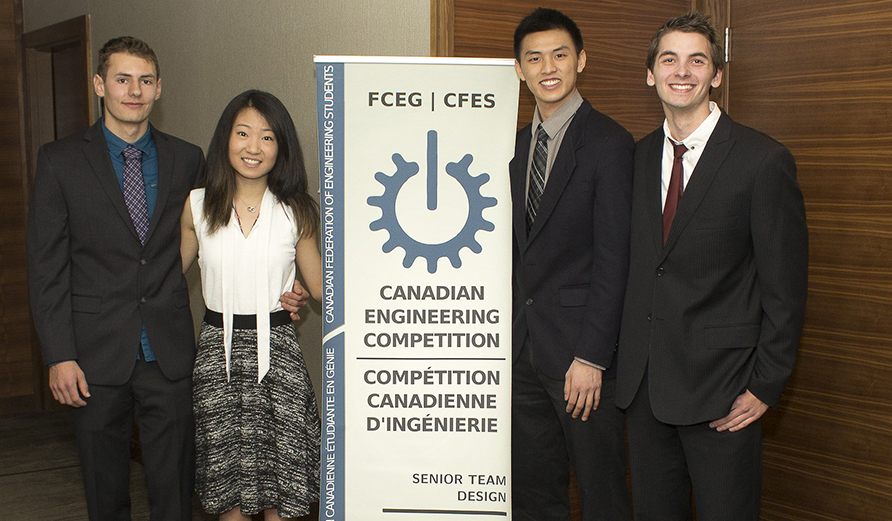
A team of four engineering students — Andrew Dworschak (Engineering Physics), Connor McFadyen (Mechanical), Allan Ng (Mechanical Engineering) and Jenny Yang (Engineering Physics) — won second place in the Senior Design category at the Canadian Engineering Competition on March 2-6 in Calgary.

The Senior Design competition challenges teams to design and construct a working prototype to complete a given engineering objective. The tasks are designed to test the competitors’ knowledge in design theory, technical skills, time management and teamwork. This year’s challenge was called Nuclear Meltdown: a nuclear facility had a malfunction, causing it to constantly release fuel cells (represented by water balloons). The team challenge was to build a robot (Bluetooth or wired) that could collect and bring the fuel cells to containment zones, activate a kill-switch and finally return back to safety in 2.5 minutes. The students were given ten hours to design, build and test the prototype before a final presentation to a judging panel.

“Having had previous experience with VEX robotics kits and Arduino programming, our team felt quite prepared to take on the given task this year!” said Jenny Yang. “Although we ran into quite a few challenges during the design process, we remained adaptable and determined, allowing us to power through in the end! Since I grew up in Calgary, it was great to go home and compete on familiar soil. I had an extremely rewarding experience with both my Senior Design team, as well as the rest of the UBC!”

The students first competed together in 2016 under the Junior Design category, where they placed fourth. This year, they wanted to make a comeback and are very pleased with their second place win.

Congratulations!

Original story from: APSC News

Dr Peter Ostafichuk selected as a recipient of the Margaret Fulton Award


Congratulations to Dr Peter Ostafichuk (a.k.a. “Dr. Pete”), recipient of the 2016/2017 Margaret Fulton Award!

On March 6, 2017, UBC announced the recipients of the Margaret Fulton Award, an award granted to an outstanding individual who has made a contribution to student development and the university community in honour of Dr Margaret Fulton’s commitment to university access and student learning. Dr Fulton was a distinguished educator in elementary, secondary, and post-secondary education. She served as the Dean of Women at UBC and University President, Mount Saint Vincent University in Halifax.

As a professor of teaching, Dr. Pete’s primary focus is on teaching and academic leadership. He is an advocate of Team-Based Learning and other innovative teaching approaches. Described as a “catalyst for change in engineering education”, Dr Pete is the recipient of other notable teaching awards, including the 3M National Teaching Fellowship and the Killam Teaching Prize. He is also the current Chair of First Year Engineering, and was instrumental in the creation of the MECH 2 program.


Dr. Yusuf Altintas named one of UBC’s Distinguished University Scholars

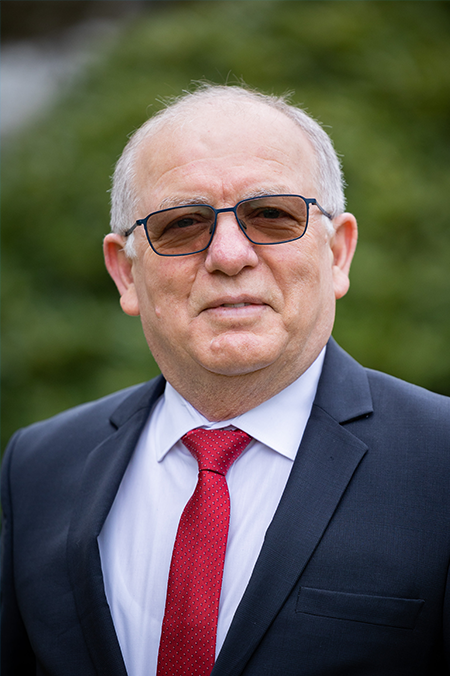
Professor Yusuf Altintas headshot

Professor Yusuf Altintas

MECH professor Yusuf Altintas was recently named a UBC Distinguished University Scholar (DUS) for 2016.

Each year, the Distinguished University Scholar (DUS) program recognizes exceptional faculty members who have distinguished themselves as scholars in research, teaching and learning. This distinction is granted for five years, and is renewable once, and includes a one-time $20,000 research award and a $20,000 per annum salary stipend, payable for the duration of the award period.

Dr. Altintas joins ten others, from across a wide range of departments and programs, who will be acknowledged at the Annual Research Awards on April 5, 2017.

Congratulations Dr. Altintas on this prestigious award!

Click here for the full list of this year’s Distinguished University Scholars.

Tiny magnetic implant offers new drug delivery method

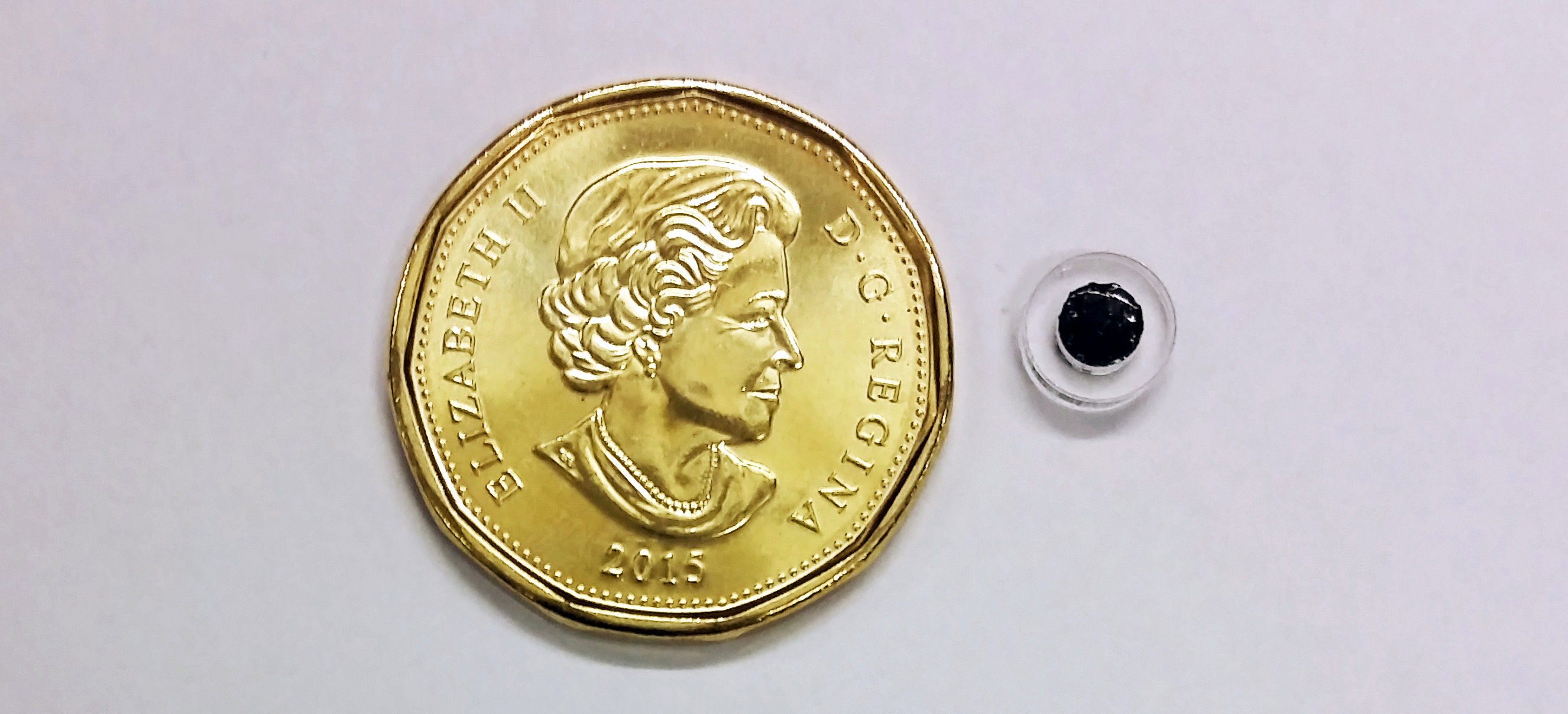
Size of the magnetic implant compared to the Canadian one-dollar coin

Size of the magnetic implant compared to the Canadian one-dollar coin. Credit: UBC

University of British Columbia researchers have developed a magnetic drug implant—the first of its kind in Canada—that could offer an alternative for patients struggling with numerous pills or intravenous injections.

The device, a silicone sponge with magnetic carbonyl iron particles wrapped in a round polymer layer, measures just six millimetres in diameter. The drug is injected into the device and then surgically implanted in the area being treated. Passing a magnet over the patient’s skin activates the device by deforming the sponge and triggering the release of the drug into surrounding tissue through a tiny opening.

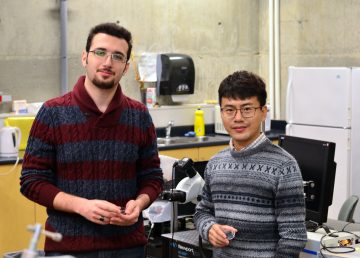
Ali Shademani and co-author Hongbin Zhang

Ali Shademani and co-author Hongbin Zhang

“Drug implants can be safe and effective for treating many conditions, and magnetically controlled implants are particularly interesting because you can adjust the dose after implantation by using different magnet strengths. Many other implants lack that feature,” said study author Ali Shademani, a PhD student in the biomedical engineering program at UBC.

Actively controlling drug delivery is particularly relevant for conditions like diabetes, where the required dose and timing of insulin varies from patient to patient, said co-author John K. Jackson, a research scientist in UBC’s faculty of pharmaceutical sciences.

“This device lets you release the actual dose that the patient needs when they need it, and it’s sufficiently easy to use that patients could administer their own medication one day without having to go to a hospital,” said Jackson.

The researchers tested their device on animal tissue in the lab using the prostate cancer drug docetaxel. They found that it was able to deliver the drug on demand even after repeated use. The drug also produced an effect on cancer cells comparable to that of freshly administered docetaxel, proving that drugs stored in the device stay effective.

Mu Chiao, Shademani’s supervisor and a professor of mechanical engineering at UBC, said the team is working on refining the device and narrowing down the conditions for its use.

“This could one day be used for administering painkillers, hormones, chemotherapy drugs and other treatments for a wide range of health conditions. In the next few years we hope to be able to test it for long-term use and for viability in living models,” said Chiao.

“Active regulation of on-demand drug delivery by magnetically triggerable microspouters” was recently published online in the journal Advanced Functional Materials. Click here to download a copy.

Photos and video: Flickr

Original story from UBC Public Affairs.

Congratulations to our Outstanding Undergraduates!

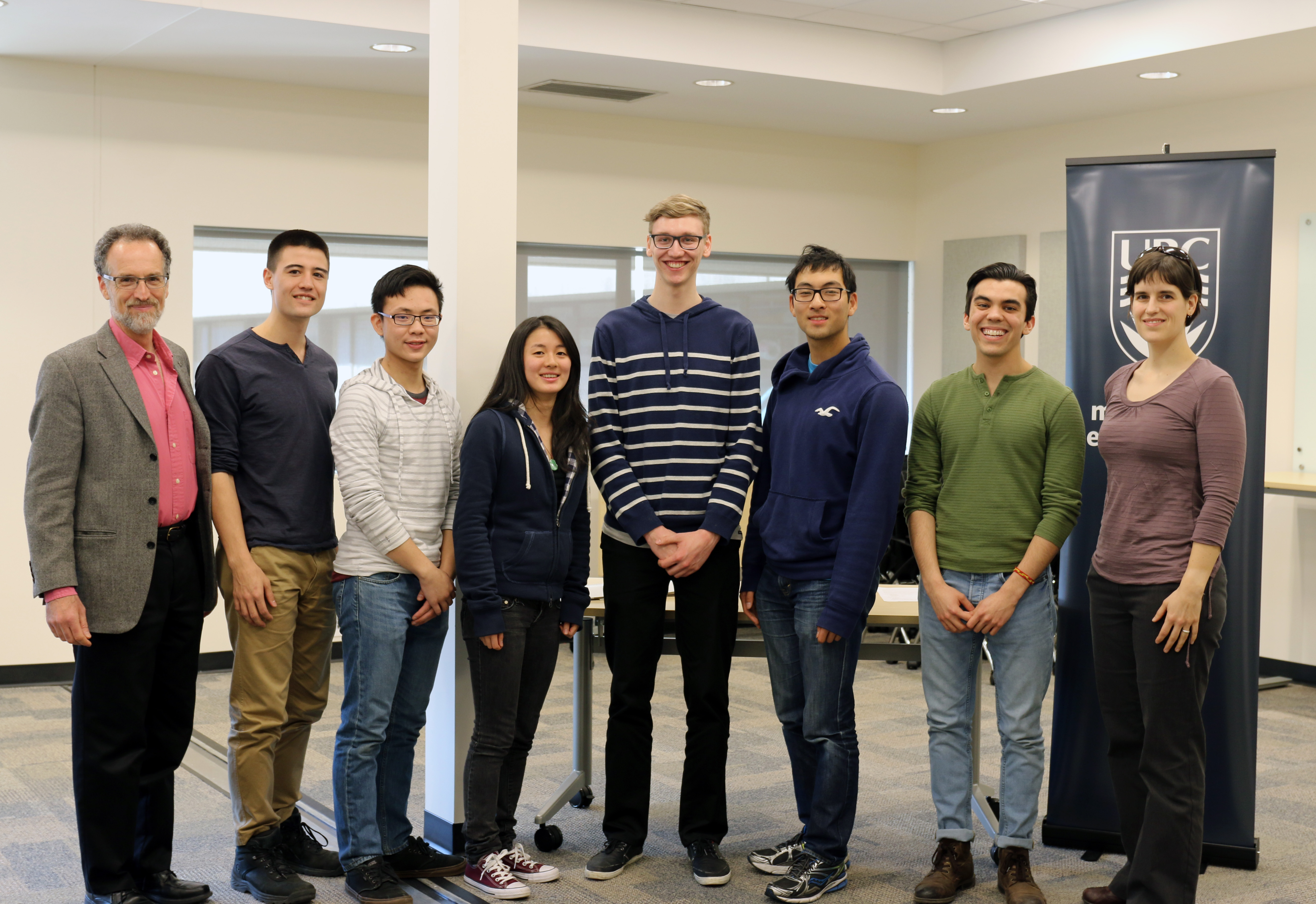
Group of outstanding undergraduate students

On February 1st, 2017, the department of Mechanical Engineering recognized nine undergraduate students who excelled during their time in the MECH 2 program.  The following students achieved an over 85% average in their second year studies:

Riley Aldis
Kye Arbuckle
Jenny Chu
Carter Tung Yung Fang
Anthony Jun-Shiang Hsu
Jose Francisco Martinez Castro
Alexander Bruce von Schulmann
Kevin Ta
Raymond Yu

Please join us in congratulating these exceptional students!


MECH alumnus Matt Harper named one of BIV’s Forty Under 40

Matt Harper, MECH alumnus and co-founder of Avalon Battery, was recently named one of Business In Vancouver’s (BIV) 2016 Forty Under 40. This award was created to recognize the achievements of BC’s young entrepreneurs, executives, and professionals who have demonstrated excellence in business, judgement, leadership, and community contribution.

After graduating from MECH in 2000, Harper started off his career by interning in the clean-tech sector at Ballard Power Systems before eventually becoming a product manager at VRB Power Systems (now Prudent Energy), and later the vice-president of product management and marketing.  In 2013, he and a number of colleagues decided to leave Prudent Energy in order to start up Avalon Battery, where Harper is now the chief product officer. Specializing in end-user focused sustainable energy storage solutions, Avalon Battery is currently developing a turnkey energy storage system.

This year’s winners were honoured at the 2016 Forty under 40 gala dinner, which was held on January 25th, 2017 at the Vancouver Convention Centre.

Congratulations Matt Harper!

BIV created a feature on Harper.

MECH 2 students recreate historic Cassini mission

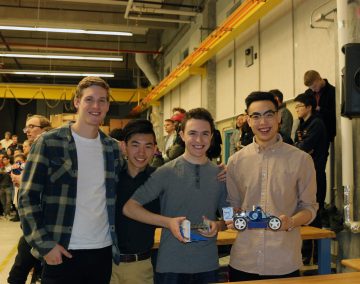
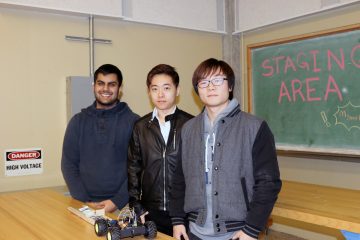
The winning team, B4Electronics, competing with their "spacecraft", Orange is the New Black .

The winning team, B4Electronics, competing with their “spacecraft”, Orange is the New Black .

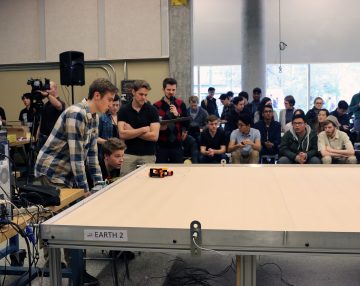
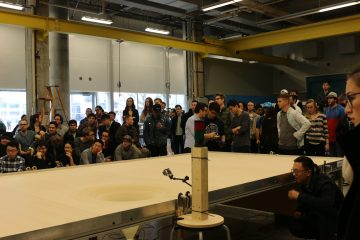
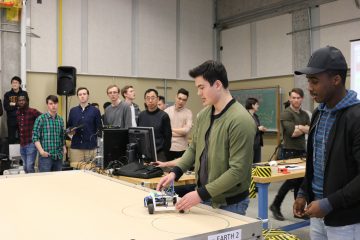
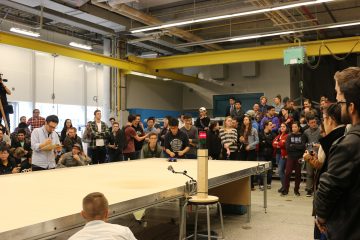
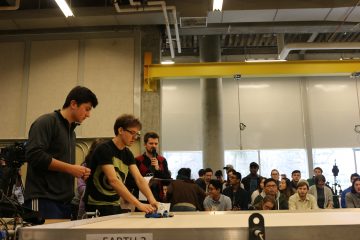
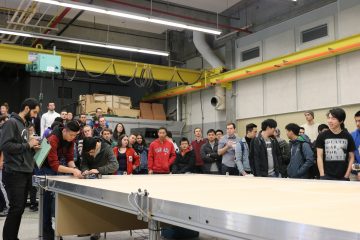
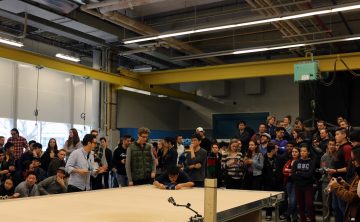
Wednesday, January 25th, MECH 2 students took part in the annual MECH 223 design competition. This year, students were asked to recreate NASA’s historic 2005 Cassini mission — a mission that successfully landed a probe on Saturn’s largest moon Titan. As part of this simulation, students had to design a 3D printed Launcher and an autonomous Orbiter spacecraft capable of deploying a set of standard Landers — or probes.

Represented by balls, 20 teams had to shoot their probes across a 160 square-foot table and have it “orbit” around the fake Titan, which was simulated by a funnel. Each team was timed and graded on the machine’s ability to shoot three different-sized balls into the funnel (or Titan’s orbit).

CBC Vancouver, Global News, and the Discovery Channel were also on site to cover the event, as well as to conduct interviews with some of our professors and student teams. When asked about by CBC about the learning outcomes of this project , MECH 2 Coordinator Dr Agnes d’Entremont stated that the goal of the project was to teach students the need to minimize costs, consider weight restrictions, while ultimately ensuring maximum performance ability.

The winning team, B4Electronics, received the overall highest score with their “spacecraft,” Orange is the New Black.

See more about the competition here as well: Global News, Surrey Now


More photos from the event can be found here: MECH 2 Design Competition: Titan Endurance

Distinguished alumnus Jay Drew receives the CSCE-CANAM Innovation Award

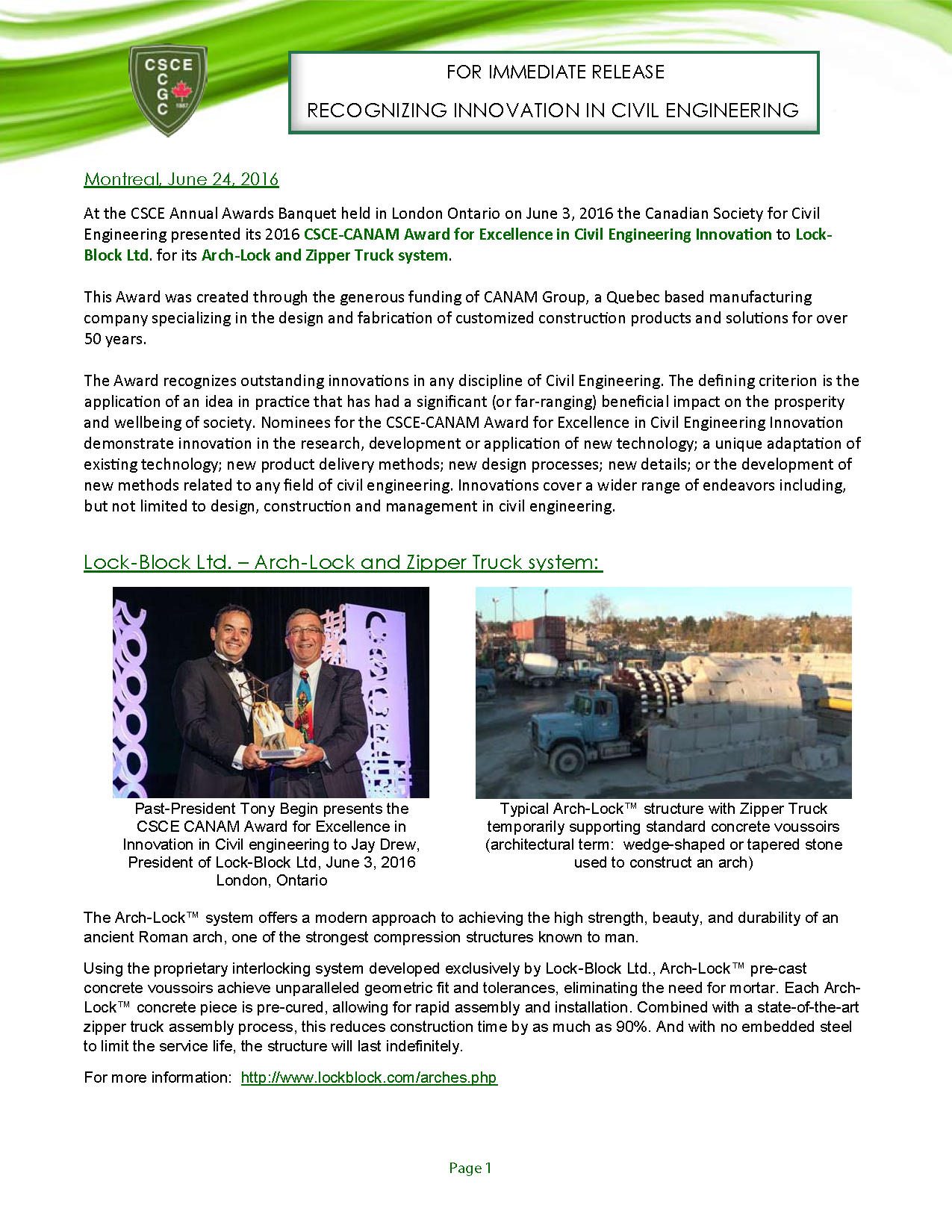
On June 6, 2016, at the Canadian Society for Civil Engineering (CSCE) Annual Awards Banquet, MECH alumnus James (Jay) Drew received the CSCE-CANAM Award for Excellence in Civil Engineering Innovation on behalf of Lock-Block Ltd for their Arch-Lock and Zipper Truck system. Presented to an individual or group, the award recognizes an outstanding innovation in the field of civil engineering that has had a significant beneficial impact on the prosperity and well-being of society.

President of Lock-Block, Jay has received may awards and recognition for his community service and dedication to community projects, such as the Governor General’s Caring Canadian Award, the R.A. Mclachlan Memorial Award, and the CBC Golden Heart Award. During his involvement with the Tetra Society chapter in Vancouver, Jay has been responsible for “creat[ing] dozens of devices to help the disabled lead easier and more self-sufficient lives. He has donated thousands of hours to crafting unique solutions to many problems.”*

Congratulations to Lock-Block on their achievement!

The full details of the award and more about the Arch-Lock and Zipper Truck system can be read in CSCE’s press release below.


CSCE’s press release CSCE’s press release