VGH Research Institute: “Sport-related head injury is a significant health concern that can lead to harmful effects down the line, such as permanent brain injury. Research led by Vancouver Coastal Health Research Institute researcher Dr. Lyndia Wu and Ahmad Rezaei used a novel computer vision algorithm to create a head injury baseline that could help protect sports participants from short- and long-term negative outcomes from head impacts.”
Alumnus Martin Nielsen to receive 2022 Dean’s Medal of Distinction
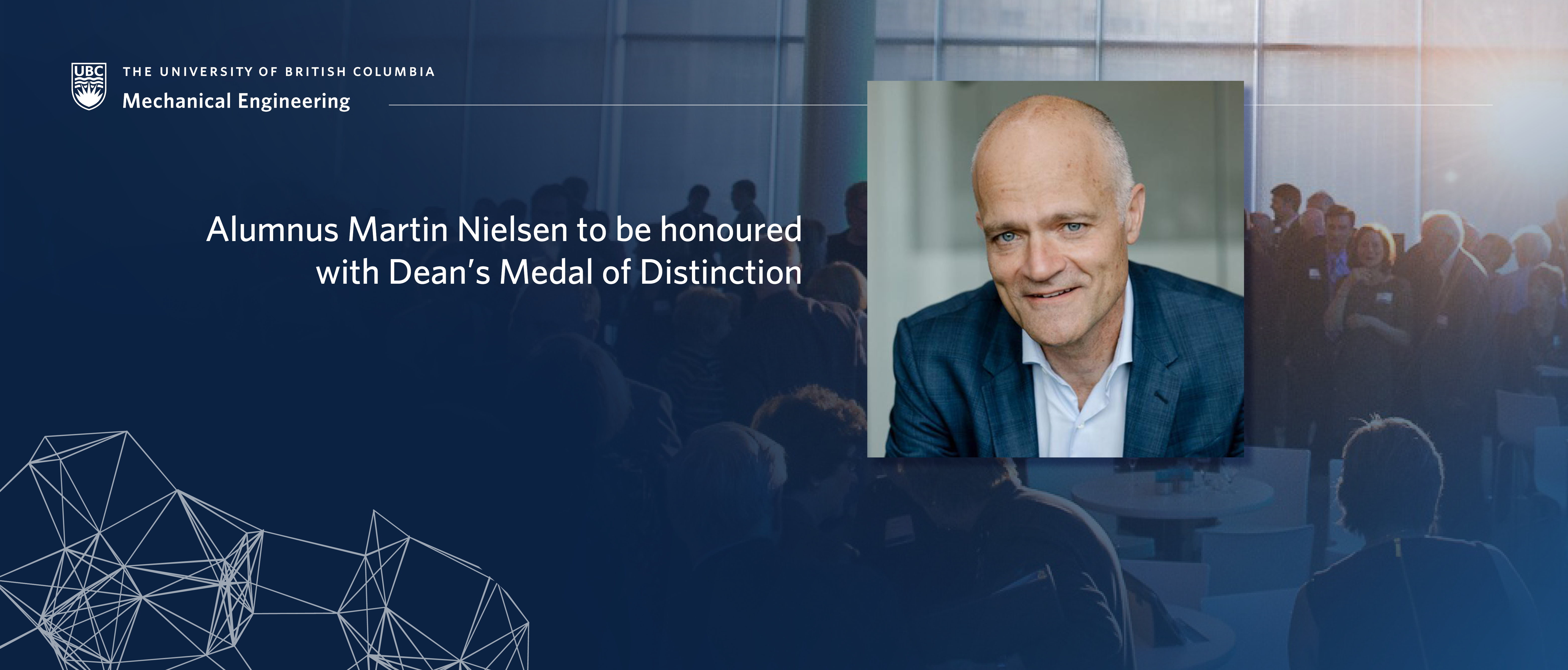
The Faculty of Applied Science has announced the recipients it’s 2022 Dean’s Medal of Distinction, and Mechanical Engineering alumnus Martin Nielsen is one of the industry members to be honored with the medal. The medal celebrates members of the APSC community for “contributions to advance the faculty’s vision, mission, and mandate, and for their exemplary work in one of our member disciplines…,” and recipients include alumni, faculty members, and members of industry.
Holding two degrees from UBC Applied Science, Nielsen graduated with a Bachelor of Applied Science in Mechanical Engineering in 1986 before continuing on to complete his Master of Architecture at UBC’s School of Architecture and Landscape Architecture (SALA). He is currently a Partner at interdisciplinary architectural firm DIALOG, which designs elegant, high-quality, sustainable buildings across Canada – including UBC’s AMS Student Nest. With DIALOG, Nielsen has worked on notable UBC design projects including the LEED® Gold certified Campus Energy Centre, and the new Exchange Residence and UBC Bus Exchange. Previously, Nielson’s contributions to the Vancouver campus also included the Centre for Interactive Research on Sustainability (CIRS), one of the greenest institutional buildings in North America, and a LEED® Platinum certified and Living Building. As well as shaping the UBC skyline, he has contributed to the university as chair of the UBC Advisory Urban Design Panel, and as an instructor at SALA and UBC Engineering.
Applied Science will host it’s annual Applied Science Celebration on November 1st, when it will honor the 2022 medal recipients. For event information, please get in touch with alumni@apsc.ubc.ca.
MECH research on underwater acoustics featured on JASA cover
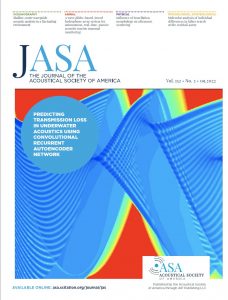
The September issue of the Journal of the Acoustical Society of America featured a new publication by UBC Mechanical Engineering researchers. Postdoctoral researcher Dr. Wrik Mallik, Associate Professor Rajeev Jaiman and Assistant Professor Jasmin Jelovica are the authors of the recent publication, “Predicting transmission loss in underwater acoustics using convolutional recurrent autoencoder network.”
Their work explores using a data-driven deep-learning technique called a convolutional recurrent autoencoder network (CRAN) architecture to model underwater signal transmission loss within the complex ocean environment, in which acoustic transmission is affected by geometric spreading, refraction, and reflection from the surface and bottom. The team demonstrate that the CRAN is successful at learning these physical elements, and its ability to predict this complex acoustic behavior could be developed into real-time far-field underwater noise prediction with potential applications for marine vessel decision-making and online control.
Read “Predicting transmission loss in underwater acoustics using convolutional recurrent autoencoder network.” at DOI: https://doi.org/10.1121/10.0013894.
Statement regarding protests in Iran

The Department of Mechanical Engineering joins UBC and the Government of Canada in standing with the women of Iran and all Iranians fighting for women’s rights in response to the death of 22 year old Mahsa Amini. We stand with our Iranian students, staff and faculty members who are experiencing trauma and distress, who are fighting for their freedom from gender-based violence and persecution, and those who fear for their loved ones and cannot reach them due to internet blackouts. The ability to speak out is fundamental to the pursuit of human rights, and we affirm the equality of all people regardless of gender and support the right of Iranians to fight for their freedoms through peaceful protest.
– Equity, Diversity and Inclusion Committee, on behalf of UBC Mechanical Engineering
UBC Mental Health Resources
For those needing mental health support, UBC resources are available for students, faculty, and staff:
- Students can access the UBC Vancouver Students Assistance Program, which provides free, 24/7 confidential wellness resources, including crisis, grief, and trauma counseling. Find further health and wellbeing resources at https://students.ubc.ca/health.
- Faculty and staff can find resources at https://hr.ubc.ca/health-and-wellbeing/mental-health through UBC’s Extended Health Benefits Plan, and the Employee and Family Assistance Program, a confidential resource providing professional and emergency counselling services and support via phone, video, web or mobile app.
2022 Martha Salcudean Prize awarded to Dr. Juuso Heikkinen

Dr. Juuso Heikkinen has been awarded the 2022 Martha Salcudean Prize in Mechanical Engineering, which is given to a graduating doctoral candidate with an outstanding dissertation and academic record. The $1,000 prize is only awarded to a candidate with outstanding performance, and is not given out every year.
The award is given in memory of former Department Head Professor Martha Salcudean (1934-2019), a leading expert in computational fluid dynamics and heat transfer, and the first woman to lead an engineering department at a Canadian university. Born in Romania, Professor Salcudean was a Holocaust survivor and lived under totalitarian communist regimes before emigrating to Canada 1975. Head of UBC Mechanical Engineering from 1985 to 1993, she was integral to the growth of the department. Professor Salcudean was internationally recognized for her contributions to metallurgy and pulp and paper processes.
Completing his doctoral studies under the supervision of Professor Gary Schajer in the Renewable Resources Laboratory, Dr. Heikkinen developed a non-contact inspection tool that can remotely measure object distance, relative surface angles and microscopic surface motions from tens of meters away. By allowing measurements to be observed remotely, Dr. Heikkinen’s device was initially designed to be used in hazardous situations or for monitoring structures that are too large to be observed comprehensively from up close, and low-cost sensors developed from this technology could have applications in a range of fields from augmented reality to self-driving cars.
His research work garnered recognition in 2020, when his paper “Remote Surface Motion Measurements using Multi-Wavelength Defocused Speckle Imaging” received first place in the Society for Experimental Mechanics’ prestigious Michael Sutton International Student Paper Competition. Notably, Dr. Heikkinen’s dissertation on this technology was lauded as “an excellent contribution to the advances in modern optical metrology” by the External Examiner of his doctoral defence.
As the 2022 Martha Salcudean Prize recipient, he will give a seminar on his dissertation research, on Nov 10 at 12:00 PM in CEME 2202.
CREATE-U 2022 poster session celebrates undergraduate research

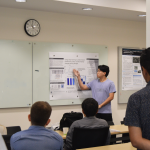
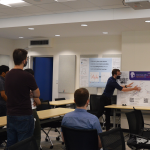
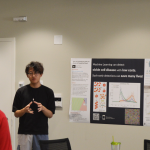
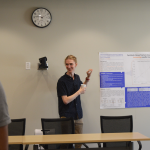
The 2022 CREATE-U program culminated with with a poster session on August 31st, where undergraduate participants presented their summer research. Combining Research Experience and Technical Electives for Undergraduates (CREATE-U) is a unique summer program that allows students to work on a paid research project from a participating Mechanical Engineering lab, while fulfilling six credits of course work on applicable skills. Through their courses this summer, students learned about the research process, funding, grant writing, and how a researcher interprets and uses the data they’ve generated. Integrating their classroom learning and research experiences, students summarized their project work in an academic research poster, and presented their findings to their peers, graduate student or postdoctoral mentors, and faculty supervisors.
This year, CREATE-U students gave the following presentations:
Ahijit Banerjee on “Flow characteristics to treat gastrointestinal bleeding”
from research in the Industrial and Biological Multiphysics Laboratory, under the supervision of Professor Dana Grecov and mentorship of Dr. Mehdi Jahandardoost
You Cheng on “Using machine learning to predict blood transfusion quality via deformability changes during storage”
from research in the Multi-scale Design Laboratory under the supervision of Associate Professor Hongshen Ma and mentorship of Erik Lamoureux
David Downey on “Non woven fabrics and cotton flannel mixed masks offer a sustainable improvement to woven cotton masks”
from research in the Aerosols and Energy Lab under the supervision of Professor Steven Rogak and mentorship of Hamed Nikookar
Arthur Feng on “Low-cost screening of sickle cell disease in Canada and Nepal”
from research in the Stoeber Lab, under the supervision of Professor Boris Stoeber and mentorship of Pranav Shrestha
Curtis Geffner on ” Measurements of Tissue Fracture Toughness in Dynamic Needle Insertions”
from research in the Stoeber Lab, under the supervision of Professor Boris Stoeber and mentorship of Pranav Shrestha
Simon Jang on “Understanding Air Quality in Rural India; Low Cost Sensor Calibration”
from research in the iREACH (Integrated Research in Energy, Air, Climate and Health) Lab under the supervision of Assistant Professor Naomi Zimmerman and mentorship of Sakshi Jain
Peter Lin on “Piezoelectric paper: a study on effect of fiber content on mechanical and electro-mechanical properties”
from research in the Stoeber Lab, under the supervision of Professor Boris Stoeber and mentorship of Dr. Kanagasubbulakshmi Sankaralingam
Student are encouraged to submit their posters to UBC’s Multidisciplinary Undergraduate Research Conference (MURC), which will take place in the spring of 2023.
CREATE-U prepares participants for research with insights many graduate students only gain when they enter a lab for the first time. Besides giving undergraduates a head start, the program benefits the graduate student or postdoctoral mentors who support the CREATE-U students in the lab by providing guidance as they gain their own experience towards supervising a trainee. Faculty members gain access to skilled undergraduates who are receiving research training outside of the lab.
Admission to CREATE-U is based on broad criteria and all interested undergraduates are encouraged to apply. Students can check the undergraduate Research Opportunities page to find out more about the 2023 program, where projects and the application portal will be available in December. Faculty members who wish to submit a project for 2023 should contact Jen Pelletier (jen@mech.ubc.ca).
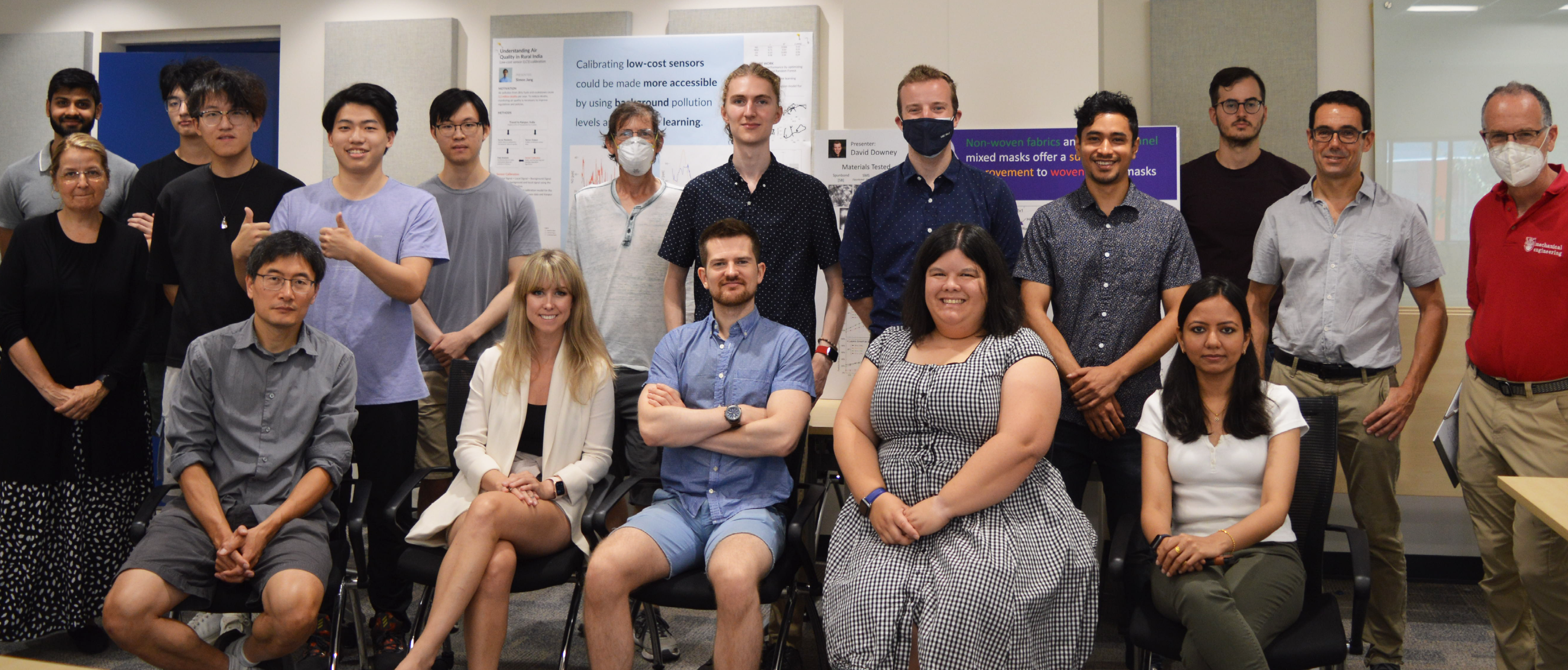
2022 CREATE-U cohort, supervisors and mentors

UBC engineering students’ aircraft model features BC wood in international competition
This article originally appeared in APSC News.
Sitka spruce key to UBC AeroDesign’s 2022 and 2023 aircraft models.
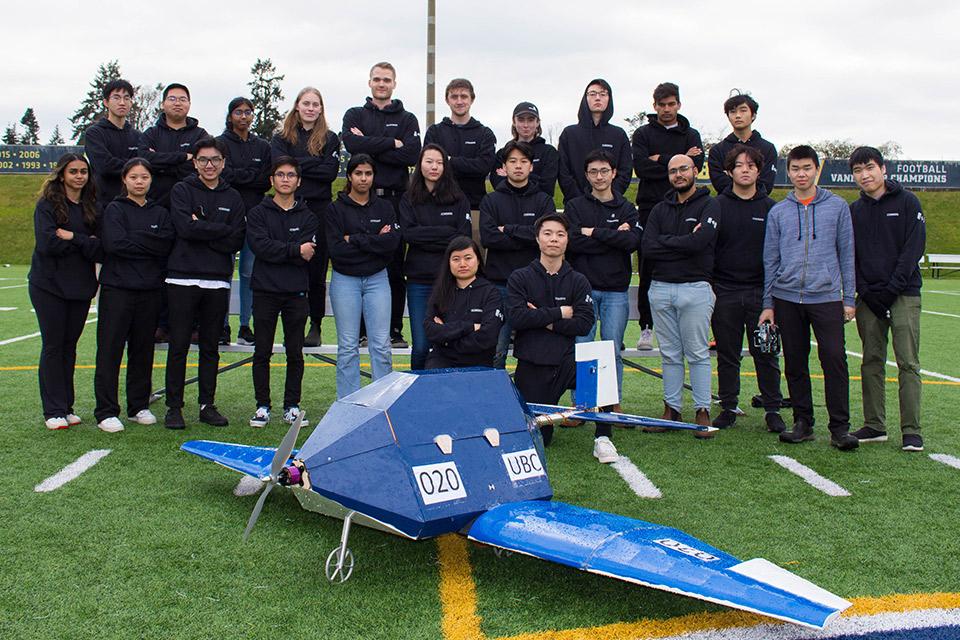
Following successful test flights in BC, UBC AeroDesign competed at SAE Aero Design East in May 2022, placing second in design report and oral presentation, with renewed determination to soar even higher next year. (Photo credit: UBC AeroDesign)
UBC AeroDesign students are showcasing hometown pride with their use of BC wood in their newest competitive aircraft models.Each year, international competitors gather at the SAE Aero Design Competition in the US, to pit their fixed-wing, electrical-powered, remote-controlled aircraft against each other in specific design challenges.
Built for the 2022 Regular Class design challenge, UBC AeroDesign’s model features balsa and BC-grown Sitka spruce in its fixed wing.
“The spar is the most important structural element of the wing as it carries the weight of the wings,” said Vincent Liu, UBC AeroDesign team captain and a fourth-year mechanical engineering student. “Sitka spruce is light, strong and flexible, which makes it an ideal material for this challenge.”
“With family roots in the BC forest industry, I am so proud to see this team incorporate local Sitka spruce products so close to home in our aircraft,” said Simon Jobst, UBC AeroDesign Regular Class Airfoils co-lead and a third-year mechanical engineering student.
I cannot wait to see our aircraft fly high down in Texas next year, knowing its roots are native to British Columbia, fabricated at UBC and designed by my colleagues!
Interdisciplinary connections key to sustainable engineering solutions
For insight into wood fabrication methods and tolerances for their 2022 model, the team turned to the Centre for Advanced Wood Processing (CAWP) at UBC Faculty of Forestry.
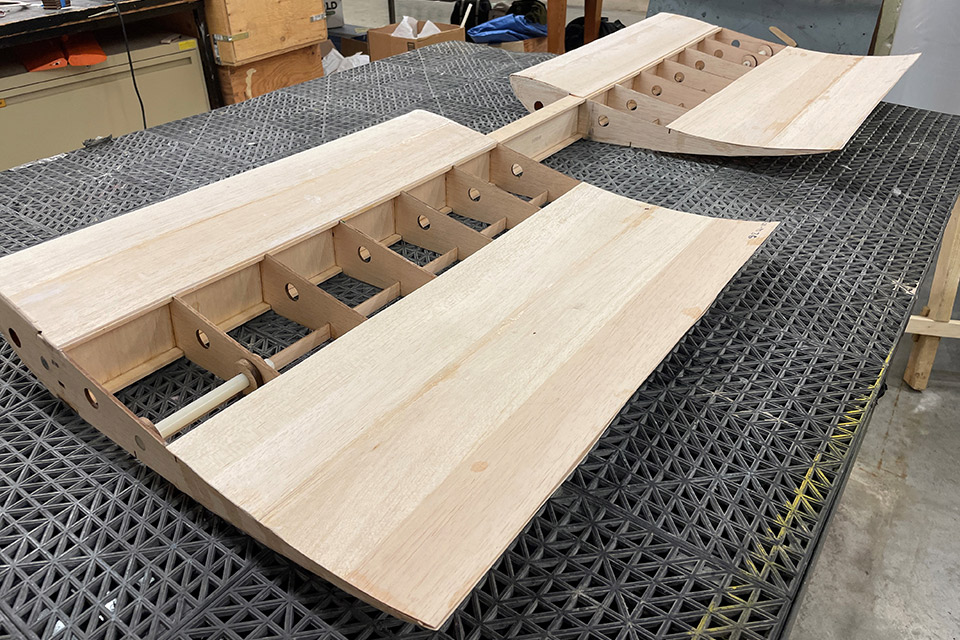
CAWP allowed the team to use lab space, sponsored technician hours towards fabricating the spar and offered tours of the facilities. (Photo credit: UBC AeroDesign)
“It was so helpful having CAWP be a part of this project in such a big way,” said Jobst. “Our team gained practical, hands-on learning toward a sustainable aerospace engineering solution that built upon and beyond what we learned in class.”
Regular Class Airfoils co-lead Thenushaa Balasingam, a biomedical engineering student in her second year, said: “I am incredibly grateful to have attended one of CAWP’s tours. It was eye-opening to see the equipment used first-hand to fabricate the spar for our Regular Class aircraft.
“Truth be told, I would not have realized the incredible significance of wood processing and how much room for improvement our team has in this field. We look forward to continuing our collaboration with CAWP, so that our aircraft can excel at the 2023 competition.”
UBC AeroDesign plans to continue designing with BC-grown Sitka spruce donated by CarlWood Lumber Limited for the 2023 Regular Class design mission, which is to design an aircraft that can lift as much weight in the form of payload plates as required. Wingspan can be maximized up to 18 feet.
Join an engineering design team
UBC AeroDesign is one of over 30 engineering student design teams on UBC’s Vancouver campus. Established in 1992, the team is operated by more than 50 undergraduate students from six engineering disciplines and 11 countries around the world. Learn more or support their projects by visiting the UBC AeroDesign website.
Engineering design teams actively recruit new members at the beginning of every academic year. Design teams’ focus range from aerospace and automotive to robotics and sustainability, and are open to all years of engineering students, including first-years. Many are also open to students from other faculties in science, business and arts.
Find an Engineering Design Team
Bacteria-based batteries? UBC engineering design teams offer students chance to innovate
This article originally appeared in APSC News.
Students in UBC Rocket collaborated to create a new type of fuel cell. UBC Rocket is one of over 30 engineering design teams that students can join.
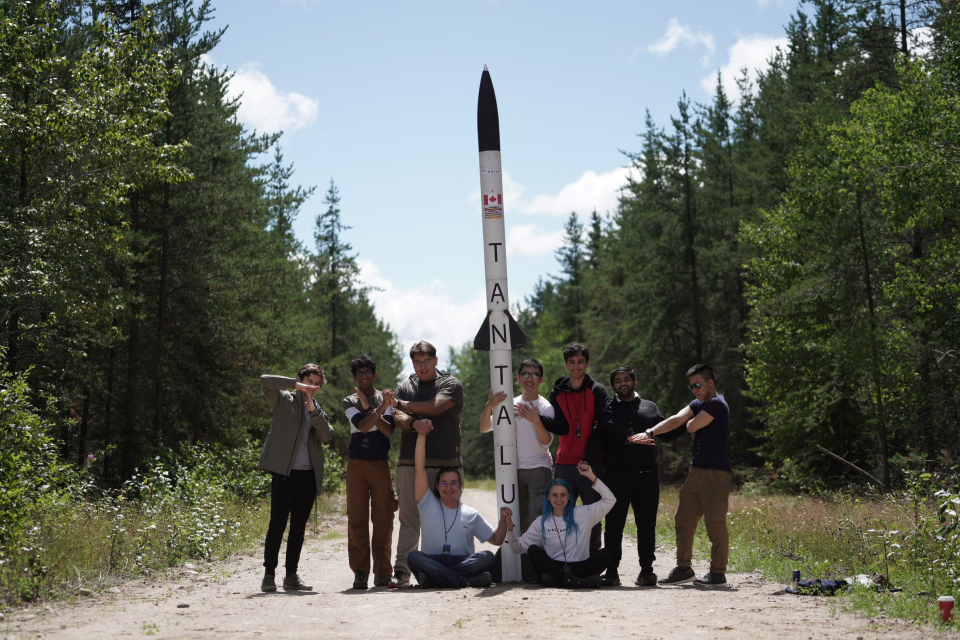
Engineering design teams are an opportunity for students to apply what they learn in design courses into practice.
The next generation of rockets could be fueled by bacteria.
“A microbial fuel cell is basically a battery that uses bacteria to generate electricity,” explained Paul Juralowicz, payloads project lead for UBC Rocket, one of UBC’s many engineering design teams.
Bacteria living inside the battery generate electricity as it feeds on sewage. It also happens to clean waste products.
The UBC Rocket payloads team wanted to see if this technology could become a source of sustainable energy, fresh water and rocket fuel in space.
They launched six different microbial fuel cells since 2019, attending three different nation-wide competitions. Four of these batteries were successfully tested on a parabolic flight simulating zero gravity conditions last summer.
Most recently, they launched a microbial fuel cell in two of UBC Rocket’s student designed and manufactured rockets, ending two and a half years’ hard work on a promising high note.
A long journey
In August 2019, the UBC Rocket payloads team applied to compete at the next Canada Reduced Gravity Experiment Design Challenge.
“We planned to create and test the microbial fuel cell by July 2020,” said Kassandra Hawes-Gardner, payloads team member.
“Instead, the COVID-19 pandemic hit and all the barriers it created meant several extra months of navigating through the turmoil.”
The team were finally able to make their microbial fuel cell and compete in Ottawa at the Canada Reduced Gravity Experiment Design Challenge in the summer of 2021.
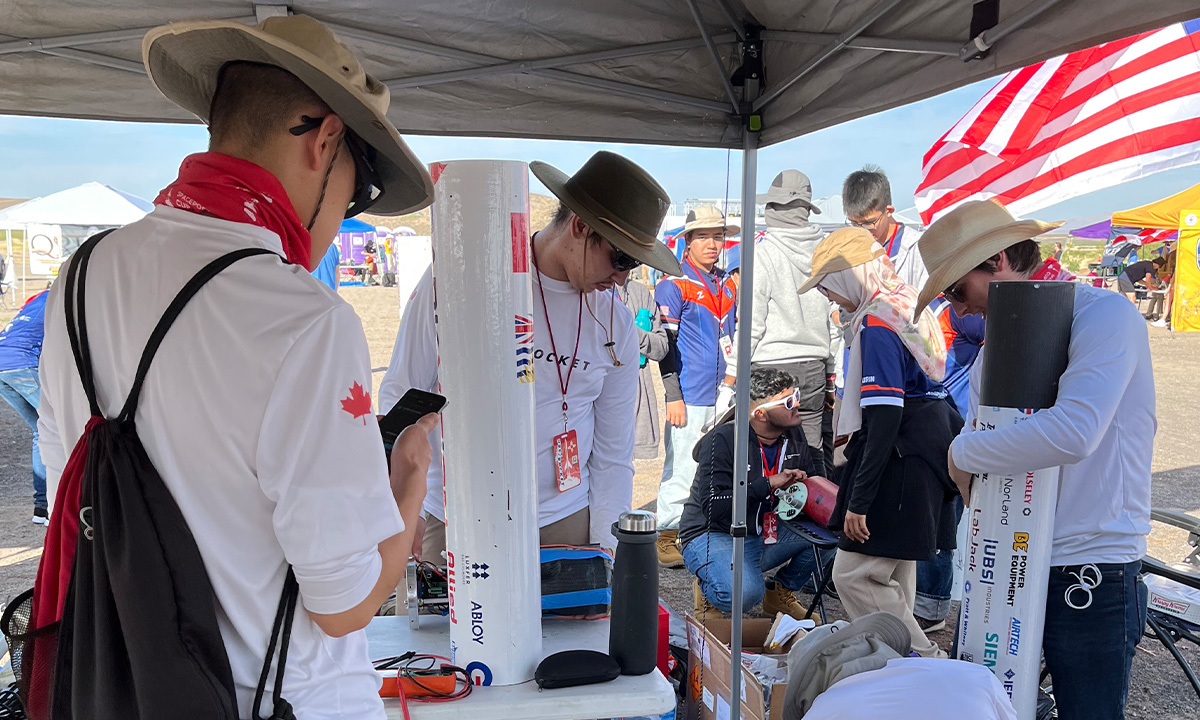
This summer, they launched a small form version that traveled from Vancouver to New Mexico, then back to Vancouver and to a launch site in Ontario.
The team’s success at these various competitions is promising for further research. While tests are only in their very early stages, their theory is that space travel powered by microbial fuel cells could one day be widely deployed.
Fueling innovation
Any engineer will tell you the importance of turning theory to practice, and one way to do this during your undergraduate degree is by joining a design team. Design teams are an opportunity for students to put what they learned in design courses into practical applications. It is also a chance for students to grow a network and connect with like-minded peers.
This invaluable hands-on experience of creating and testing new research is exactly what drew Juralowicz to joining UBC Rocket.
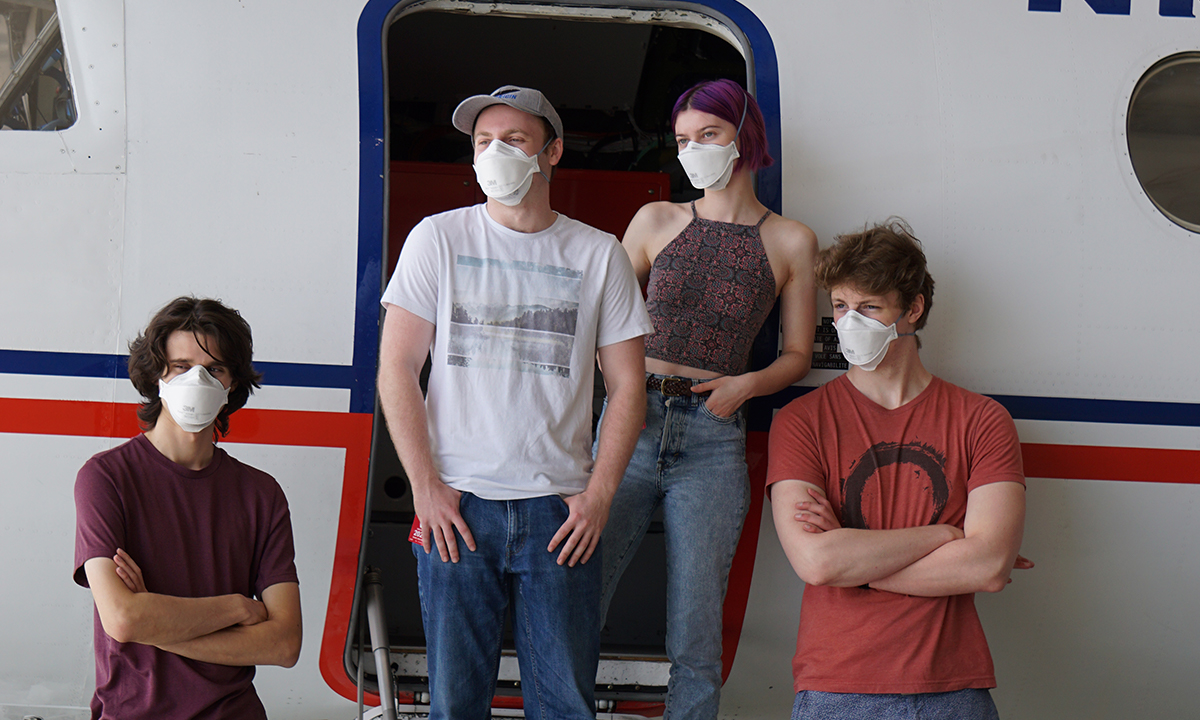
Paul Juralowicz, Kassandra Hawes-Gardner, Justin Lawrence and Peter Vozynuk worked together on the UBC Rocket’s payloads team for over two and a half years.
As one of many engineering design teams at UBC, joining the payloads team along with Hawes-Gardner, Justin Lawrence and Peter Voznyuk allowed Juralowicz to gain great experience, countless memories and firm friendships.
“Everyone should join a design team. I almost think it should be required in the curriculum,” said Juralowicz. “You learn so much that you don’t learn in your design courses. It really reaffirms what you learn beyond a classroom.”
Join an engineering design team
There are over 30 different UBC engineering design teams that actively recruit new members at the beginning of every academic year. Many will have booths on Imagine UBC.
Design teams’ focus range from aerospace and automotive to robotics and sustainability.
Design teams are open to all years of engineering students, including first-years, and many are also open to students from other faculties in science, business and arts.
Learn more about UBC’s Engineering Design Teams