Supporting those affected by conflicts

Supporting those affected by conflicts

UBC Mechanical Engineering believes violence is not an answer for conflict, and we lend our support and compassion to those who are affected by current world conflicts. As world conflicts deepen and innocent civilians are caught in the tragic repercussions in Israel, Gaza and elsewhere, the implications are distressing for those with families and friends affected. The Department joins the University and the individuals, organizations and nations here in Canada and around the world in calling for dialogue towards peaceful resolution.

Students seeking support should reach out to UBC Mechanical Engineering Student Services (for referrals or academic concession support), the Applied Science Counsellor in Residence, or community supports (costs for which can often be supported by your student extended health plan).

Information about supports for students in Vancouver is available here:

Information about supports for faculty and staff is available here:

MECH Stands with our 2SLGBTQIA+ Communities

UBC Mechanical Engineering stands with its community – its whole community, including people from across gender and sexuality spectrums – in condemning the anti-transgender and anti-queer actions taking place on campus and across the country.  As a community and a society, we are at our best when we bring diverse perspectives and experiences together, and at our worst when we allow rhetoric to invalidate the lived experiences of any given demographic of people.

As a Department, we value diversity.  We value community.  And we value each person that brings diversity to our community.  There is no room for hate or intolerance.

As a place of education, we firmly stand by our transgender, nonbinary, and all 2SLGBTQIA+ students’ right to a safe, inclusive and equitable learning environment. Instructors will offer appropriate concessions where possible to those who miss class or assignment deadlines due to these events.

With actions scheduled on campus for September 20th, members of our community who feel unsafe are encouraged to walk between classes with others, or stay home and take advantage of appropriate concessions.  There are safe spaces open for 2SLGBTQIA+ students such as the Women’s Centre and Resource Lounge in the AMS Nest.  Students can visit Mech Student Services (CEME 2205) and Faculty and Staff can visit Mech Administrative Services (CEME 2053), which are available from 8:00 am – 4:00 pm on weekdays.

Other Resources

  • If anyone needs to reach out for emotional support, consider calling:
    • Trans Lifeline: (877) 330-6366,
    • Crisis Centre BC: 1 (866) 661-3311, or
    • Crisis Services Canada: 1 (833) 456-4566
  • Students can also use AMS Safewalk from 8pm-2am if they want support walking across campus: (604) 822-5355.
  • In case of an emergency, dial 911. For non-emergency threats, call Campus Security: (604) 822-2222.


Media Mention: Washington Post speaks to Dr. Lyndia Wu on brain impact of heading the ball in soccer

WASHINGTON POST: “A number of studies suggest that the powerful forces involved in heading a ball may lead to thinking and memory problems, and possibly dementia”

“Astronauts during rocket launch may experience a few g’s of acceleration,” said Lyndia Wu, an assistant professor of mechanical engineering at the University of British Columbia who led the study. “A car traveling at 35 mph running into a wall could experience about 30g of acceleration.” In Wu’s study, heading often resulted in impacts of 22g or more, with some of the impacts surpassing 30g.

Capstone Project Profile: Micromanipulator for Mandibular Reconstruction Surgery

This article is from the Applied Science Student Project Spotlights

Anthony Zhou, Audrey Alianto, Cecile Ying, Daniel Andjelic, Yizhen Song

  • Community Partner: ISTAR Group at Vancouver General Hospital
  • Degree: Bachelor of Applied Science
  • Program: Mechanical Engineering
  • Campus: Vancouver

Our project

Mandibular reconstruction surgery involves removing cancerous portions of the jawbone, which leaves the patient with a gap in their jaw. To allow patients to regain jaw functionality for eating, speaking and aesthetic purposes, the missing sections are replaced with bone segments from the patient’s fibula or scapula bone.

A micromanipulator device is a surgical tool that assists surgeons with aligning and securing the bone segments. We believe that the better the segments fit into place, the better the post-surgery tissue healing and patient recovery will be. The project is important because it benefits patients’ health and could reduce costs for the hospital.

Our inspiration

Anthony: My co-op experiences in the biomedical industry have instilled a passion in me to work on innovative medical devices and tools that could positively affect patients’ lives. Knowing my work could make a difference, no matter how small, has inspired me to work on projects such as this one.

Audrey: I have a strong interest in the biomedical field, so applying our technical knowledge to improve people’s quality of life is what inspired me to pursue this project.

Cecile: I have always been interested in biomedical engineering, and this project provided me with the opportunity to learn more about the design process for medical devices.

Daniel: The prospect of a school project that could produce something which benefitted patients’ lives was important to me. As I am interested in environmental and medical applications of mechanical engineering, this project ticked all the boxes for me.

Yizhen: I chose to pursue this project because it had relevance to my degree as a biomedical engineer. The fact that a family member is in the medical field was also a great motivation for me.

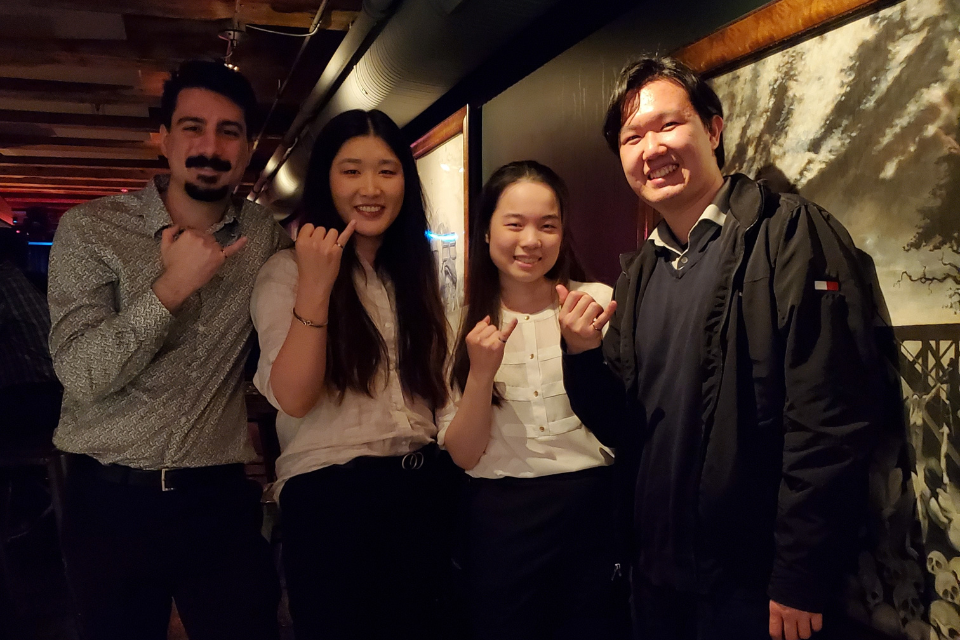
Team with their iron rings.

Our biggest challenge

Defining the scope of the project with the clients and generating a medically acceptable solution for real-world surgical use was the biggest challenge the team faced. Creating a medical device or tool was substantially more difficult than we had anticipated due to the strict requirements and changing needs of the surgeons and engineers.

What excited us most

The opportunity to observe a mandibular reconstruction surgery live in the operating room was the most exciting part of the project.

The most interesting/surprising thing we learned

The fibula bone, which can act as replacement segments for the removed jawbone sections, is NOT a weight-bearing bone. It means the bone is not entirely needed for basic movements. Only the top and bottom few centimetres are required for ankle stability, and therefore most of the bone is actually not needed. This was something interesting and surprising the team learned from our discussions with the surgeons we worked with.

Our project’s future

The group at Vancouver General Hospital is looking to patent the device mechanisms and ideas soon, after some iteration. We are excited that the medical device has impressed the biomedical engineers and surgeons we were working with, and we look forward to seeing the project succeed in real-world operating room use!
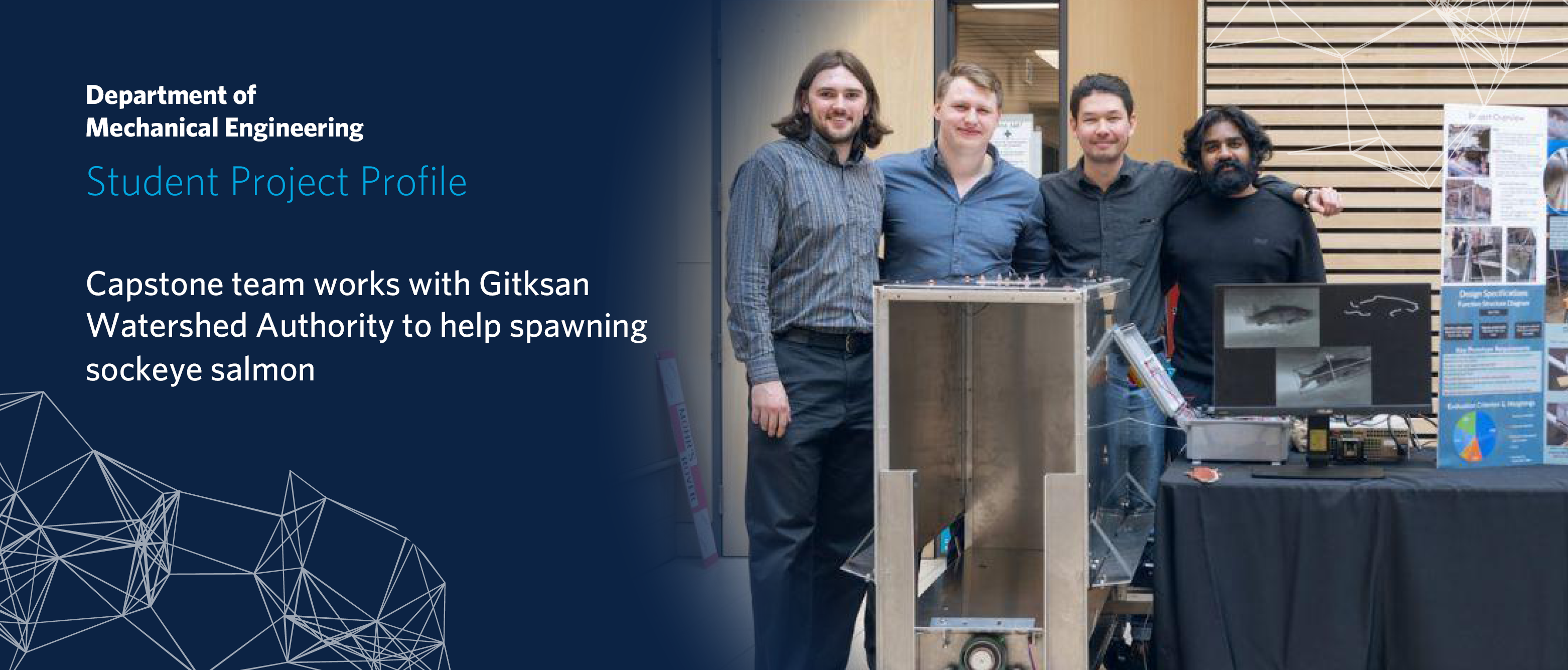
Capstone Project Profile: Designing and building fish identification and sorter for the Big Bar fish wheel

This article is from the Applied Science Student Project Spotlights

Ansel Hait, John Matheson, Ansen Ramsawmy and Kim Ristimaki

The challenge

The goal was to reduce the person-hours required to operate the fish wheel and make the process more efficient.

In 2019, a landslide near Big Bar in the Fraser River created severe rapids that prevented salmon from reaching their spawning grounds farther upstream. Since then, a lot of conservation work has been done to reduce the severity of the rapids, and chinook salmon are now generally able to make it to their upstream spawning areas. However, sockeye salmon, a smaller species, are still struggling. To help them, fish wheels have been installed that catch the fish and then measure, tag and transport them around the rapids.

We were asked to design a system that would automatically sort different salmon species, directing sockeye salmon to live tanks (from which they can be transported upstream) and redirecting chinook salmon to the river. The goal was to reduce the person-hours required to operate the fish wheel and make the process more efficient.

Our design process and challenges

We enjoyed taking something from an idea to reality and operating the lathe and milling machines to build our product.

At the start of the project, we met with stakeholders that included some of the operators of the fish wheel, members of the Gitksan Watershed Authority and representatives from the Department of Fisheries and Oceans. One of the main criteria that emerged from this discussion was the need to create a solution that could be assembled using conventional hand tools and installed directly on the existing fish wheel.

Fish Sorter Design

One of our first design decisions was determining how we were going to sort the chinook salmon – which are larger fish – from the sockeye salmon. We debated using a weight-based solution, but in the end decided that a machine learning system would be more reliable. The computer vision algorithm we developed detects the length of the fish and based on that makes a prediction of whether it is salmon or chinook.

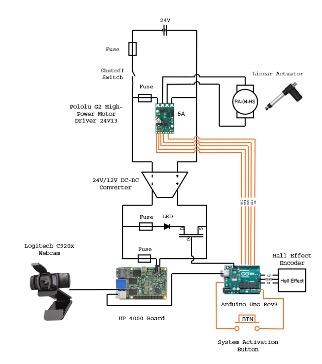
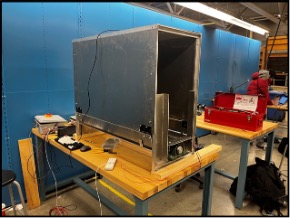
Our final product consists of three main assemblies. It includes an inlet chute that is mounted to the arm that holds the fish wheel and is made of sheet metal to direct fish to the fish sorter. The fish sorter contains a tray mounted on a shift with the linear actuator and a lid with a mounting position for the camera. The final assembly, the electronics enclosure, incorporates the electronics components and is mounted on the side of the live tank.

MECH Tray Sorter

It was challenging to do the machining work and build the physical structure. But it was really fun too.  The machinists at UBC were great and taught us so much: they have a ton of experience and gave us just the right amount of guidance while letting us figure things out for ourselves.

What excited us most

One of the most rewarding things about our capstone was just seeing it evolve from an initial idea to a tangible and usable product by the end of term.

Over the course of this capstone project, we learned how important salmon are – both for First Nations people and for their role in bringing nutrients upstream. In watersheds, nutrients typically flow downstream, but when salmon migrate upstream to spawn and die, their decomposing bodies release valuable nutrients into the ecosystem.

It was also exciting to dive into machine learning. We didn’t have any experience in machine learning before working on this project, or much experience with software. This project was an excellent way to learn a lot in a short amount of time.

Our project’s future

If the live testing goes well, we hope that the structure will be installed at the fish wheel near Big Bar. It can then start sorting out the sockeye salmon so they can be transported upstream and have a better chance of spawning.